

By: Audrey Raymonda John
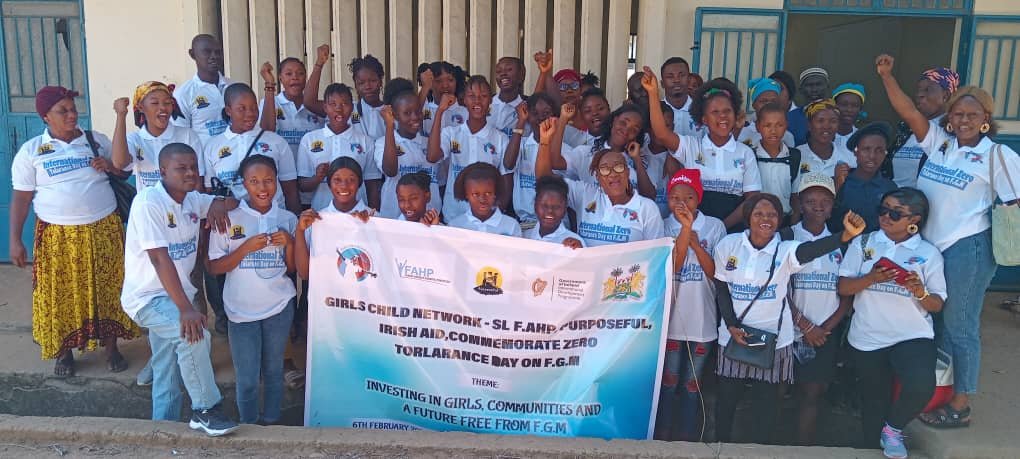
The Girl Child Network Sierra Leone (GCN-SL), in collaboration with the Forum Against Harmful Practices (FAHP), Purposeful, and Irish Aid, on 6 February 2026 commemorated the International Day of Zero Tolerance for Female Genital Mutilation (FGM) in Makeni City, renewing calls for urgent government action to end the practice nationwide.
The commemoration began with a debate competition at the SOS School compound, providing a platform for young people to openly discuss the dangers of FGM and articulate their vision for a future free from harmful practices.
This year’s theme, “Investing in girls, communities, and a future free from FGM,” highlighted the need for sustained engagement from schools, government institutions, civil society organizations, and local communities. Organizers stressed that every action whether policy reform, mentorship, or the creation of safe spaces for dialogue brings Sierra Leone closer to eliminating FGM.
Speaking at the event, Madam Anita Koroma, Executive Director of GCN-SL, commended FAHP and partner organizations for their tireless mobilization and advocacy efforts.
She described FGM as a grave violation of fundamental human rights* and called for stronger government intervention.
“Ending FGM requires coordinated action at every level,” Koroma said. “It is not just a women’s issue. It is a societal problem that demands the involvement of policymakers, traditional leaders, educators, and men as allies.”
She warned that silence allows the cycle of harm to persist. “We cannot stand by while girls suffer lifelong physical and psychological trauma. Ending FGM is not negotiable. It is essential for achieving gender equality.”
Koroma further highlighted GCN-SL’s ongoing initiatives, including stakeholder engagement, community sensitisation, school clubs, survivor support, and advocacy for legislative reform.
Advocates at the event also pointed to growing regional momentum to end FGM. The ECOWAS Court of Justice has ruled that governments are obligated to protect women and girls from harmful traditional practices, including FGM, affirming that such acts violate human rights under regional and international law.
The ruling places a clear responsibility on ECOWAS member states, including Sierra Leone, to enact and enforce protective legislation.
Speakers emphasized that while community awareness initiatives are crucial, progress remains fragile without a clear national law banning FGM.
Speaking on behalf of GCN-SL, Hellen Neneh Turay said the absence of a legal framework continues to undermine years of advocacy.
“While FGM may be declining in some areas, the lack of clear laws allows the practice to continue in secrecy,” she said. “We must challenge its normalization and push for real policy change.”
Turay explained that GCN-SL and its partners have worked with religious leaders, schools, and former practitioners to promote safer, non-harmful alternatives to traditional rites of passage.
“Many former practitioners have publicly renounced cutting. This proves that culture can evolve without harming girls,” she noted.
However, she stressed that voluntary change alone is insufficient. “Without the law, girls remain unprotected.”
Using the occasion, advocates made a direct appeal to President Julius Maada Bio to enact an explicit national ban on FGM. They argued that despite Sierra Leone’s obligations under ECOWAS rulings and international human rights treaties, girls continue to suffer injury, trauma, school dropout, and long-term health complications.
They further noted that preventable FGM-related complications place unnecessary strain on the health system, while communities lack clear legal deterrence.
“Now is the time for leadership,” Turay said. “A national ban would send a strong message that Sierra Leone stands with its daughters, not against them.”
Representatives from the Ministry of Gender, the Paramount Chief of Bombali Shebora Chiefdom, the Human Rights Commission, traders’ associations, and other stakeholders echoed the call for zero tolerance.
As debates, testimonies, and commitments shaped the day’s activities, one message resonated clearly. Ending FGM is not only a cultural issue, it is a matter of justice, protection, and political will.
For many in Makeni, Zero Tolerance Day was more than symbolic. It was a demand for action. And that action, advocates insist, must begin with the law.