

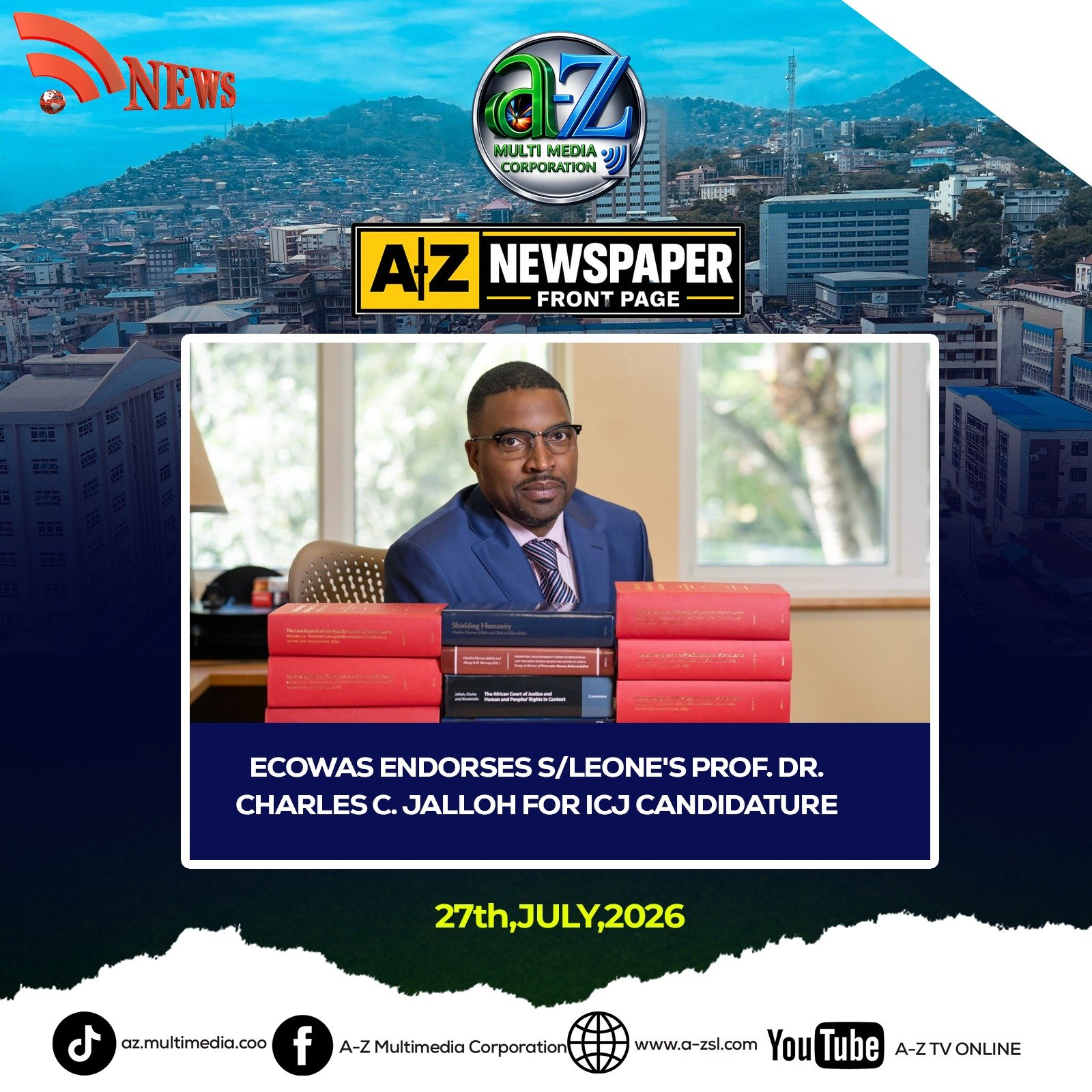
By: Mohamed Sahr
The Economic Community of West African States (ECOWAS) has officially endorsed Sierra Leone’s candidature for a seat on the International Court of Justice (ICJ), backing the nomination of distinguished international law scholar Prof. Dr. Charles C. Jalloh for the 2027-2036 term.
The endorsement was announced during the 69th Ordinary Session of the ECOWAS Authority of Heads of State and Government, held on 19 July 2026 in Lungi, Sierra Leone, alongside the Summit on the Future of Regional Integration in West Africa. The session was chaired by President Julius Maada Bio, who serves as Chair of the ECOWAS Authority of Heads of State and Government, now outgoing.
In Paragraph 73 of the Summit’s Final Communiqué, the Authority stated: “The Authority welcomes the spirit of solidarity demonstrated by Member States in support of regional candidatures and endorses the candidature of the Republic of Sierra Leone for the position of Judge of the International Court of Justice for the period 2027-2036.”
The endorsement marks a significant milestone in Sierra Leone’s campaign to secure one of the world’s most prestigious judicial positions.
Earlier, on 30 October 2024, Sierra Leone’s Permanent Mission to the United Nations announced the Government’s endorsement of Prof. Jalloh’s nomination by the Sierra Leone National Group.
A globally respected scholar, legal practitioner, and academic, Prof. Jalloh has built an outstanding career in international law. He has served on the United Nations International Law Commission (ILC), where he held several leadership positions, including serving as Special Rapporteur on the topic “Subsidiary Means for the Determination of Rules of International Law” under Article 38 of the ICJ Statute.
Accepting his nomination, Prof. Jalloh described it as a great honour.
“It is a great honour to be nominated to serve on the bench of the International Court of Justice for the 2027-2036 term. As I seek the support of all UN Member States in the elections to be held at the United Nations in New York, I wish to share my sense of the vital role of the ICJ in contemporary international affairs,” he said.
Prof. Jalloh said his vision for the Court is to strengthen its role as a cornerstone of global justice, stability, and the peaceful settlement of disputes among States. If elected, he said he would work to ensure that international law is applied fairly, consistently, and impartially in resolving inter-state disputes. He also pledged to provide judicial guidance on emerging global challenges, including climate change, sea-level rise, cyber warfare, and human rights.
He further emphasised the need to amplify the perspectives of Africa and other underrepresented regions in the development of international law while promoting stronger collaboration between the ICJ, the International Law Commission, and other United Nations bodies.
Outlining his judicial philosophy, Prof. Jalloh said he would approach the role guided by what he described as the three “I’s”- Integrity, Independence, and Impartiality.
“I will seek to serve with Integrity, Independence, and Impartiality always in mind. I will strive to understand and respect the views of all parties appearing before the Court, even where I may initially disagree with their interpretation of the law. Most importantly, I will always keep an open mind and be willing to be persuaded. I will do my utmost to preserve the independence and authority of the Court as an apolitical beacon of hope for States and humanity through the good-faith interpretation and application of international law,” he stated.
Prof. Jalloh also underscored Africa’s significant engagement with the ICJ, noting that approximately 72 per cent of the Court’s cases have involved African States, with 39 of the continent’s 54 countries having appeared before the Court. He argued that Africa’s extensive participation highlights the importance of ensuring the Court remains responsive to the continent’s concerns.
According to him, while every ICJ judge must act honestly, conscientiously, and independently, judges from Africa, like those from other regions, bring valuable lived experiences and regional perspectives that help strengthen the representativeness and universality of international law.
Prof. Jalloh’s endorsement by ECOWAS is expected to strengthen Sierra Leone’s campaign ahead of the elections for the ICJ seat, which will be held at the United Nations Headquarters in New York. If elected, he would become one of the judges responsible for interpreting and applying international law in disputes between States, serving a nine-year term from 2027 to 2036.