

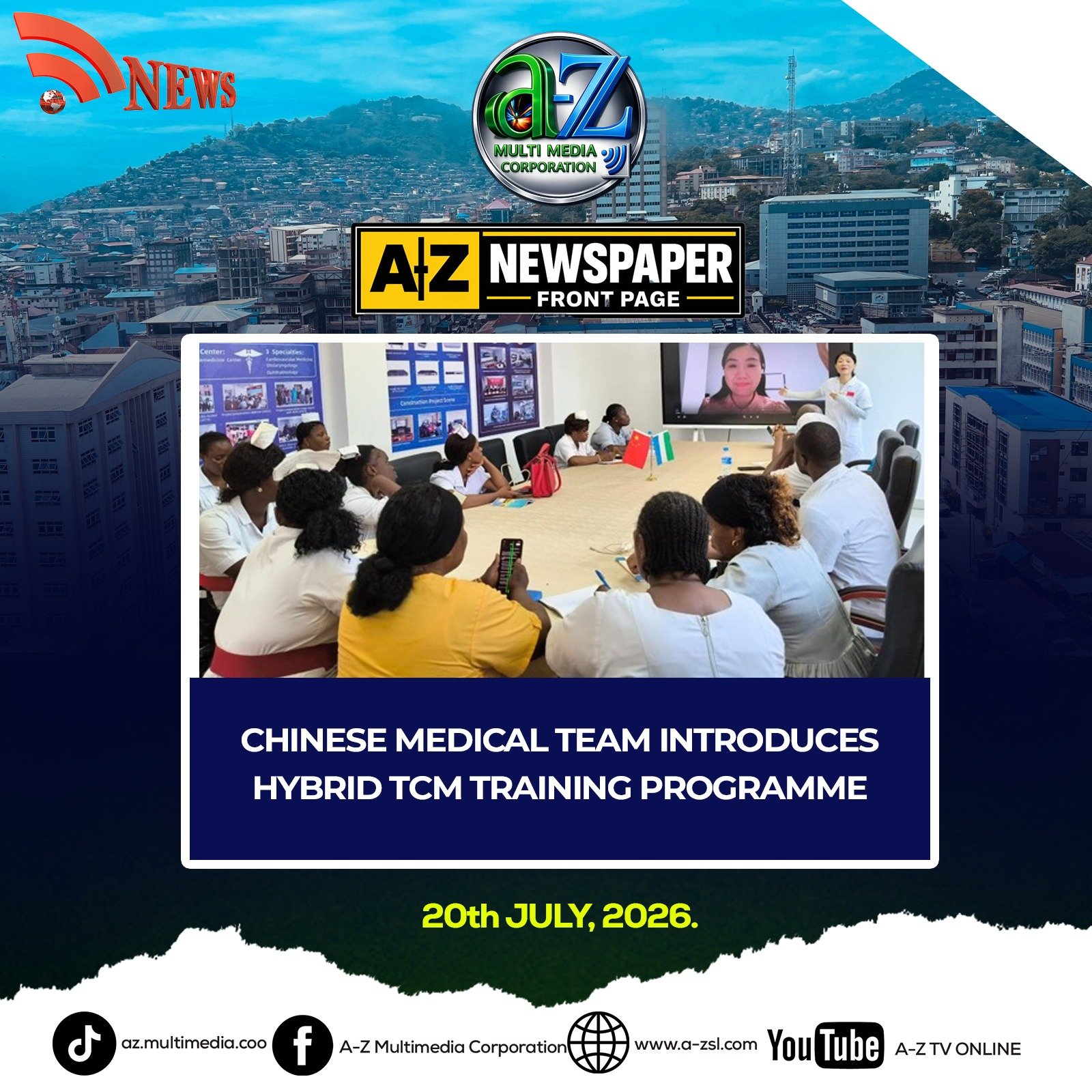
The Telemedicine Center of the Sierra Leone-China Friendship Hospital in Freetown was filled with more than 40 local nursing professionals on Saturday as the 27th Chinese Medical Team launched a specialized Traditional Chinese Medicine (TCM) training programme aimed at strengthening local healthcare capacity on Friday 17th July 2026.
The training, titled “The Past and Present of Acupuncture,” marked the beginning of an integrated TCM nursing education programme developed by the 27th Chinese Medical Team to Sierra Leone. The initiative combines virtual lectures from Chinese medical experts with practical, on-site clinical demonstrations by medical team doctors.
Implemented under the framework of the China-Sierra Leone Nursing Training Center, the programme seeks to introduce standardized TCM techniques to support the management of common musculoskeletal conditions, particularly chronic neck, shoulder, and joint pain, while building sustainable skills among local healthcare workers.
The hybrid training model brought together experts from China and Sierra Leone through a four-dimensional teaching approach covering theory, simulation, question-and-answer sessions, and clinical demonstrations.
Professor Guo Liwen from Hunan Cancer Hospital delivered a live virtual presentation from China, while Dr. Zhou Shengqiang, Deputy Chief Physician at the Hunan Integrated Traditional Chinese and Western Medicine Hospital, led the on-site theoretical sessions. The practical demonstrations were coordinated by Tan Yan, Director of the China-Sierra Leone Nursing Training Center, and Dr. Li Duandan, Deputy Chief Physician at the Changsha Hospital of Traditional Chinese Medicine.
During the lecture session, Dr. Zhou provided an overview of the history and development of acupuncture, tracing its origins from ancient stone needle techniques and moxibustion practices to the theoretical foundations documented in the Huangdi Neijing (Yellow Emperor’s Classic of Internal Medicine).
He explained key concepts of Traditional Chinese Medicine, including the meridian system, Yin-Yang theory, the Five Elements, the circulation of qi and blood, and the traditional four diagnostic methods.
Addressing healthcare challenges in Sierra Leone, where chronic musculoskeletal pain is common, but specialized acupuncture services remain limited, Dr. Zhou introduced Fu Needle Therapy, a modern acupuncture technique designed to complement traditional approaches.
He demonstrated how healthcare workers could identify painful myofascial trigger points through physical examination and explained treatment procedures, including needle positioning, movement techniques, and supportive rehabilitation practices. The training was delivered in simplified English to improve understanding among local participants.
The programme later moved into practical clinical demonstrations involving real patient cases. An 18-year-old university student suffering from recurring knee pain and limited mobility for six months participated in a live demonstration. Dr. Zhou applied Fu Needle Therapy, after which the patient reported significant pain relief and improved ability to perform movements such as squatting, standing, and knee flexion.
Local nursing professionals closely observed the procedure and documented the techniques, including the correct needle insertion angle and clinical application methods.
Additional practical sessions focused on other Traditional Chinese Medicine therapies, including Gua Sha (scraping therapy) and moving cupping. Tan Yan demonstrated standard upper-limb scraping techniques, highlighting proper tool selection, the recommended 45-degree application angle, pressure control, assessment of skin responses, and safety precautions.
Dr. Li Duandan demonstrated cupping techniques, explaining the management of negative pressure and movement along the bladder meridian. The practical sessions covered five major external TCM therapies: acupuncture, moxibustion, scraping, cupping, and massage, with emphasis on safe clinical application.
During the question-and-answer session, participants raised practical concerns related to their daily nursing responsibilities, including the use of moxibustion for acute pain and patient screening before treatment.
Dr. Zhou responded by adapting TCM principles to Sierra Leone’s healthcare environment, taking into consideration local climate conditions and common clinical situations faced by healthcare workers.
“This course provides structured and practical knowledge that aligns with our daily clinical demands, addressing a clear gap in pain management services here,” said Zainab Bangura, a State Registered Nurse at the Sierra Leone-China Friendship Hospital.
Since arriving in Sierra Leone, the 27th Chinese Medical Team has continued to use the China-Sierra Leone Traditional Chinese Medicine Center and the Nursing Training Center as platforms for sustainable healthcare capacity building.
The team plans to continue conducting bilingual TCM workshops through the Telemedicine Center, with training programmes tailored to common musculoskeletal conditions in Sierra Leone and aimed at expanding access to standardized clinical nursing practices across West Africa