

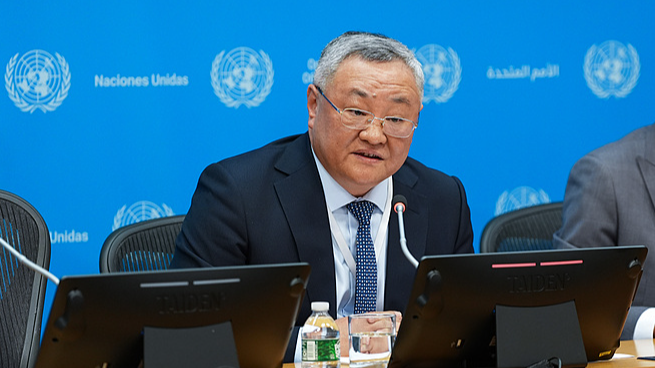
A Chinese envoy on Tuesday called for greater efforts to end hostilities and create a secure environment for food production.
Fu Cong, China’s permanent representative to the United Nations, made the remarks at a Security Council open debate on the council’s role in mitigating global and local food crises.
“Raging conflicts displace people, destroy farmland and disrupt food production, and are an important driver of humanitarian crises and hunger,” said Fu.
“The Security Council bears the primary responsibility for maintaining international peace and security. It should make promoting political solutions to conflicts a priority, actively engage in mediation and good offices, encourage the parties to resolve their differences through dialogue, and work for an early and lasting ceasefire to create the basic conditions for restoring agricultural production,” he said.
International humanitarian law is a fundamental baseline that must be respected, Fu said, stressing that hunger must never be used as a weapon of war.
Parties to conflict should always put the protection of life first, protect agricultural infrastructure, avoid disrupting agricultural activities, and ensure the unimpeded delivery of humanitarian assistance, including food aid, he said.
In the context of economic globalization, food production and supply are closely linked to the international situation, particularly the global logistics and transportation system. In the face of intensifying geopolitical rivalry and regional conflicts, the international community should ensure the safe and unobstructed operation of land and sea trade routes and the normal flow of essential goods such as food and fertilizer, Fu noted, adding that China welcomes the UN initiative to establish a time-bound mechanism for the Strait of Hormuz and supports a greater role for the United Nations.
At the same time, all parties should further uphold open and transparent market policies, deepen international cooperation on food supply, and promote the rational allocation of food resources globally, he said.
Food security governance is a global issue that requires coordinated action and a collective response from all countries. It cannot be dictated by a handful of countries or interest groups, Fu emphasized.
All parties should firmly support the UN in playing a central role, while the representation and voice of emerging market economies and developing countries in international organizations dealing with food-related issues should be effectively enhanced, he said.
“We should uphold the principles of extensive consultation, joint contribution and shared benefits, promote a more equitable, reasonable, inclusive and effective global food security governance system, and safeguard the common interests of all countries,” Fu added.
As the world’s largest grain producer, China feeds more than 1.4 billion people with less than 9% of the world’s arable land. Through its own efforts, China has achieved basic self-sufficiency in grain supply and absolute security of staple food, Fu said.
“This is not only a great achievement in China’s development, but also a major contribution to safeguarding global food security,” he said, highlighting China’s commitment to strengthening international cooperation, helping improve global food security and contributing to global poverty reduction.
China stands ready to continue upholding the vision of building a community with a shared future for humanity, work with all parties, and make greater contributions to the complete eradication of global hunger and to world peace, security, development and prosperity, Fu stated.
SOURCE: CGTN News