

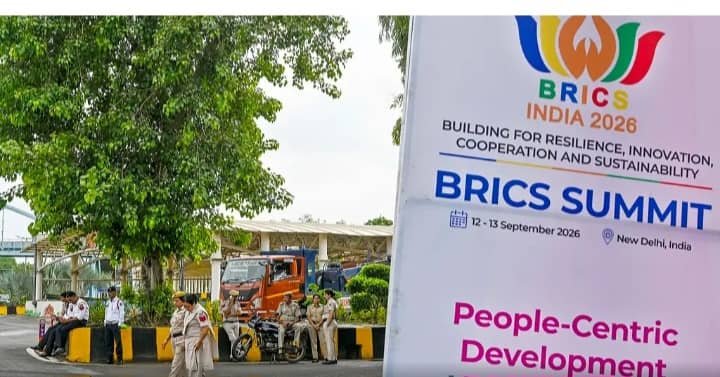
As the 18th BRICS Summit prepares to take place in New Delhi, India, this upcoming weekend, the grouping is entering a new phase of development. The summit’s theme, “Building for Resilience, Innovation, Cooperation and Sustainability,” reflects the organisation’s priorities as it continues to expand and strengthen cooperation among emerging economies.
From its original five members, BRICS has expanded to 11 countries, evolving from a relatively small group of emerging economies into a major platform representing about half of the world’s population.
The bloc now accounts for approximately 40 percent of global GDP, while intra-BRICS trade reached $1.17 trillion in 2024. These developments have increased BRICS’ influence in the global economy and international governance.
China has played a central role in this evolution, particularly in promoting greater inclusiveness and cooperation within the bloc.
At the 2017 BRICS Summit in Xiamen, China introduced the “BRICS Plus” model, which sought to expand BRICS cooperation to a wider range of emerging economies and strengthen the voice of the Global South.
During China’s chairmanship, leaders from Egypt, Guinea, Mexico, Tajikistan and Thailand were invited to the summit. The initiative helped establish a broader and more diversified network of partnerships and demonstrated China’s push for greater engagement beyond the bloc’s original members.
The proposal later contributed to the expansion of BRICS. Six countries — Egypt, Ethiopia, Indonesia, Iran, Saudi Arabia and the United Arab Emirates — subsequently joined as full members, creating what has been described as “Greater BRICS” and ushering the organisation into a new phase of development.
China has continued to support the expansion of BRICS. In 2024, the grouping formally established a partner-country mechanism, providing countries with an opportunity to participate more closely in BRICS activities without immediately becoming full members.
China has argued that an open and inclusive BRICS can strengthen cooperation among countries of the Global South, increase their collective influence and help them address shared development challenges.
According to a study by Xi Manzhao, a teaching assistant at the School of Northeast Asian Studies at Shandong University, and Yang Yanlong, a research fellow at the Institute of International Studies at the same university, the expansion of BRICS can strengthen solidarity among developing countries while helping them jointly respond to global economic risks and pursue more stable development.
TURNING COOPERATION INTO ACTION
BRICS’ growing influence is also reflected in practical initiatives aimed at addressing common challenges.
China has played a leading role in establishing several collaborative platforms within the BRICS framework.
The China-BRICS Artificial Intelligence Development and Cooperation Center, for example, seeks to make artificial intelligence more accessible and affordable to businesses and local governments, particularly in addressing practical and local challenges.
The BRICS Deep-Sea Resources International Research Center brings together research capabilities from BRICS countries to address resource scarcity and promote sustainable development of ocean resources.
Meanwhile, the China Center for Cooperation on Development of Special Economic Zones in BRICS Countries promotes trade cooperation, policy exchanges and institutional innovation among BRICS members and other emerging economies.
China has also played an important role in the development of the New Development Bank (NDB), which provides financing for infrastructure and sustainable development projects.
The country also supported consensus on the Contingent Reserve Arrangement (CRA), a mechanism designed to provide mutual liquidity support to participating countries facing short-term balance-of-payments pressures, according to a United Nations Trade and Development report.
As BRICS enters a new era marked by a larger membership and broader opportunities, China’s contribution has increasingly focused on transforming the bloc’s vision into practical institutions, mechanisms and cooperation platforms.
Speaking about China’s role at the 2025 BRICS Summit, Ezzat Saad El Sayed, director of the Egyptian Council for Foreign Affairs, described China as a crucial force within the organisation.
He said China is a major pillar of BRICS and a powerful driving force behind cooperation among its members.
The continued expansion of BRICS, alongside China’s emphasis on inclusiveness, practical cooperation and Global South solidarity, is reshaping the bloc into an increasingly influential platform for economic cooperation and global governance.