

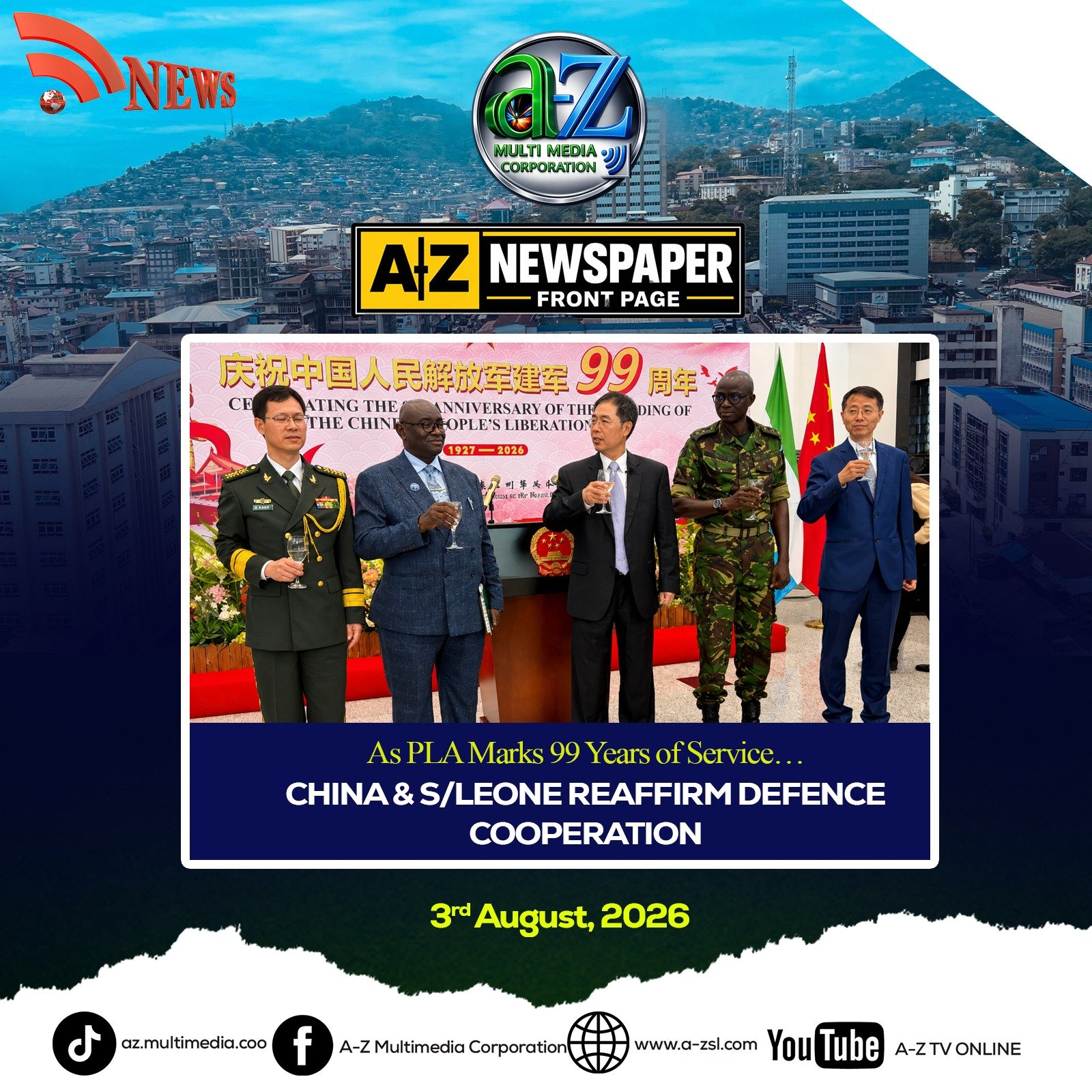
The Embassy of the People’s Republic of China in Sierra Leone has commemorated the 99th anniversary of the founding of the Chinese People’s Liberation Army (PLA), with senior officials from both countries reaffirming their commitment to strengthening defence cooperation, expanding military training opportunities, and deepening the longstanding friendship between China and Sierra Leone.
The anniversary celebration, held on Wednesday, 29 July 2026, at the Chinese Embassy in Freetown, also marked the 55th anniversary of diplomatic relations between China and Sierra Leone. The event brought together senior government officials, military commanders, diplomats, development partners, and media representatives to reflect on decades of collaboration in defence, security, healthcare, and national development.
Zhao Yong, Chinese Ambassador to Sierra Leone said the celebration represented two historic milestones: the 99th anniversary of the PLA and the 55th anniversary of diplomatic relations between China and Sierra Leone, which were established on 29 July 1971.
Ambassador Zhao mentioned that the relationship between the two countries has expanded significantly over the past five decades, with cooperation growing in areas including defence, healthcare, education, infrastructure, and development.
He reaffirmed China’s commitment to further strengthening its friendship and partnership with Sierra Leone, expressing confidence that bilateral cooperation would continue to deliver mutual benefits for both nations.
Senior Colonel Pu Lin, China’s Defence Attaché to Sierra Leone described the PLA as a modern military force that has, over the past 99 years, played a significant role in safeguarding China’s sovereignty, supporting national development, and contributing to global peace and security.
He explained that under the leadership of the Communist Party of China and President Xi Jinping’s vision for military modernization, the PLA has undergone significant reforms aimed at improving its capabilities while maintaining China’s commitment to a defensive defence policy and peaceful development.
Senior Colonel Pu emphasized China’s role as a responsible contributor to international peace and security through its participation in United Nations peacekeeping operations, humanitarian assistance programmes, and maritime security missions.
He noted that China remains the largest contributor of peacekeepers among the permanent members of the United Nations Security Council, with nearly 1,800 personnel currently serving in UN missions worldwide. He added that, over the past 35 years, more than 50,000 Chinese peacekeepers have participated in international operations, supporting communities affected by conflict through infrastructure development and medical assistance.
Highlighting China’s maritime security contributions, Senior Colonel Pu said the Chinese Navy has maintained anti-piracy escort missions in the Gulf of Aden and waters off Somalia since 2008. He stated that more than 150 naval vessels and over 36,000 personnel have participated in these operations, escorting thousands of commercial ships and assisting vessels in distress.
He also recalled China’s humanitarian support to Sierra Leone during major health emergencies, including the Ebola outbreak and the COVID-19 pandemic, when medical supplies, relief materials, and expert teams were provided to support national response efforts.
The Defence Attaché further highlighted the role of China’s hospital ships, Peace Ark and Silk Road Ark, which have provided medical services to hundreds of thousands of people across several countries, including Sierra Leone.
Speaking on bilateral defence relations, Senior Colonel Pu said cooperation between China and Sierra Leone has continued to grow through military exchanges, professional training, institutional support, and technical assistance.
He disclosed that training opportunities for personnel of the Republic of Sierra Leone Armed Forces (RSLAF) increased from 28 slots in 2024 to 51 in 2025 and 61 in 2026. He added that more than 50 Sierra Leonean military officers participated in specialized training programmes and seminars in China over the past year, covering areas such as military medicine, law, agriculture, infrastructure development, and security studies.
According to him, military medical cooperation remains a key area of partnership. He revealed that China deployed its ninth team of military medical experts to Sierra Leone earlier this year, bringing the total number of Chinese military medical personnel who have served in the country to more than 100.
He said the teams have treated over 10,000 people while supporting healthcare delivery within the RSLAF and contributing to the wider health sector.
Senior Colonel Pu also highlighted China’s support to military infrastructure development, including the construction of an underground water tank at the 34 Military Hospital and the donation of equipment such as computers, printers, and air conditioners to the 34 Military Nursing School and the Freetown Garrison.
Ahead of Sierra Leone Armed Forces Day celebrations, the Chinese Embassy donated essential food items, including rice, sugar, and cooking oil, to officers and personnel of the RSLAF.
Beyond military cooperation, he noted that China has extended support to Sierra Leone’s wider security institutions, including the Office of National Security, the National Commission on Arms and Ammunition, and Parliament’s Defence Committee, through the provision of equipment and professional training opportunities.
Responding on behalf of the RSLAF, Chief of Defence Staff Major General Sahr David Thomas Ngaujah described the PLA anniversary as a celebration of a military institution that has made valuable contributions to global peace, stability, and development.
He praised China as a trusted defence partner whose continued support has strengthened Sierra Leone’s military capacity through training, technical assistance, and institutional development.
Major General Ngaujah disclosed that more than 200 Sierra Leonean military personnel have benefited from professional military education and specialized training programmes in China over the years.
He further revealed that 61 officers, cadets, and non-commissioned officers are currently being processed for admission into Chinese military institutions for the 2026-2027 academic year.
According to him, China’s investment in human capacity development has improved the professionalism, technical knowledge, and operational readiness of the RSLAF, with skills acquired abroad contributing positively to military operations in Sierra Leone.
The Chief of Defence Staff also commended China’s support during national emergencies, particularly during the Ebola outbreak and the COVID-19 pandemic, when China provided medical supplies, technical expertise, and military medical assistance.
He praised China’s continued deployment of military medical teams, describing the initiative as an important contribution to improving healthcare services within the armed forces and promoting knowledge transfer among Sierra Leonean medical personnel.
Major General Ngaujah further acknowledged China’s donation of engineering equipment, saying the support has strengthened the engineering capacity of the RSLAF and enhanced its participation in national infrastructure projects.
He noted that military relations between Sierra Leone and China have evolved beyond traditional defence cooperation into a broader partnership built on mutual respect, cultural exchange, peace, security, and sustainable development.
The celebration ended with renewed commitments from China and Sierra Leone to expand military exchanges, strengthen institutional cooperation, and build on the historic friendship that has characterized relations between the two countries for more than five decades.