

By: Audrey Raymonda John
The Sierra Leone Police (SLP) has taken another significant step towards strengthening its forensic investigation and drug detection capabilities following the acquisition of two specialized scientific equipment for the Transnational Organised Crime Unit (TOCU) Forensic Laboratory.
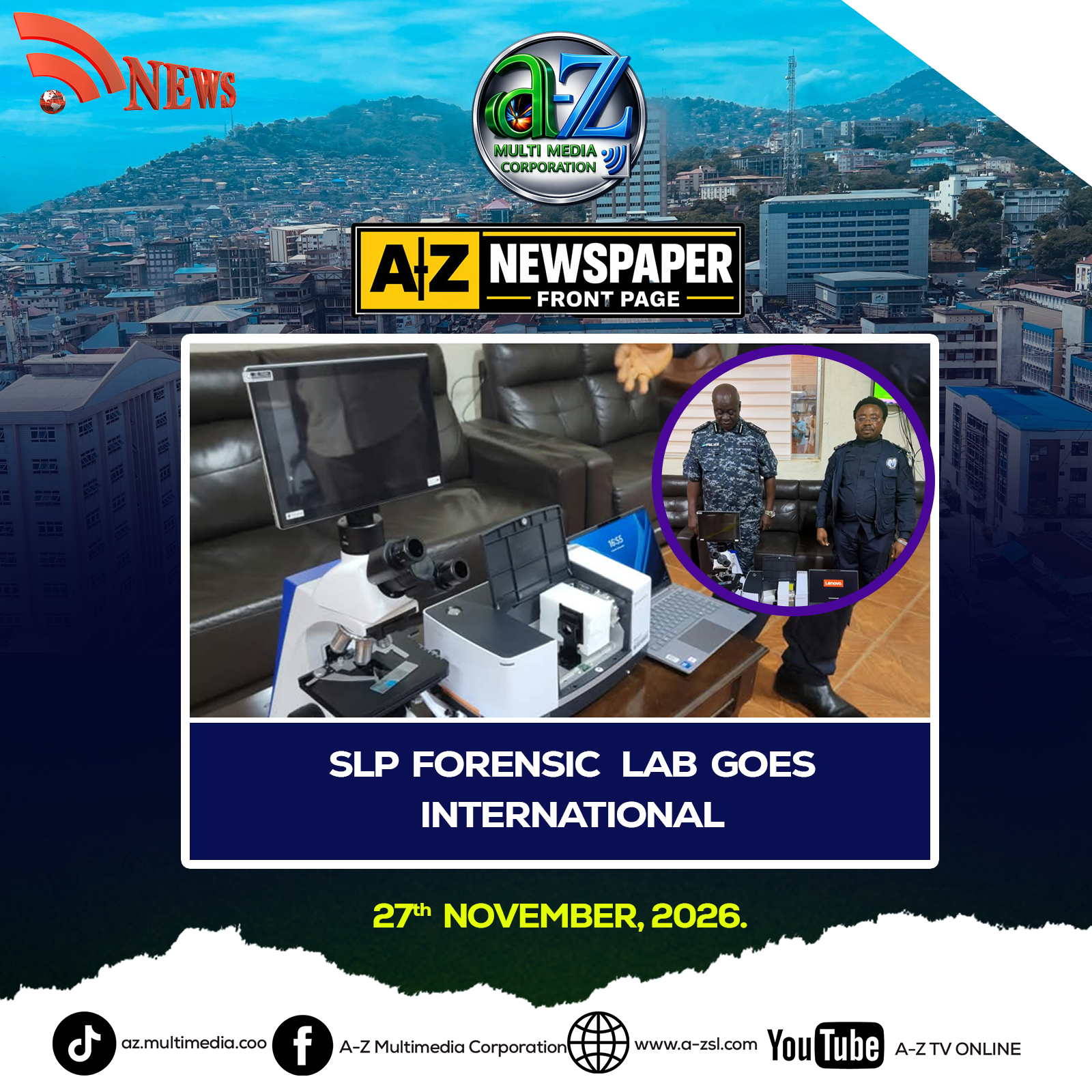
The Inspector General of Police (IGP), Mr. William Fayia Sellu, on Thursday, 26 November 2026, received a Fourier Transform Infrared (FTIR) machine and a Polarizing Microscope for the TOCU Laboratory. The equipment is expected to enhance the laboratory’s capacity to identify, analyze and characterize suspected narcotic substances, particularly emerging synthetic drugs.
The acquisition represents an important milestone in the Sierra Leone Police’s ongoing efforts to modernize its forensic services and align its drug-testing capabilities with internationally recognized standards.
According to recommendations associated with the Global Initiative Against Transnational Organised Crime (GI-TOC), the adoption of appropriate scientific equipment, including FTIR technology, is important in strengthening the reliability, accuracy and international credibility of forensic drug analysis.
The development also reflects the outcome of sustained engagement between the SLP and its international partners, particularly in addressing the growing threat posed by synthetic drugs and other emerging forms of transnational organised crime.
In 2025, the Head of the Sierra Leone Police Forensic Laboratory, Assistant Superintendent of Police (ASP) Stevens, participated in the Annual Meeting of Forensic Laboratory Directors in Casablanca, Morocco.
During the meeting, he presented Sierra Leone’s efforts in combating the emerging trend of synthetic drugs, highlighting the progress made, operational challenges and the need for improved scientific equipment to strengthen the country’s forensic response.
His presentation, which highlighted the achievements of the SLP, the challenges confronting its laboratory and the strategic support and commitment of the IGP towards improving forensic services, attracted the attention of international partners.
The engagement subsequently contributed to the provision of drug-testing kits and further support towards strengthening the laboratory’s technical capacity.
Receiving the equipment, IGP Sellu acknowledged the specialized nature of forensic science and pointed out that the laboratory expert, ASP Stevens, was better positioned to explain the technical functions and significance of the newly acquired machines.
Providing a technical explanation, ASP Stevens said the Fourier Transform Infrared (FTIR) machine is an advanced analytical instrument used to identify and characterize chemical compounds and materials by measuring how they absorb infrared light.
He explained that different chemical bonds absorb infrared radiation at specific frequencies, producing a unique spectrum that serves as a molecular fingerprint for identifying substances.
According to him, the technology has several important applications, including material identification, functional group and molecular structure analysis, as well as quality control and monitoring.
He further explained that the equipment would significantly improve the laboratory’s ability to analyze suspected drug samples, distinguish between different chemical substances and identify emerging synthetic compounds that may otherwise be difficult to detect using conventional testing methods.
On the other hand, the Polarizing Microscope provides an additional scientific tool for examining the physical and optical properties of materials. It enables forensic experts to study the structure, composition and characteristics of substances under specialized lighting conditions, thereby supporting more detailed laboratory examinations.
ASP Stevens noted that the availability of the two machines would strengthen the SLP’s capacity to conduct more reliable and scientifically supported drug examinations, while bringing its laboratory operations closer to internationally recognized forensic practices.
Beyond drug detection, the equipment is expected to contribute to improved evidence analysis, professional competence and the overall effectiveness of investigations involving narcotic substances and organised crime.
The development is particularly significant at a time when law enforcement agencies across the world are confronted with increasingly sophisticated synthetic drugs, whose chemical compositions often change in response to enforcement measures.
For Sierra Leone, strengthening local forensic capacity means reducing reliance on external laboratory services, improving the speed and quality of scientific investigations and providing stronger technical evidence to support criminal proceedings.
The acquisition also underscores IGP Sellu’s commitment to transforming the Sierra Leone Police from a traditional Force into a modern, service-oriented institution driven by professionalism, technology, accountability and operational efficiency.
It is another demonstration of the Police Chief’s broader vision of building an institution capable of responding effectively to contemporary security challenges through strategic partnerships, investment in technology and continuous professional development.
With the introduction of the FTIR and Polarizing Microscope machines, the TOCU Forensic Laboratory is better positioned to strengthen Sierra Leone’s response to the growing threat of illicit drugs and contribute to the country’s participation in the wider international fight against transnational organised crime.