

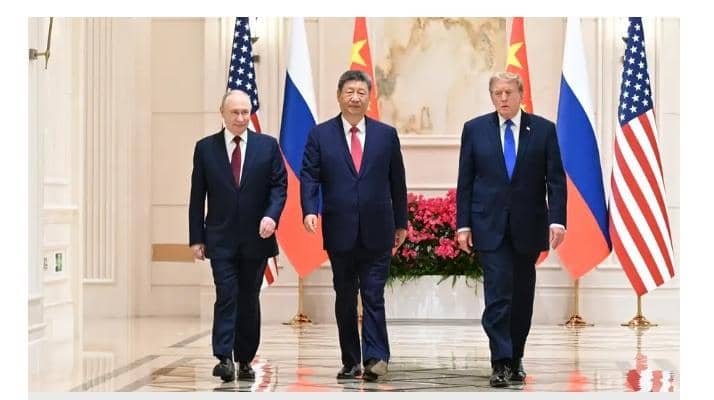
Experts have described the unprecedented engagement between Chinese President Xi Jinping, Russian President Vladimir Putin and US President Donald Trump as a potential turning point in global diplomacy, saying it could reduce geopolitical tensions, prevent confrontation and create new opportunities for international cooperation.
The three leaders met on Thursday, November 19, 2026, in Shenzhen, southern China, at a time of growing geopolitical uncertainty and intensifying competition among major powers.
The meeting focused on the need for dialogue, mutual respect and cooperation in addressing global challenges, including energy and food security, nuclear risk reduction, artificial intelligence (AI) safety and regional conflicts.
During the engagement, President Xi Jinping emphasised that humanity lives in a shared global village where major countries have special responsibilities to uphold peace and stability.
He outlined four principles for relations among major powers: mutual respect, peaceful coexistence, win-win cooperation, and dialogue and consultation.
Zhang Tengjun, an Associate Research Fellow at the Institute of American Studies of the Chinese Academy of Social Sciences, said relations among China, Russia and the United States have significant implications for global strategic stability and the future of the international order.
He explained that the meeting provides a direct channel for communication at the highest level, helping the three countries manage their differences, reduce strategic miscalculations and prevent tensions from escalating into confrontation or a new Cold War.
Similarly, Sun Taiyi, Associate Professor of Political Science at Christopher Newport University in the United States, described the engagement as historically significant, noting that the three countries share a responsibility to prevent catastrophic conflict despite their political differences.
He cautioned, however, that a single meeting cannot resolve longstanding structural differences, stressing the need for institutional mechanisms, reliable crisis hotlines and effective communication channels to prevent unintended military escalation.
The discussions also highlighted the importance of preserving the post-World War II international order, with President Xi calling on the three countries to uphold the principles of the United Nations Charter and defend the international system based on international law.
On economic and security cooperation, experts identified food and energy security, nuclear risk reduction and AI safety as areas where practical collaboration could deliver significant benefits.
They suggested cooperation to maintain stable global supply chains, protect commercial shipping, facilitate grain and fertiliser deliveries, and reduce disruptions to civilian energy infrastructure.
On nuclear security, regular consultations on strategic forces, arms control and non-proliferation were recommended to minimise the risks of miscalculation and unintended conflict.
The experts also called for greater coordination within the United Nations framework on climate change, public health and poverty reduction, alongside sustained diplomatic engagement to address regional conflicts.
Sun stressed that translating political understanding into practical results would require clear implementation processes, designated officials, timelines for follow-up meetings and measurable outcomes.
He maintained that even limited achievements in areas of mutual interest could build confidence among the three powers and provide a stronger foundation for lasting global stability.