

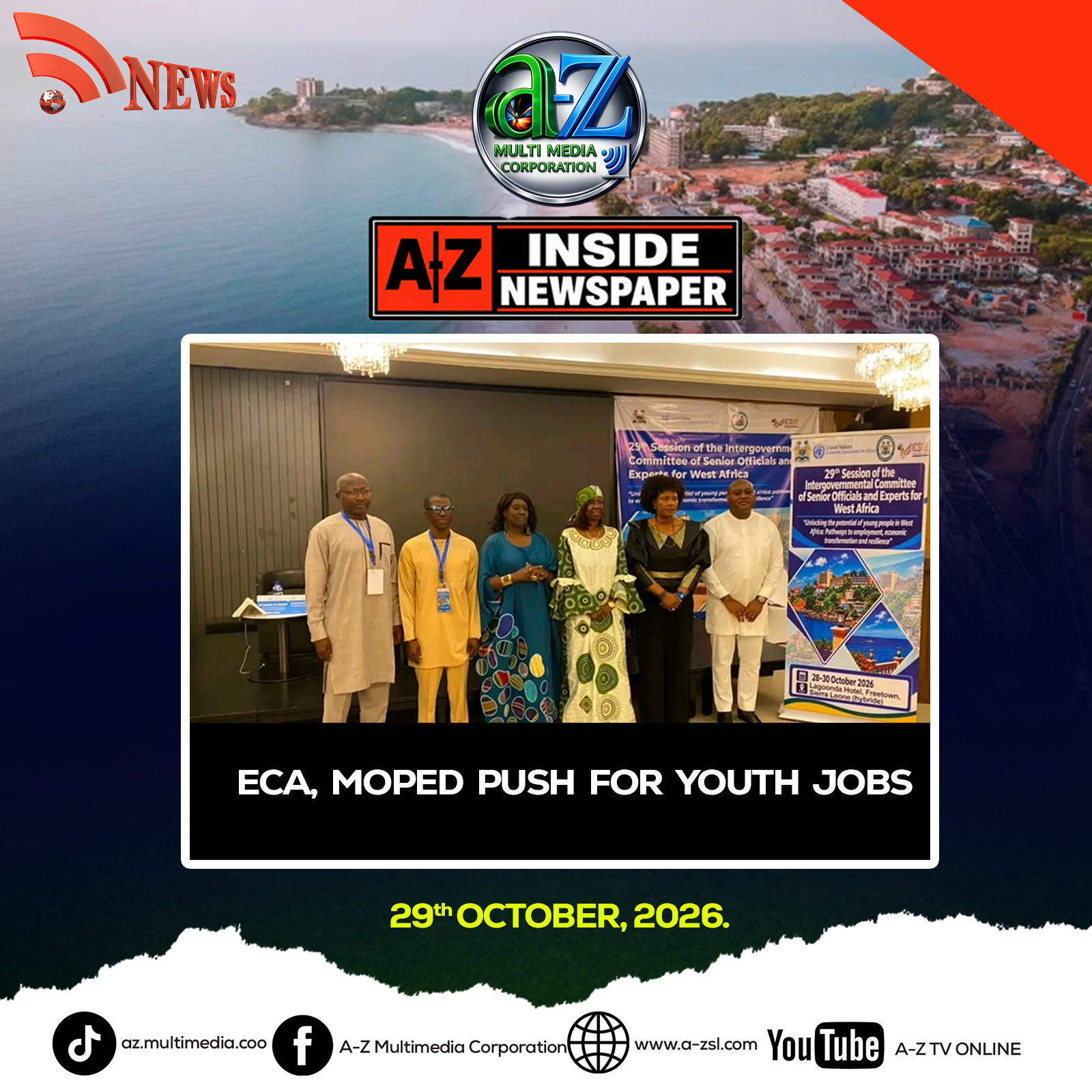
By: Mamajah Jalloh
The United Nations Economic Commission for Africa (ECA), in collaboration with the Government of Sierra Leone through the Ministry of Planning and Economic Development (MoPED), has called for stronger action to tackle youth unemployment, accelerate economic transformation and turn West Africa’s youthful population into a driver of inclusive growth and sustainable development.
The session, held under the theme “Unlocking the Potential of Young People in West Africa: Pathways to Employment, Economic Transformation and Resilience,” brought together government officials, experts and development partners to examine the challenges facing young people and identify practical strategies for expanding employment opportunities across the subregion.
Delivering a statement on behalf of the Vice President of Sierra Leone, Minister of Planning and Economic Development Kenyeh Barlay reaffirmed the government’s commitment to placing young people at the centre of national development.
She said youth employment remained a key priority under the Medium-Term National Development Plan (MTNDP) 2024–2030, which targets the creation of at least 500,000 jobs for young people by 2030 through skills development and expanded economic opportunities.
Minister Barlay explained that the current development plan builds on the MTNDP 2019–2023, which prioritized human capital development and Free Quality Education. She noted that more than one million additional children entered the education system between 2019 and 2023, laying a stronger foundation for future employment, entrepreneurship and leadership.
She emphasised the importance of technical and vocational education and training in equipping young people with practical skills that can translate into sustainable livelihoods. She also identified the Feed Salone programme as a major avenue for employment creation across agricultural value chains, including fisheries and fish farming.
The minister further highlighted the role of the National Commission for Social Action (NaCSA) in providing short-term employment opportunities for young people. She said approximately 15,000 young people gained work experience in 2024 through projects involving the rehabilitation of community schools, health centres, vocational centres and other facilities.
Barlay also stressed the need to protect young people’s futures through stronger laws against child marriage, policies that encourage girls to remain in school and initiatives that enable young people to participate in decisions affecting their lives.
However, she acknowledged that underemployment, informal work, skills gaps, limited access to finance and climate vulnerability continued to restrict employment opportunities. She urged governments to protect investments in education, human capital and youth development despite competing demands on limited public resources.
On regional cooperation, Barlay said no country could address youth unemployment and related development challenges alone, given the interconnected nature of West African economies and the growing integration of regional markets.
She urged delegates to share national experiences openly, listen to young people, agree on specific commitments with measurable targets and timelines, and establish clear mechanisms for monitoring progress.
The minister called for an action-oriented Freetown Declaration on Youth Empowerment in West Africa, backed by concrete commitments from governments, institutions and development partners. She announced that Sierra Leone would present its national commitments on the second day of the meeting and encouraged other member states to follow suit.
“Young people are not asking for charity, but for a fair opportunity to build, create and lead,” Barlay reminded delegates, challenging them to ensure that the meeting produced tangible results rather than declarations alone.
She subsequently declared the 29th Session open.
The Development Secretary at MoPED, Ambrose James, described the meeting as an important platform for developing policy recommendations that respond to West Africa’s development priorities.
He called for practical, coordinated and action-oriented measures to address structural barriers, including limited economic diversification, skills mismatches, high levels of informal employment and inadequate access to finance, technology and decent jobs.
James stressed that youth employment must be treated as an economic strategy rather than merely a social programme. He urged delegates to move beyond identifying challenges and focus on implementable policies that strengthen human capital, accelerate industrialization and build resilience against economic and climate-related shocks.
He also commended the outgoing chair of the committee, Joseph M. Samah, for his leadership during Sierra Leone’s chairmanship of the 28th Session, held virtually in November 2025.
The Director of the ECA Subregional Office for West Africa, Bouna Diop, described youth employment as a central economic and development concern requiring coordinated policy responses.
She said West Africa’s youthful population represented enormous potential for innovation, productivity and economic growth, but warned that this potential would not automatically translate into a demographic dividend without deliberate investments in health, education, skills, productive capacity and job creation.
Diop identified the predominance of informal employment, barriers facing young women, limited access to finance and productive assets, and weaknesses in public expenditure effectiveness as issues requiring urgent attention.
She called for stronger alignment between education and labour-market needs, faster economic diversification, private-sector development and the use of digital and green transformation to create new employment opportunities.
She also emphasised the need to improve domestic resource mobilization and ensure that public spending translates into better services and tangible benefits for citizens.
The United Nations Resident Coordinator in Sierra Leone, Seraphine Wakana, highlighted the need to link youth employment with broader economic transformation, regional integration and resilience.
She observed that although young people across West Africa possessed considerable talent and creativity, many continued to face barriers to quality education, skills development, decent employment and access to finance.
Wakana called for greater economic diversification, industrialization and productivity growth to expand employment opportunities beyond dependence on primary commodities.
She identified the African Continental Free Trade Area, the digital economy, renewable energy, agribusiness, manufacturing and services as sectors with significant potential to create jobs and support entrepreneurship.
The UN Resident Coordinator cited the inaugural Mano River Union Youth Connect Forum, hosted in Freetown in June 2026 by the Ministry of Youth Affairs and the United Nations Development Programme, as an example of regional engagement that brought young leaders together to advance peace and sustainable development.
She urged governments, regional institutions, development partners and the private sector to work together to create an enabling environment for young people to participate meaningfully in economic and social development.
In his subsequent remarks, Development Secretary James reiterated that economic transformation must remain central to efforts to address youth unemployment. He called for stronger private-sector partnerships and closer cooperation among West African countries, urging participants to learn from one another and build synergies to advance regional integration.
He described young people as entrepreneurs, active citizens and drivers of change, stressing that investing in their potential was essential to promoting peace, stability and prosperous communities.
The session is expected to continue until 30 October 2026, with delegates and experts examining regional development priorities, sharing national experiences and identifying practical solutions to advance youth employment, economic transformation and resilience.
The outcomes are expected to contribute to discussions at the 2027 Conference of African Ministers of Finance, Planning and Economic Development.