

By: Mohamed J. Bangura
President Julius Maada Bio has reaffirmed Sierra Leone’s commitment to international justice, accountability and the rule of law as the country hosts a high-level regional seminar organised by the International Criminal Court (ICC) on cooperation and complementarity for the first time.
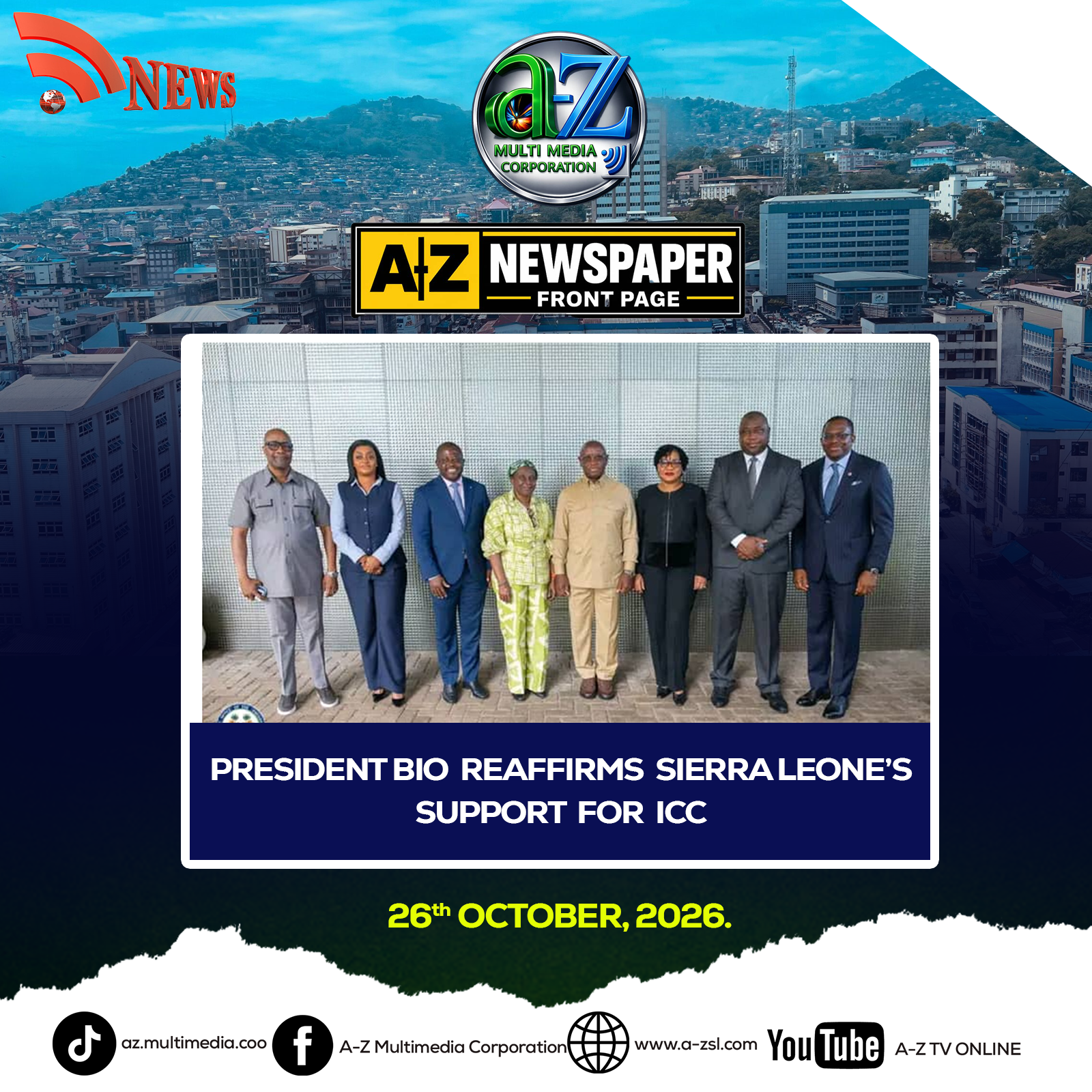
President Bio made this reaffirmation following a meeting with ICC Vice-President Judge Reine Adélaïde Sophie Alapini-Gansou and her delegation at State Lodge in Freetown.
In an update, President Bio said Sierra Leone remained committed to supporting the Court’s efforts to promote justice and ensure accountability for individuals responsible for serious international crimes, including crimes against humanity.
The regional seminar provides a platform for stakeholders to discuss ways of strengthening cooperation between the ICC and national judicial institutions, while addressing challenges in investigating and prosecuting serious international crimes.
Cooperation between states and the ICC is essential for facilitating investigations, exchanging information, protecting witnesses and ensuring that suspects within the Court’s jurisdiction can be brought to justice.
Central to the Court’s mandate is the principle of complementarity, under which national courts have primary responsibility for investigating and prosecuting serious international crimes. The ICC generally intervenes when national authorities are unwilling or genuinely unable to carry out genuine proceedings.
The principle highlights the importance of strengthening domestic justice systems while ensuring that international mechanisms remain available to address crimes falling within the Court’s jurisdiction.
For Sierra Leone, the discussions hold particular significance given the country’s experience with transitional justice following its civil war.
The establishment of the Special Court for Sierra Leone marked a major step in prosecuting those bearing the greatest responsibility for serious crimes committed during the conflict. The Court’s work also contributed to broader international discussions on accountability, reconciliation and the role of judicial institutions in addressing atrocities.
By hosting the regional seminar, Sierra Leone has an opportunity to share lessons from its own experience and contribute to discussions on strengthening justice systems and cooperation among African countries and the ICC.
The meeting between President Bio and Judge Alapini-Gansou further underscores the importance of engagement between Sierra Leone and international judicial institutions in promoting accountability and the rule of law.
Effective cooperation requires appropriate legal frameworks, strong investigative and prosecutorial capacity, and national institutions capable of responding to allegations of serious crimes.
The seminar is therefore expected to facilitate exchanges on practical measures to improve cooperation, reinforce accountability mechanisms and strengthen regional responses to international crimes.
Sierra Leone’s hosting of the event places the country at the centre of regional discussions on international justice and the shared responsibility of states to ensure that those responsible for serious international crimes are held accountable through credible legal processes.