

By: Mohamed J. Bangura
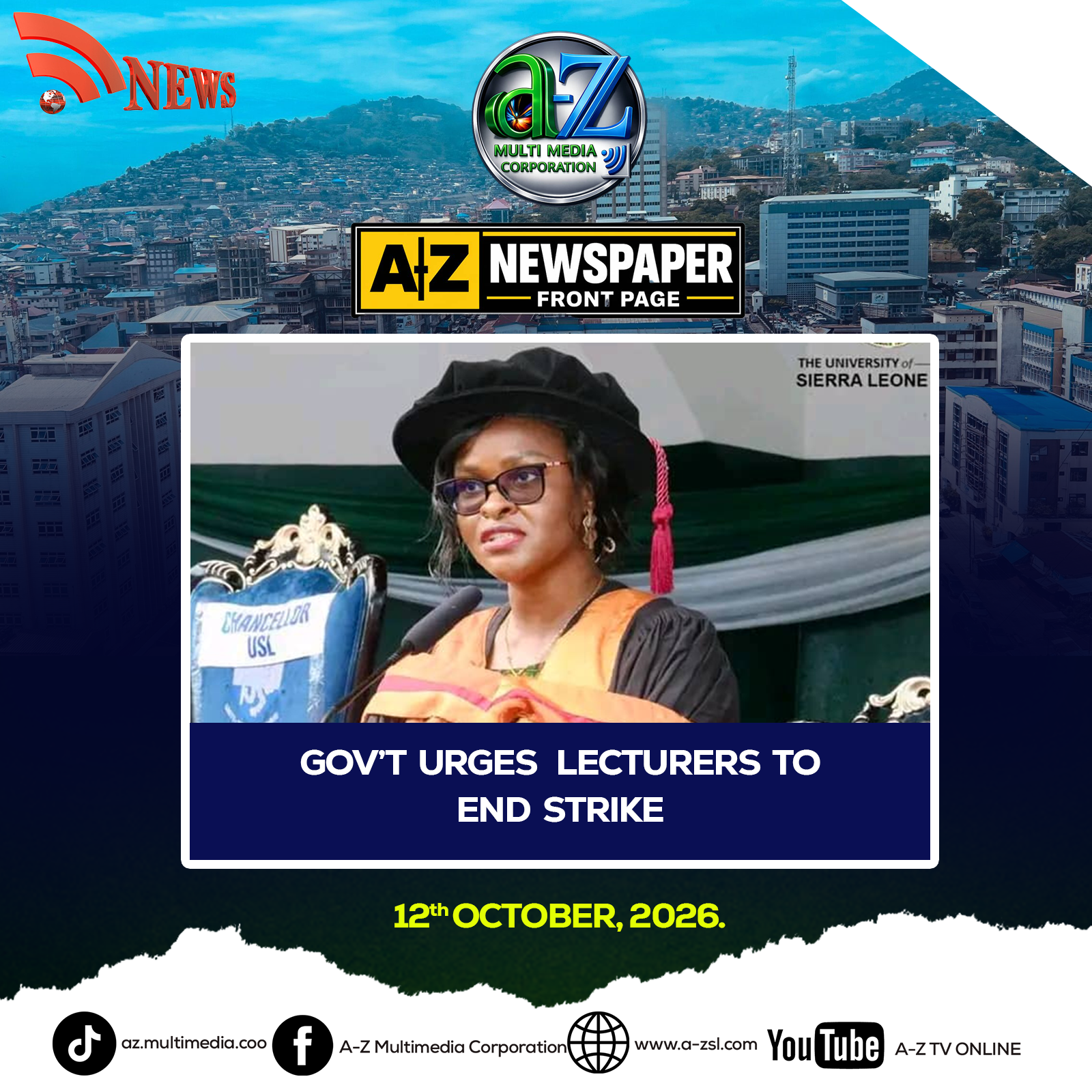
The Government of Sierra Leone has reaffirmed its commitment to improving the welfare of academic staff in public tertiary institutions, while urging striking lecturers to return to work ahead of the scheduled reopening of public universities on Monday, October 12, 2026.
In a press release issued on Friday, October 9, 2026, the Ministry of Technical and Higher Education (MTHE) said the government remained committed to addressing outstanding concerns through dialogue, mutual respect, transparency and established legal procedures.
The ministry acknowledged the concerns raised by academic staff but maintained that the government had taken significant steps to improve their welfare, including salary increases and the payment of salaries and annual leave allowances.
According to the ministry, a total salary increase of 75 per cent was agreed upon and implemented in three instalments. When compounded, the increases amounted to approximately 87.5 per cent. The government subsequently approved an additional 15 per cent salary increase for staff of tertiary educational institutions, effective April 2025.
The ministry further disclosed that, since July 2019, the government had assumed responsibility for financing approximately 83 per cent of university staff salaries, as well as annual leave allowances for employees of public tertiary institutions. It added that these payments had been made on time.
The government said these measures demonstrated its commitment to supporting academic staff and strengthening Sierra Leone’s higher education system.
On the ongoing industrial action, the ministry explained that Academic Staff Associations (ASAs) had raised concerns about their Conditions of Service. In response, the government directed that the issues be referred to the respective University Courts for negotiation and harmonization in line with established procedures.
In June and July 2026, the academic staff associations also demanded a 100 per cent salary increase. The ministry said the request required assessment by the Wages and Compensation Commission (WCC), given the government’s responsibility for financing a substantial proportion of university staff salaries.
The WCC subsequently submitted its assessment of the financial implications to the Ministry of Finance on September 11, 2026. According to the ministry, negotiations on salaries and Conditions of Service were still ongoing when the strike commenced on September 16, 2026.
However, the government expressed concern that the strike notice had been issued under the umbrella of the Union of Academic Staff Associations (UASA), despite the ongoing negotiations and questions surrounding the union’s statutory authority to declare industrial action.
Citing the Industrial Relations and Trade Union Act, 2024, the ministry referred to Section 63(3), which states that parties to an industrial dispute should not resort to a strike while negotiations or mediation proceedings are ongoing.
The ministry also cited Section 63(4), which requires an aggrieved unionized employee intending to strike to channel that intention through the secretary-general of a registered trade union holding a bargaining certificate.
Based on its engagements with the relevant authorities, the ministry maintained that UASA had not been issued the required bargaining certificate. It further argued that registration as a corporate entity with the National Investment Board did not, by itself, establish registration as a trade union or confer collective bargaining authority under the applicable labour laws.
The ministry also noted that the Universities Act, 2021, recognizes Academic Staff Associations within university governance structures but does not identify UASA as such a body.
On these grounds, the government considers the ongoing industrial action unlawful, arguing that negotiations were still in progress when the strike began. However, the ministry stressed that its position did not diminish academic staff’s right to raise legitimate concerns or the government’s willingness to address them through dialogue.
With public universities scheduled to reopen on Monday, October 12, the ministry urged lecturers to report for duty and resume teaching and other academic responsibilities.
It reiterated that its doors remained open to constructive engagement, emphasizing the government’s determination to reach a fair, lawful and financially sustainable resolution that protects lecturers’ interests, safeguards students’ education and strengthens the country’s higher education system.
The government’s appeal comes at a critical time for students and parents, as the continuation of the strike could further disrupt academic activities and the university calendar.
The ministry maintained that dialogue remained the preferred means of resolving the dispute, urging all parties to respect established legal procedures and work towards a lasting solution.