

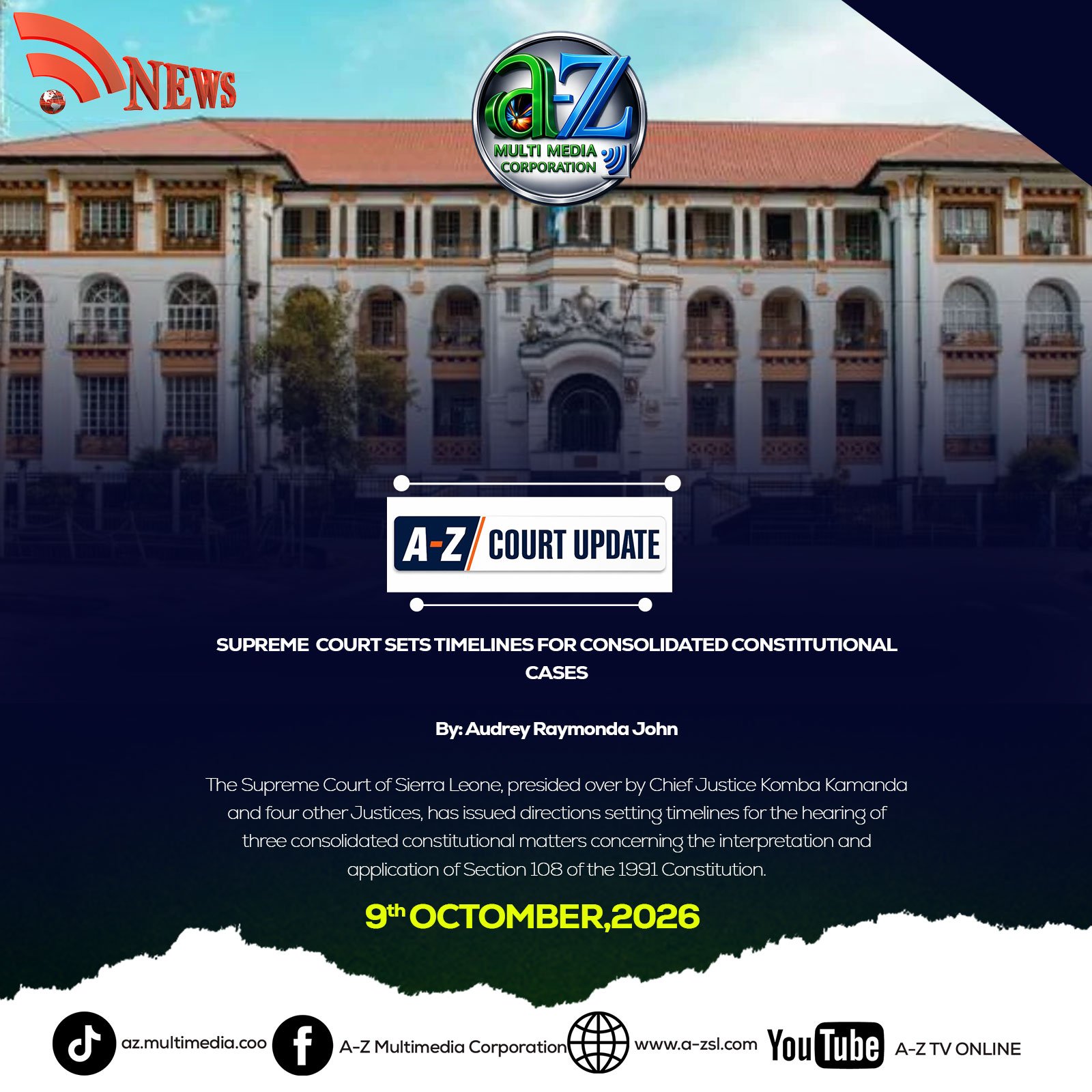
By: Audrey Raymonda John
The Supreme Court of Sierra Leone, presided over by Chief Justice Komba Kamanda and four other Justices, has issued directions setting timelines for the hearing of three consolidated constitutional matters concerning the interpretation and application of Section 108 of the 1991 Constitution.
The directions were issued on Thursday, October 8, 2026, following the Court’s decision to consolidate the related matters for hearing.
Under the order, the parties are required to file a memorandum specifying the issues agreed upon for determination in the consolidated cause within 14 days.
The Defendants/Applicants, represented by the Office of the Attorney-General and Minister of Justice, have also been directed to file and serve their Statement of Case within 10 days of the order.
The Plaintiffs/Respondents, led by Joseph Fitzgerald Kamara, are required to amend, file and serve their Statement of Case within 10 days of receiving the Defendants/Applicants’ Statement of Case.
The Court further directed the Registrar to maintain a single consolidated file and record for the proceedings.
The Supreme Court also clarified the role of the party admitted to participate in the matter as amicus curiae.
According to the order, the amicus curiae’s participation shall extend to the consolidated cause but shall be confined to making submissions of law on the questions raised by the parties.
The amicus curiae is barred, at this stage, from raising new issues, seeking new reliefs or advancing the case of any of the parties.
The Court further directed that the amicus curiae shall not participate in interlocutory applications unless specifically invited by the Court to make submissions on a particular issue.
The parties have also been ordered to serve the amicus curiae, within 10 days of the order, with a list of all relevant documents and processes filed in the matters that have been consolidated.
In addition, every party is required to serve the amicus curiae with any process filed in the consolidated matter within 10 days of filing.
The Court further directed the amicus curiae to file and serve a final written address, together with a list and bundle of authorities, in accordance with the Court’s directions.
The directions follow submissions previously made by Solicitor-General Osman I. Kanu, who urged the Supreme Court to consolidate the three related constitutional matters.
Counsel Kanu argued that the requirements prescribed under Section 108 of the 1991 Constitution are mandatory and must govern the passage of any Bill seeking to alter the Constitution, particularly where the proposed alteration concerns Section 6.
He submitted that the three matters arose from the same transaction relating to the passage of a Bill on August 10, 2006, and involve substantially similar constitutional questions.
According to Counsel Kanu, the matters involve the same Defendants and are represented by the same counsel, making consolidation desirable in the interest of judicial efficiency and the proper administration of justice.
He further argued that hearing the matters separately could result in conflicting or inconsistent submissions, directions or decisions on identical constitutional questions.
Counsel Kanu maintained that consolidation would avoid unnecessary delays and costs while allowing the Court to determine the common legal issues in a single proceeding.
In support of the application, he referred the Court to authorities previously cited, including a matter involving the Chief Electoral Commissioner and two others, as well as Supreme Court Citation No. 1 of 2007 and Supreme Court Citation No. 2 of 2007.
He told the Court that those matters were considered together by the Supreme Court on July 26, 2007, because they concerned the same subject matter relating to the then Vice President’s contest in the 2007 elections.
Addressing the affidavit filed in support of the application on September 2, 2026, Counsel Kanu relied particularly on paragraphs 10 and 11, which he said demonstrated the practical convenience and interest of justice in having the three matters heard together.
The Solicitor-General further submitted that the matters raise identical or substantially similar questions of law, particularly concerning Sections 91(1), 94(2), 108 and 171 of the 1991 Constitution.
He identified as a central issue whether the requirement prescribed under Section 108 is mandatory in relation to any attempt to alter the constitutional position under Section 6.
Counsel Kanu argued that the common legal issues affecting the parties made it undesirable for the matters to proceed separately, as doing so could create a risk of conflicting directions or judgments on the same constitutional questions.
He therefore urged the Court to consolidate the matters to promote consistency, judicial economy and the efficient administration of justice.
In support of the application, Counsel Kanu referred to Order 4 Rule 4(1) of the High Court Rules, the Supreme Court Act 1982 and relevant provisions of the 1991 Constitution.
He submitted that where the rules governing the original and supervisory jurisdiction of the Court of Appeal do not expressly provide for a particular matter, the practice and procedure applicable in the High Court may apply, mutatis mutandis.
Counsel further relied on Order 4 Rule 4, which provides for the joining or consolidation of matters where a common question of law or fact arises, where the rights or reliefs claimed arise from the same transaction or series of transactions, or where, for any other reason, it is desirable for the matters to be heard together.
He maintained that the present application met those requirements, arguing that the three constitutional matters raise common questions of law and substantially similar reliefs.
Counsel Kanu therefore urged the Supreme Court to grant the relief sought by the Defendants in the Notice of Motion dated September 11, 2026.
In reply, Lawyers Joseph Fitzgerald Kamara, Africanus Sesay and Bamine Davies said they had no objection to the application made by Solicitor-General Osman I. Kanu.
The Court’s latest directions will now guide the further filing of pleadings, written submissions and other processes ahead of the hearing of the consolidated constitutional matters.