

By: Audrey Raymonda John
The Supreme Court, presided over by Chief Justice Komba Kamanda and other Justices, has overruled an objection challenging the hearing of an application seeking to consolidate three related matters involving the Attorney-General and Minister of Justice as the First Defendant and the Speaker of Parliament as the Second Defendant.
The matters include SC No. 8/2026, involving Hon. Osman Timbo, Hon. Abdul Kargbo and Hon. Daniel Koroma, and SC No. 9/2026, involving the APC, Thomas Moor Conteh and Hon. Tamba Kellie, among other parties before the Court.
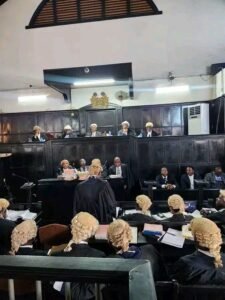
The objection was raised during proceedings on the consolidation application. Counsel for the Plaintiff, Joseph Fitzgerald Kamara, argued that there was no paper file before the Court containing the Defendants’ response to the matter.
Kamara submitted that a defendant who had failed to file the necessary court documents should not have an audience before the Court and, therefore, should not be heard on issues relating to consolidation and compliance.
He further argued that there was no application or prayer before the Court seeking an extension of time for the Defendants to file their papers.
Referring to Rule 92, Kamara submitted that the Defendants’ failure to file the required court papers or records was a matter that should be considered by the Court.
He also argued that the Attorney-General, having failed to file a defence in the matter, could not properly raise the objection before the Court.
Other counsel appearing in the matter adopted Kamara’s arguments, particularly the position that the issue before the Court was fundamental and did not require consolidation.
Counsel also urged the Court to strike out the objection, arguing that no certificate of non-compliance had been filed.
However, in its ruling, the Supreme Court rejected the objection and allowed the consolidation application to be heard.
The Court considered the nature of the application and relied on the precedent in SC 4/20, John Benjamin and Two Others v. Professor Christian Atto and Three Others, among other authorities.
The Court also referred to a 2015 Supreme Court matter involving MMBP and BNDC, in which Mr. Charles Makaru had objected to Mr. Makoli proceeding with an interlocutory motion without first filing a statement of case on behalf of the defendants he represented.
The Court explained that, in that matter, the application concerned the jurisdiction of the Court to hear the plaintiff’s application. Consequently, a ruling in Mr. Makoli’s favour would have made it unnecessary for him to file a statement of defence on behalf of the defendants he represented.
The Court distinguished that case from the present matter, noting that the current application did not concern the jurisdiction of the Court.
According to the Court, the issue before it was a matter that could be dealt with preliminarily before the substantive merits of the case were addressed.
The Court further stated that it had considered the authorities cited by counsel for the Plaintiff/Respondent but, with respect; found that they did not directly address the application before the Court.
“In the instant case, the application before us is for the consolidation of three matters that appear to be related,” the Court stated.
The Court rejected the argument that the Defendant/Applicant was required to file a statement of case in all three matters before being heard on the consolidation application.
It held that imposing such a requirement would substantially render the consolidation application nugatory, since the principal purpose of consolidation was to enable the defendants to file one comprehensive case in respect of all the consolidated matters.
“In view of the above, the objection is overruled, and we allow the application for consolidation to be heard,” the Court ruled.
The ruling clears the way for the Supreme Court to proceed with the hearing of the application seeking to consolidate the related matters.
The matter was adjourned to tomorrow at 10:00 a.m. for continuation.