

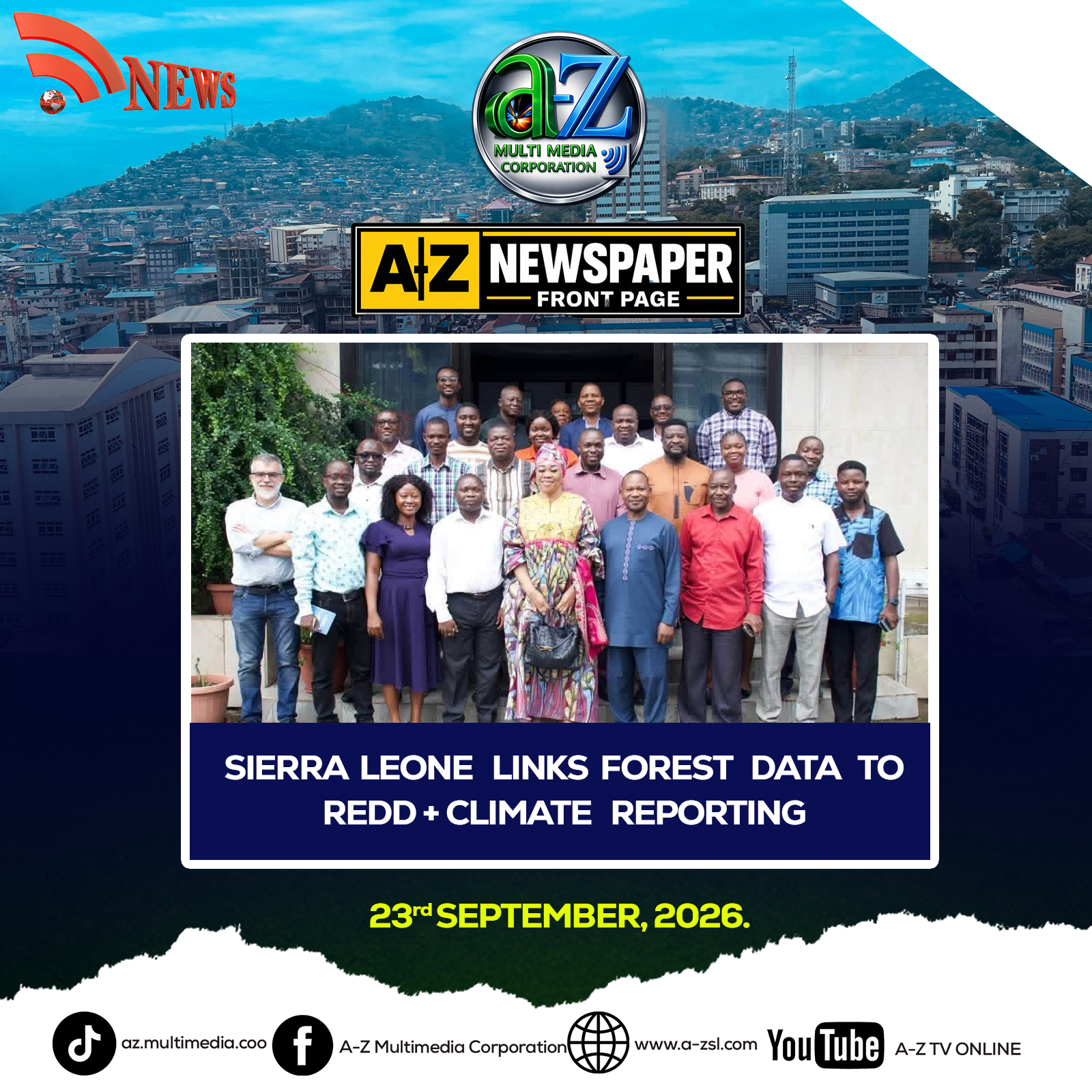
Sierra Leone is strengthening its climate reporting and forest governance systems by aligning data from its National Forest Inventory (NFI) with the country’s Forest Reference Emission Level (FREL) under the REDD+ mechanism.
The initiative is part of efforts to establish a robust and operational National Forest Monitoring System (NFMS), which will improve the country’s capacity to measure, report and verify changes in forest cover, carbon stocks and emissions.
The development was highlighted during a National Technical Training Workshop on strengthening country capacity for the operationalization of the NFMS and forest monitoring in Sierra Leone, held from September 15 to 18, 2026.
The workshop brought together government institutions, technical partners and forestry experts to strengthen forest-monitoring methodologies and harmonize approaches to climate reporting.
A major focus of the discussions was ensuring that data generated through the NFI directly supports the refinement of Sierra Leone’s FREL, which serves as a benchmark for estimating emissions and removals from forests under REDD+.
A credible FREL is important for tracking the country’s progress in reducing deforestation and forest degradation, while also creating opportunities to access results-based climate finance.
According to the Directorate of Forestry, Kate Karemo-Garnett, Sierra Leone has made significant progress in developing the technical and institutional foundations required for an operational NFMS and FREL.
She, however, noted that further work is needed to consolidate land-cover and forest classifications, improve reference and activity data, integrate remote-sensing products with field measurements, and establish transparent and reproducible methodologies for national forest and land monitoring.
The completion of field data collection for the NFI is considered a major milestone for Sierra Leone. It represents the country’s first comprehensive national assessment of its forest resources in more than five decades, following the last NFI conducted in 1975 with support from the Food and Agriculture Organization of the United Nations (FAO).
Through the current inventory, Sierra Leone has completed both field-based and remote-sensing data collection, providing an important evidence base for improved forest management and climate reporting.
Speaking at the workshop, FAO representative Saeed Abubakarr Bancie said Sierra Leone’s forests are critical to climate regulation, biodiversity conservation, rural livelihoods and sustainable development.
He noted that the country’s forest resources continue to face pressure from agricultural expansion, logging, mining, infrastructure development and recurrent fires.
Bancie said addressing these challenges requires forest governance systems based on transparent, credible and scientifically robust data.
The workshop forms part of the implementation of two major initiatives: Institutional and Technical Support for REDD+ Readiness in West Africa, funded by the Green Climate Fund (GCF), and Support to Sustainable Forestry in Sierra Leone, which supports the NFI and is funded by the European Union with technical support from FAO.
Together, the initiatives seek to establish a nationally owned and sustainable forest monitoring framework that can be managed by Sierra Leonean institutions and technical experts.
A key objective is to develop a permanent pool of national specialists capable of independently operating, validating and maintaining modern forest-monitoring systems.
Participants received practical training on monitoring platforms, including SEPAL, Collect Earth Online, GROUND and WHISP, which support the collection, analysis and validation of forest data using satellite imagery and field observations.
The integration of NFI data into the FREL development process is particularly important to Sierra Leone’s climate reporting obligations under the Paris Agreement and REDD+ framework.
By combining field measurements from the NFI with satellite-based monitoring systems, the country is working to improve the quality, consistency and reliability of information used to report progress towards national and international climate commitments.
The alignment of NFI data with the FREL therefore represents an important step in strengthening Sierra Leone’s climate readiness, improving transparency in forest-sector reporting and enhancing opportunities for future REDD+ results-based financing.
As Sierra Leone continues to operationalize its NFMS, collaboration between government institutions, FAO and development partners is laying the foundation for a modern, data-driven approach to forest management.
The initiative is expected to contribute to improved protection of forests and biodiversity while strengthening Sierra Leone’s capacity to meet its climate commitments and contribute to global efforts to address climate change.