

By: Saidu Jalloh
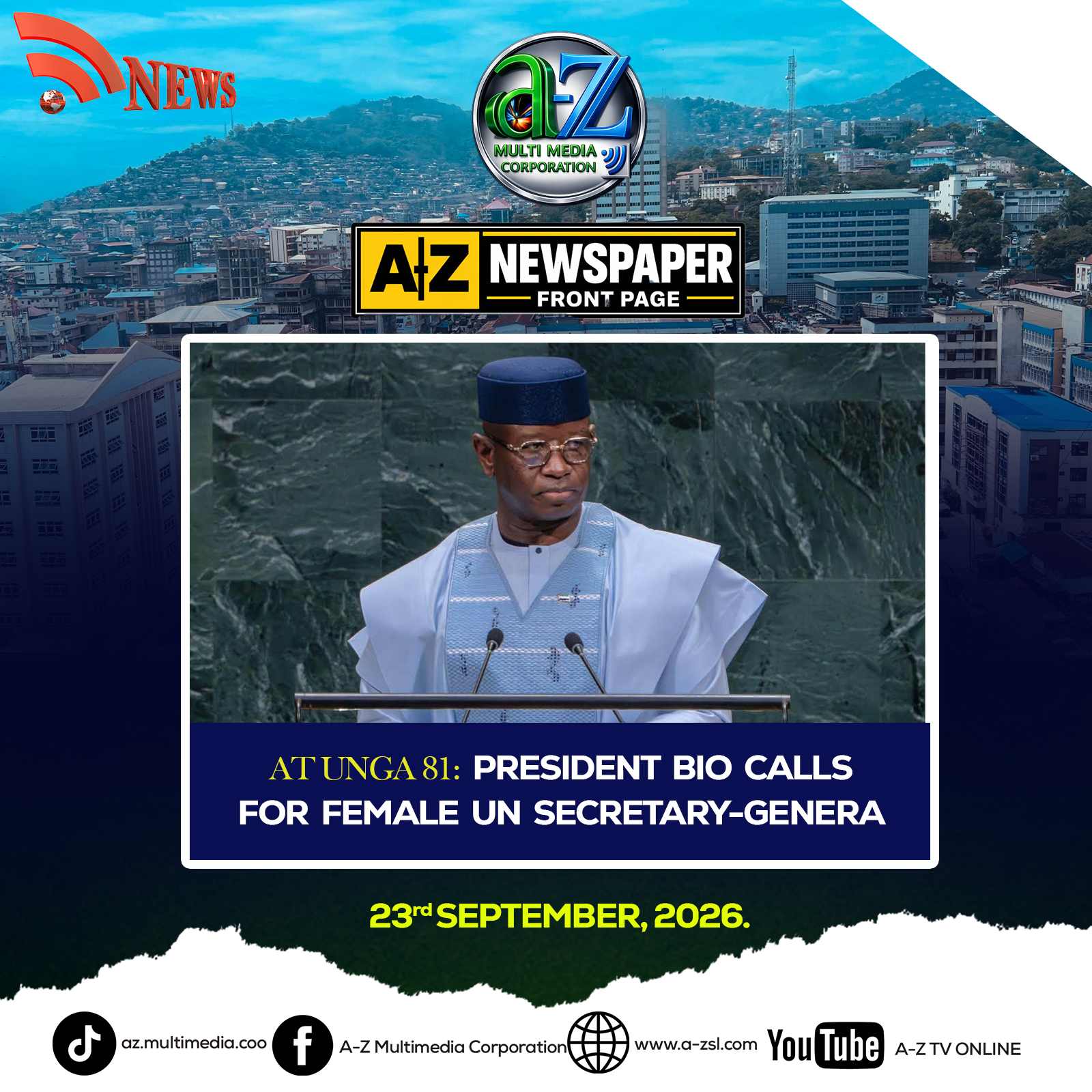
President Julius Maada Bio has called for a woman to be entrusted with the position of United Nations Secretary-General, saying the organization must demonstrate the gender equality it promotes around the world.
At UNGA 81, President Bio said the selection of the next Secretary-General represents another test of institutional effectiveness and equality, noting that the UN’s top office has been held by men throughout its history.
“The women put forward for this office have placed their competence beyond dispute,” President Bio said, adding that what remains is the will of the organization to uphold the equality it advocates for others and entrust a woman with its highest office.
President Bio made the call while addressing the 81st session of the United Nations General Assembly in New York, where he also urged the international community to restore trust in multilateralism, strengthen international law and reform global institutions.
He congratulated Dr. Khalilur Rahman of Bangladesh on his election as President of the 81st session of the General Assembly and pledged Sierra Leone’s full support for his leadership. The 81st session is being held under the theme “Restoring Trust, Managing Transformation: A United Nations That Delivers for All.”
United Nations
President Bio also paid tribute to UN Secretary-General António Guterres as he approaches the end of his mandate, commending his service to the organization, and recognized Deputy Secretary-General Amina J. Mohammed for her service and representation of Africa.
Reflecting on Sierra Leone’s peacebuilding experience, President Bio said the country’s nearly 25-year journey since the end of the civil war demonstrated the importance of international cooperation.
He said peace was strengthened not only by the formal declaration of the end of the war, but also by families returning home, communities rebuilding trust, citizens choosing the ballot and institutions gradually regaining public confidence.
“The United Nations stood with us through disarmament, inaction and the long walk of peacebuilding,” President Bio said, stressing that Sierra Leone had experienced what international cooperation could make possible.
He said the country’s experience had also shown that trust cannot be created by declarations alone.
“Trust grows when promises are honoured, when the law protects everyone, when institutions serve their people, and when citizens can see a future for themselves,” President Bio said.
President Bio described trust as “the currency of multilateralism” and called for international law to be applied consistently, regardless of geography or the identity of those involved.
On the Middle East, he called for the protection of civilians, unhindered humanitarian access, an end to aggression and occupation, and the safeguarding of freedom of navigation.
President Bio also reaffirmed the right of the Palestinian people to self-determination through a viable State of Palestine living alongside Israel in peace and security.
On Sudan, he called for the protection of civilians, unhindered humanitarian access, accountability and a Sudanese-led political process that safeguards the country’s sovereignty, unity and territorial integrity.
He also expressed concern over the continued conflict in eastern Democratic Republic of the Congo, noting that agreements had yet to silence the guns or allow millions of displaced people to return home.
President Bio said conflicts in West Africa and the Sahel demonstrated the links between insecurity, poverty, exclusion, unemployment and weak institutions.
He stressed that military action alone could not build lasting peace and called for greater investment in prevention, development and peacebuilding.
President Bio called for reform of the UN Security Council, arguing that its current structure does not adequately reflect the contemporary world.
He noted that Africa, home to more than 1.6 billion people and a continent that remains central to much of the Council’s work, has no permanent seat on the Security Council.
“Africa seeks its rightful place because the Council cannot be fully legitimate or effective while an entire continent remains permanently absent from its highest level of decision-making,” President Bio said.
As Coordinator of the African Union Committee of Ten on Security Council reform, President Bio said Sierra Leone would continue to advance the Common African Position contained in the Ezulwini Consensus and the Sirte Declaration.
That position calls for at least two permanent seats for Africa with all the rights and privileges of permanent membership, including the veto if it is retained, as well as five non-permanent seats.
President Bio also called for progress in the intergovernmental negotiations on Security Council reform.
President Bio called for greater representation and fairer voting power for developing countries in international financial institutions.
He advocated increased capital, affordable financing, concessional resources and fairer debt treatment for developing countries.
He also reaffirmed Sierra Leone’s support for the UN Framework Convention on International Tax Cooperation, saying developing countries should have a meaningful role in shaping international taxation rules.
President Bio called for progress on reparatory justice, linking the issue to Africa’s history of the trafficking and enslavement of Africans.
He noted Sierra Leone’s historical connection to the transatlantic slave trade and highlighted Freetown’s history as a home for formerly enslaved and liberated Africans.
“Reparatory justice is therefore not a plea for charity,” President Bio said, calling for acknowledgement, formal apology, the return of cultural heritage, fair redress and guarantees of non-repetition.
President Bio also highlighted Africa’s critical minerals as an important component of the global energy transition.
He called for local processing, fair value chains, technology transfer and investment in domestic industries so that mineral resources can generate jobs, strengthen economies and expand opportunities for young people.
He warned that the green transition should not reproduce the extractive patterns of the past.
President Bio said jobs, skills and dignity must form part of serious international policies for peace and development.
President Bio said Sierra Leone was applying similar principles at home through programmes aimed at improving food security, education and opportunities for young people.
He highlighted the Feed Salone initiative to increase domestic food production and strengthen food security, as well as Free Quality Education.
He also highlighted Sierra Leone’s 2024 Prohibition of Child Marriage Act and the country’s efforts to promote international action against child, early and forced marriage.
President Bio said protecting girls’ childhood, education and freedom was central to the meaning of development.
President Bio said climate change, artificial intelligence and the energy transition were reshaping the world and required fair and inclusive global governance.
He said artificial intelligence could improve education, healthcare, agriculture and public administration, but could also widen inequality if infrastructure, knowledge and rule-making remained concentrated in a few countries.
President Bio therefore called for developing countries to participate in shaping standards governing technologies that affect their populations.
On climate change, he highlighted the experience of coastal communities in Shenge, where families face the loss of land, fishing grounds and ancestral graves.
He called for accessible and predictable climate finance, stronger adaptation support and effective arrangements for loss and damage.
Concluding his address, President Bio said Sierra Leone’s commitment to a capable United Nations was rooted in the country’s own history.
He recalled the UN’s role in supporting Sierra Leone during and after the civil war and said the organization remained an important platform where small states could exercise an equal vote alongside major powers.
President Bio reaffirmed Sierra Leone’s commitment to UN peace operations, international law, mediation and peacebuilding, as well as the rights of women and girls.
He also reaffirmed Sierra Leone’s support for international justice and noted the country’s nomination of Professor Charles C. Jalloh for an international judicial position.
President Bio said Sierra Leone would continue working for a United Nations that restores trust, protects human dignity, strengthens international cooperation and delivers for all.