

By: Saidu Jalloh
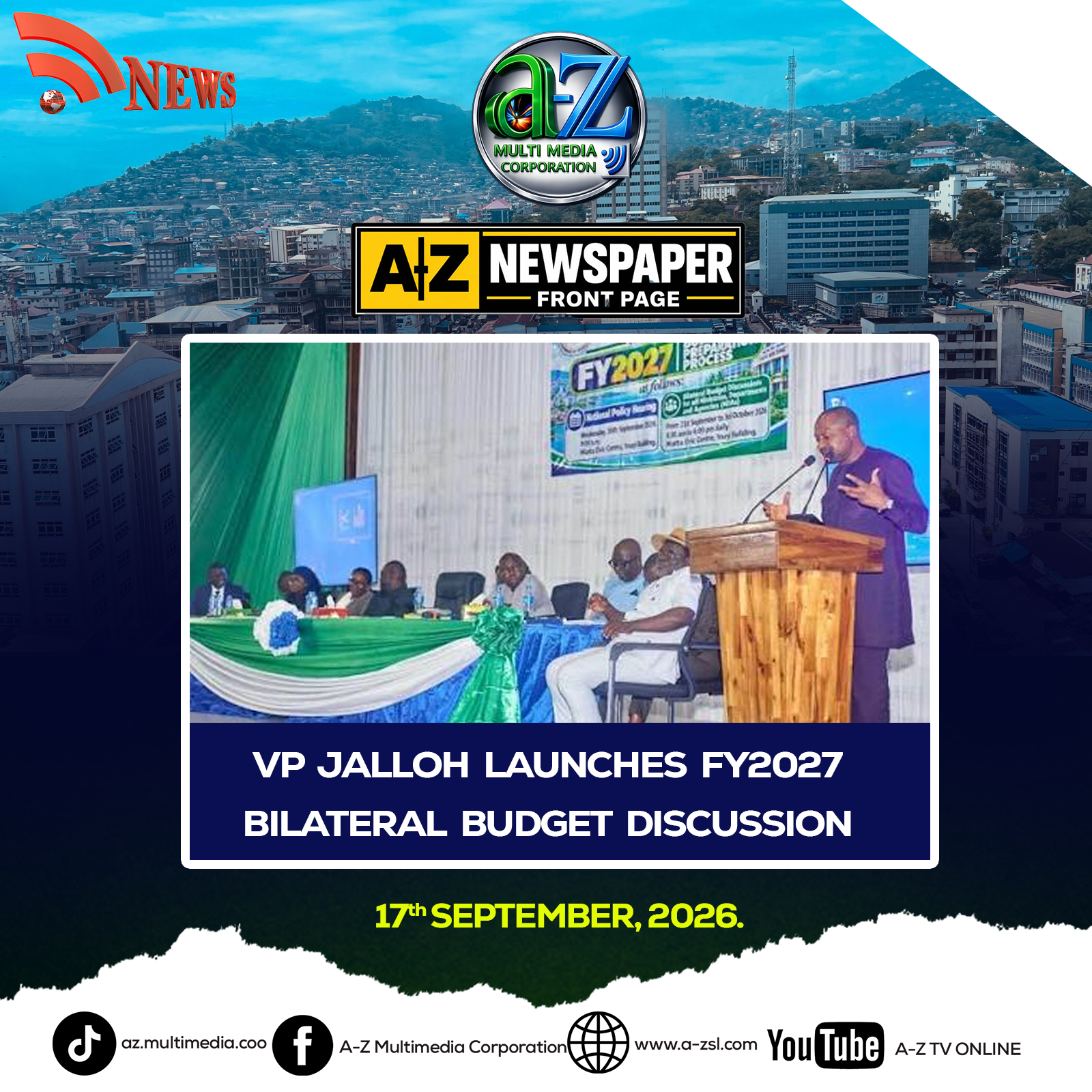
Vice President Dr. Mohamed Juldeh Jalloh has formally launched Sierra Leone’s Fiscal Year 2027 budget process, urging Ministries, Departments and Agencies (MDAs) to align public spending with national priorities while strengthening efforts to create jobs, expand private-sector growth and maintain fiscal discipline.
Dr. Jalloh made the call at the Miatta Civic Centre in Freetown during the FY2027 Budget Preparation and Hearing, held under the theme “Building Resilience to Create Jobs.”
He stressed that sustainable employment opportunities for Sierra Leone’s growing youth population cannot depend solely on government payroll, but must be supported by a vibrant private sector, sound policies, reliable infrastructure and investment-friendly reforms.
The Vice President underscored the importance of partnerships in achieving the country’s development objectives, acknowledging the contribution of international development partners to Sierra Leone’s economic and social development.
“Government cannot achieve this transformation alone. We therefore express our sincere appreciation to our development partners for the important role they continue to play in Sierra Leone’s development,” Dr Jalloh said.
He specifically highlighted the support of the International Monetary Fund (IMF), World Bank, African Development Bank (AfDB) and European Union (EU), describing the EU as a longstanding development partner.
Dr. Jalloh noted that development partners have supported infrastructure, social-sector programmes, institutional reforms and technical assistance, while increasingly directing support towards private-sector development, access to finance and improvements in the investment climate.
He maintained that such partnerships have also contributed to the implementation of Government’s flagship Big Five Game Changers, particularly through investments aimed at strengthening institutions and creating conditions for businesses to grow.
The Vice President outlined five principles to guide the FY2027 budget: realistic revenue and expenditure planning, prioritization of essential investments, public spending that facilitates economic growth, evidence-based tax policies and effective implementation.
He said budgetary allocations should translate into measurable results, including functioning classrooms, reliable electricity connections, productive roads and improved access to finance for viable enterprises.
Against the backdrop of global economic shocks and domestic fiscal pressures, Dr. Jalloh called for stronger fiscal discipline, improved resource mobilization and deeper collaboration between government and development partners.
“Our task is to use the resources available to us more intelligently, create space for the private sector to thrive, and ensure that public policy supports rather than constrains productive economic activity,” he concluded.
Minister of Finance Karefa AF Kargbo said improved macroeconomic conditions and progress in structural reforms contributed to the completion of the IMF’s third review under the Extended Credit Facility (ECF) in June 2026.
He disclosed that the review triggered a US$31.7 million disbursement for budget and balance-of-payments support, adding that discussions with the IMF are continuing ahead of a full review expected in December 2026.
Kargbo further noted that the IMF Executive Board had approved a Resilience and Sustainability Facility (RSF) arrangement for Sierra Leone valued at about US$211.45 million.
He explained that access to the resources is tied to the implementation of nine reforms during 2026 and 2027, covering public financial management, energy, agriculture, water resources, transport and environmental stewardship.
According to Kargbo, the reforms are designed to integrate climate priorities into the country’s fiscal framework, improve transparency and strengthen Sierra Leone’s resilience to climate change and other long-term structural challenges.
The Finance Minister urged institutions responsible for implementing the IMF-related reforms to treat them as priorities and include the associated costs in their 2027 budget submissions.
Kargbo also pointed to the contribution of development partners, including the World Bank, EU and AfDB, in providing budget support. He explained that such assistance helps government finance national priorities and maintain macroeconomic stability, but is linked to agreed policy reforms, performance indicators and prior actions.
For the FY2027 budget, Kargbo said government would seek to maintain a balance between recurrent and capital expenditure, while urging budgetary agencies to prepare realistic annual and multi-year budgets within approved ceilings.
He identified financial inclusion, increased access to finance for women-led micro and small enterprises, private investment in cocoa, rice and other value chains, and the promotion of climate-smart technologies among key priorities.
The Minister also listed human capital development, entrepreneurship, domestic revenue mobilization, improved mining revenue governance, healthcare and education financing, the 2026 Population and Housing Census, constitutional review and electoral reforms as areas requiring government attention.
Kargbo stressed that increasing domestic revenue mobilization remains critical, noting that Sierra Leone’s revenue-to-GDP ratio is among the lowest in Africa.
He argued that stronger domestic revenue collection is necessary to finance infrastructure, healthcare, education and social services, particularly as overseas development assistance faces increasing constraints.
Minister Koroma emphasized the need for coordinated government action and strategic partnerships to address employment challenges and expand sustainable livelihood opportunities.
He identified digitalization, increased financial support for small-scale entrepreneurs and effective implementation of government policies within the private sector as key priorities.
The Minister also stressed the importance of skills development and workforce preparedness, urging citizens to acquire relevant technical and professional skills to remain competitive in an evolving labour market.
He said his Ministry would continue working with other government institutions and strategic partners to promote inclusive employment opportunities, support entrepreneurship and improve citizens’ livelihoods in line with the Government’s human capital development agenda.
Minister of Trade and Industry Ibrahim Alpha Sesay highlighted economic diversification as a key strategy for creating sustainable employment and reducing Sierra Leone’s dependence on the primary sector.
Mr. Sesay said consistent investment in productive sectors is necessary to generate decent jobs and strengthen the country’s economic foundation.
He explained that government is promoting domestic and international trade by creating an enabling environment for businesses and investors, while placing greater emphasis on local manufacturing and agriculture.
According to Sesay, the approach is intended to increase domestic production, encourage local consumption and expand Sierra Leone’s capacity to export.
The Trade Minister stressed the need for a coordinated approach to developing sectors including mining, fisheries and tourism, noting that collaboration among ministries and relevant institutions is essential to maximize their contribution to economic growth and employment.
He further disclosed that the Ministry continues to advocate fiscal incentives to attract local and international investors, particularly amid increasing global competition for investment.
Sesay said the Ministry would continue working with the Ministry of Finance and other institutions to strengthen productive sectors expand trade and create meaningful employment opportunities for citizens.