

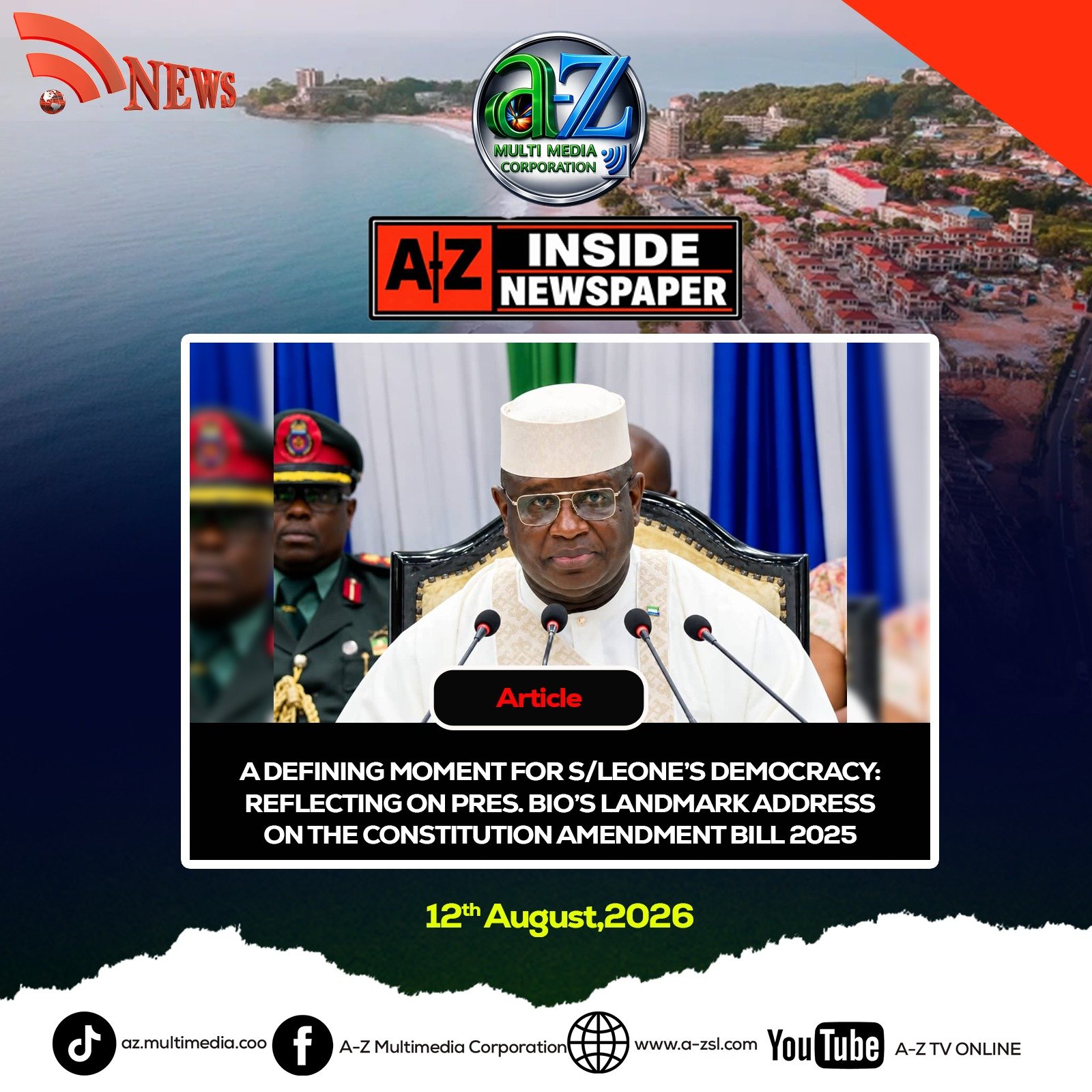
By: Alfred Kanu, Boston, Massachusetts, USA
Perhaps the most human moment in President Julius Maada Bio’s address came when he asked Parliament to consider how today’s decision would be viewed by generations yet unborn. “The decision before you will not end with the vote. It will be remembered by generations yet unborn,” he told lawmakers.
He challenged Members of Parliament to reflect on whether their daughters would inherit a Constitution that recognises their equal right to lead, whether young people would have a meaningful voice in national affairs, and whether citizens would continue to believe that Parliament could rise above political divisions in the interest of the nation.
For a country whose modern political history has been shaped by military coups, civil war, peace agreements, elections, and difficult democratic transitions, President Bio’s address to Parliament on Sunday, 9 August 2026, carried significance far beyond the immediate vote on the Constitution of Sierra Leone (Amendment) Bill 2025.
Speaking not only as President but also, in his own words, “as a fellow citizen who has journeyed with this nation through some of its darkest and most defining moments,” President Bio placed the proposed constitutional reforms within the broader context of Sierra Leone’s national experience over the past three decades.
In 1996, as head of the National Provisional Ruling Council (NPRC), then Brigadier Julius Maada Bio oversaw the return of the country to civilian rule after years of military governance. That transition paved the way for the election of the late Dr Ahmad Tejan Kabbah as President in March 1996.
However, the democratic progress was soon interrupted by another military coup in 1997. Sierra Leone later embarked on a difficult path toward peace, culminating in the signing of the Lomé Peace Agreement in July 1999 and the official end of the civil war in January 2002.
It was against this historical background that President Bio described the proposed constitutional amendment as “a historic piece of legislation that represents the culmination of decades of national dialogue.” He recalled that the Lomé Peace Agreement itself called for constitutional review as part of efforts to rebuild the country.
The Truth and Reconciliation Commission (TRC) report of 2004 further reinforced the need for constitutional reform, recommending a broad and inclusive process capable of strengthening democracy, accountability, and national unity.
The significance of the current moment, therefore, goes beyond amending sections of the 1991 Constitution. It represents a broader question about whether a nation that once struggled with violent transfers of power can continue to manage political change through institutions, dialogue, and the rule of law.
Sierra Leone’s democratic journey since the war has been remarkable, although not without challenges. The 2002 elections helped consolidate peace, while the 2007 elections marked the first peaceful transfer of presidential power from one political party to another after the civil conflict. In 2018, power changed hands again when Julius Maada Bio defeated the All People’s Congress (APC) candidate Dr Samura Kamara, succeeding President Ernest Bai Koroma.
However, the country’s democratic progress has also faced serious tests. Political tensions, disputed elections, violence, institutional mistrust, and growing ethno-regional divisions have continued to challenge national cohesion.
The 2023 presidential election, in which President Bio was declared winner with 56 per cent of the vote, reflected both the resilience and vulnerabilities of Sierra Leone’s democracy. While voter participation remained strong, international and domestic observers raised concerns about transparency in the electoral process and called for reforms to strengthen public confidence.
It is within this context that President Bio’s call for constitutional reform must be understood.
“We did not abandon that work, nor did we seek to begin the process anew,” he stated, referring to previous reform efforts, particularly the Justice Edmond Cowan Constitutional Review Committee, which conducted extensive nationwide consultations between 2013 and 2017.
That process involved thousands of citizens through public consultations, stakeholder engagements, written submissions, radio discussions, and nationwide outreach programmes, making it one of the most extensive constitutional review exercises in Sierra Leone’s history.
The proposed reforms include provisions for proportional representation and a constitutional requirement for a minimum of 30 per cent women’s representation in political nominations. These proposals carry particular significance in a country where women have historically been underrepresented in political leadership.
President Bio’s most powerful appeal was his call for lawmakers to look beyond immediate political interests and consider the long-term future of Sierra Leone.
“Do not vote for me. Do not vote for this Government. Do not vote for any political party. Vote for Sierra Leone,” he urged Parliament.
That appeal, however, should not be interpreted as a demand for unquestioning acceptance of every provision in the Bill. Constitutional reform is too important to escape scrutiny. Civil society organisations, legal experts, and human rights institutions have continued to examine and debate the proposed changes.
The Human Rights Commission of Sierra Leone, for example, submitted recommendations to Parliament in July 2026 focusing on electoral justice, inclusion, the rule of law, and human rights protections.
President Bio also acknowledged that constitutional reform requires more than changing legal provisions. It requires Parliament to protect the spirit of the Constitution, strengthen its implementation, and ensure that it continues to serve the people.
The broader lesson from this historic moment is that Sierra Leone’s democratic journey remains unfinished. A generation that experienced military rule, conflict, and political uncertainty has also witnessed peaceful transitions of power, stronger institutions, increased public participation, and greater recognition of women’s role in governance.
The generation coming of age today deserves an even stronger democracy — one built on inclusion, accountability, fairness, and trust.
If Parliament’s decision-making process reflects honesty, national interest, and a willingness to place country above party, this moment may be remembered not merely as another constitutional amendment, but as another important milestone in Sierra Leone’s long journey from political instability toward democratic confidence.
As President Bio concluded: “May history record that, at this critical hour, Parliament chose country over division, progress over stagnation, and a stronger democracy for generations to come.”