

By: Aminata Sesay
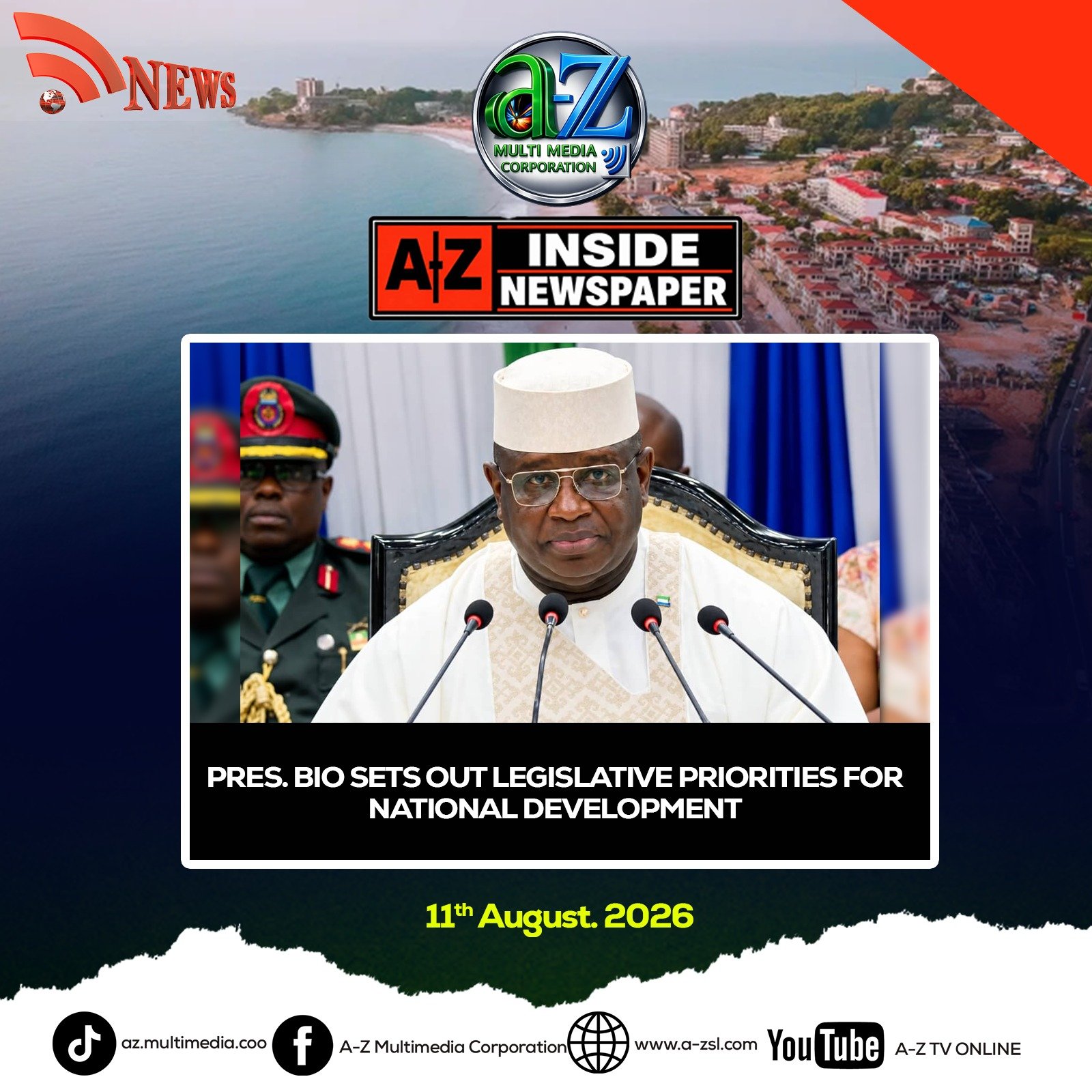
The Fourth Session of the Sixth Parliament of the Second Republic of Sierra Leone was officially opened on Friday, 7 August 2026, with President Julius Maada Bio delivering the State Opening Address and outlining the Government’s legislative agenda, development priorities, and commitments for the year ahead.
The State Opening, held in the Chamber of Parliament at Tower Hill, marked the commencement of a new parliamentary session and provided President Bio an opportunity to highlight progress achieved, acknowledge outstanding challenges, and set out the key priorities expected to guide the work of Government and Parliament in the coming year.
President Bio placed Parliament’s constitutional responsibilities at the centre of his address, reminding Members of Parliament that the House has a duty to enact laws, hold the Executive accountable, and debate issues affecting the direction of the Republic.
He welcomed the return of Members of the main opposition All People’s Congress (APC), noting that a strong democracy requires both an effective Government and responsible opposition. The President called for constructive engagement, responsible disagreement, and cooperation where possible, urging all political actors to place national interests above partisan considerations.
President Bio said the Fourth Session would provide the legislative foundation for Government’s priorities, including economic growth, local enterprise development, public resource management, justice and national security, environmental protection, land governance, extractive industries, social protection, and public administration reforms.
He urged Members of Parliament to carefully scrutinise proposed legislation to ensure that laws respond to citizens’ needs, are practical to implement, and contribute to improving the lives of Sierra Leoneans.
Addressing the economy, President Bio reported that real Gross Domestic Product (GDP) grew by 4.6 per cent in 2024 and 4.8 per cent in 2025. He noted that inflation declined to 4.4 per cent by December 2025 before rising to 10.8 per cent in April 2026 due to increased global oil prices.
He said domestic revenue collection improved from NLe14.6 billion to NLe18 billion, while public debt declined from 50.8 per cent to 49.3 per cent of GDP.
However, the President acknowledged that economic achievements must translate into tangible benefits for citizens through reduced living costs, stronger businesses, increased employment opportunities, and improved public services.
Under the Government’s Feed Salone initiative, President Bio reported significant progress in agricultural production, noting that rice production reached 1.44 million metric tonnes in 2025.
He said rice self-sufficiency increased from 68 per cent in 2023 to 73 per cent in 2025, while the country’s rice import bill declined from USD177 million in 2022 to USD159 million.
The President added that Government is supporting the cultivation of 21,810 hectares of priority crops in 2026 and has mobilised more than USD45 million to promote agribusiness development.
He stressed that the success of Feed Salone would ultimately be measured by improved incomes for farmers, affordable food prices, and Sierra Leone’s ability to feed itself.
On human capital development, President Bio highlighted Government’s expansion of school feeding programmes, which now benefit 1,016,191 pupils across 4,034 schools.
He also reported that more than 108,000 out-of-school children have been identified for support, while thousands of teachers have received training.
The President expressed concern over examination malpractice and warned that any public official, teacher, parent, or student involved in such practices would face legal consequences.
In the health sector, he cited progress in reducing maternal mortality from 1,200 deaths per 100,000 live births in 2013 to 354 in 2023.
He also noted that more than 1.76 million children have been vaccinated against measles, rubella, and polio, while HPV vaccination coverage among girls aged 11 to 18 has reached 99 per cent.
President Bio further highlighted the expansion of the Kono Maternal Centre of Excellence, the acquisition of new CT scanners, and the deployment of 15 dialysis machines as part of efforts to strengthen healthcare delivery.
Youth employment remained a key priority in the President’s address. He recalled Government’s target of creating 500,000 jobs within five years and announced that verified cumulative employment figures would soon be published.
He said the Productive Social Safety Nets and Youth Employment Project is supporting 8,000 youth-led enterprises, while Government continues to expand technical and vocational education, apprenticeships, digital skills training, and partnerships with employers.
On infrastructure development, President Bio stated that 474.46 kilometres of roads have been paved and 23 bridges constructed or rehabilitated between 2018 and 2026.
He also highlighted the USD2.2 billion Mission 300 Energy Compact, which aims to increase electricity access from 36 per cent in 2024 to nearly 80 per cent by 2030 and connect at least 720,000 additional households.
President Bio outlined reforms aimed at improving efficiency, transparency, and accountability across Government institutions.
He said Ministries, Departments and Agencies (MDAs) would be assessed against measurable performance targets, with reports published, delays explained, and corrective measures taken where necessary.
Government, he added, is reviewing key laws including the Public Financial Management Act, Public Debt Management Act, and Public Procurement Act to strengthen governance and accountability.
He also announced the establishment of a Technical Committee, chaired by the Vice President, to review a proposal to increase Paramount Chief representation in Parliament from one to two representatives per district.
On extractive industries, President Bio disclosed that Government had concluded negotiations with Marginal Energy Limited on a Petroleum Licence Agreement involving a minimum investment commitment of USD225 million over seven years, subject to Parliamentary approval.
He reported that mineral exports reached USD1.3 billion in 2025, while the mining sector created 15,543 formal jobs, with more than 92 per cent of those positions held by Sierra Leoneans.
The President said Government would continue reforms aimed at promoting local processing, improving revenue mobilisation, and ensuring that mining communities benefit more from the country’s natural resources.
President Bio also addressed climate change, environmental protection, justice, national security, electoral reform, and democratic governance.
He called for stronger action against illegal logging, improved disaster preparedness, and better urban planning as Sierra Leone continues to face challenges linked to flooding, erosion, and other climate-related risks.
On national cohesion, the President urged Government institutions, political parties, traditional leaders, religious authorities, civil society, and the media to promote tolerance, dialogue, and responsible citizenship.
He also acknowledged the discontinuation of criminal proceedings against former President Ernest Bai Koroma, expressing hope that the development would contribute to reducing political tensions, reconciliation, and national healing.
Concluding his address, President Bio urged Members of Parliament to remain connected with their constituencies, listen to citizens’ concerns, and ensure that national priorities are reflected in legislative decisions.
He reminded Parliament that the Executive, Legislature, and Judiciary have separate constitutional responsibilities but must work together while respecting the principle of separation of powers.
The President said the success of the Fourth Session should not be measured by the number of policies announced, but by completed projects, stronger institutions, and improvements that citizens can directly experience.
He identified key priorities before the next State Opening as increasing food production, expanding access to electricity and clean water, improving roads and bridges, strengthening healthcare and education, creating employment opportunities for young people and women, and building a stronger economy capable of improving living standards.
President Bio called on Parliament to make the Fourth Session a period remembered for effective lawmaking, responsible oversight, and decisions that advance the wellbeing of all Sierra Leoneans.