

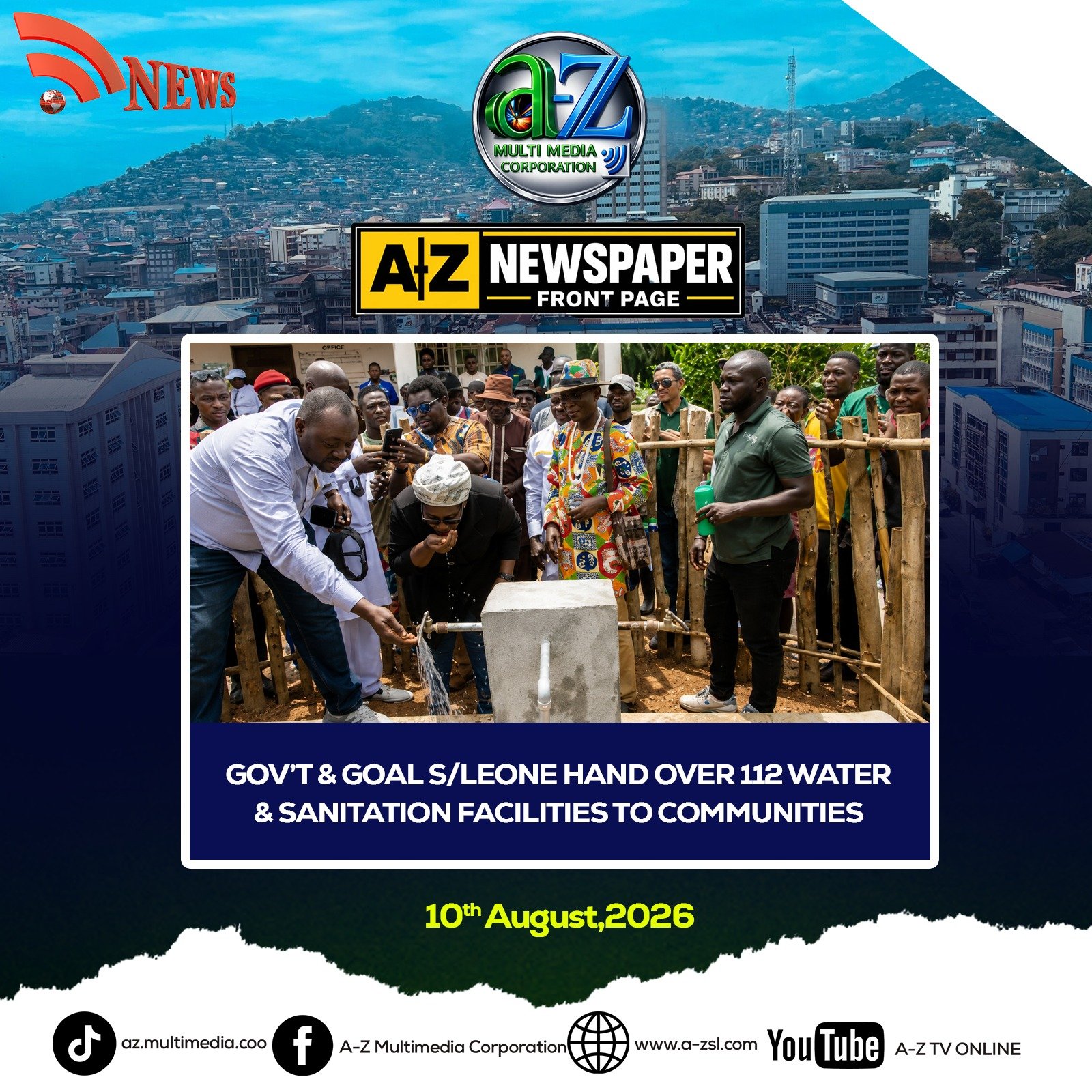
The Government of Sierra Leone, through the Ministry of Water Resources and Sanitation, in partnership with GOAL Sierra Leone and with support from Charity: Water, has handed over 112 water and sanitation facilities to communities, schools, and health centres in Moyamba and Kenema Districts on 8th August 2026
, in an intervention expected to benefit approximately 35,000 people.
The project, implemented over a 12-month period, delivered 42 water points in Moyamba District in the Southern Region and 70 in Kenema District in the Eastern Region. The facilities include boreholes, hand-dug wells, solar-powered water reticulation systems, and sanitation infrastructure aimed at improving access to safe water and hygiene services.
The intervention also provided nine toilet blocks for three Peripheral Health Units and three schools, as well as five solar-powered water systems supplying piped water to selected institutions.
The investment comes at a time when Sierra Leone continues to face significant challenges in the water, sanitation, and hygiene (WASH) sector. According to UNICEF’s WASH National Outcome Routine Mapping exercise, only 62.6 percent of the country’s population has access to basic water services, while basic sanitation coverage remains low, with open defecation still practised by a significant proportion of the population.
Although access to basic drinking water in rural Sierra Leone has improved over the years, rising from 38.2 percent in 2010 to 54 percent in 2022, many rural communities continue to experience challenges caused by limited infrastructure and unequal access.
Speaking at the handover ceremony, the Minister of Water Resources and Sanitation, Dr. Sao-Kpato Hannah Isatta Macarthy, acknowledged that government alone cannot address the country’s WASH challenges and called for stronger partnerships among ministries, local councils, traditional authorities, development partners, civil society organisations, and communities.
“Government cannot tackle the country’s WASH challenges alone,” she stated, stressing the importance of collective action in expanding access to safe water and sanitation.
The Minister described water as more than a basic household necessity, highlighting its role in agriculture, food production, and small-scale businesses. She also noted that improved water access would reduce the burden on women and girls, who often spend considerable time fetching water for their families.
The project builds on GOAL Sierra Leone’s long-standing commitment to improving WASH services across the country. The organisation, which has operated in Sierra Leone since 1999, has implemented several WASH programmes, reaching hundreds of thousands of people nationwide.
GOAL Sierra Leone Country Director, James Rialc Mathians, described the handover as a significant milestone in the organisation’s WASH programme, noting that its interventions in Kenema began in 2018 and have expanded across all 16 chiefdoms in the district.
GOAL Programme Director Getu Debella explained that the project was designed not only to provide infrastructure but also to strengthen community ownership and long-term sustainability.
“The project was designed to combine infrastructure development with sustainable behaviour change,” Debella said.
He noted that Water Management Committees, school and health facility management committees were established and trained to oversee the facilities, while pump mechanics and community technicians received technical training to maintain and repair the systems.
The programme also introduced Village Savings and Lending Associations to strengthen community financial resilience and support the operation and maintenance of water facilities. In addition, Community-Led Total Sanitation and Community-Led Action activities were implemented in 69 communities, with 30 communities achieving Open Defecation-Free status.
Through a sanitation-marketing pilot, 10 private businesses were engaged, while trained local masons were supported to provide affordable sanitation solutions to households. The approach reflects a broader effort to ensure that WASH services remain sustainable through community ownership, behaviour change, and resilient infrastructure.
Stakeholders at the ceremony emphasized that the sustainability of the newly handed-over facilities would depend largely on the commitment of beneficiaries and local institutions.
Chairman of the Southern Regional Council of Paramount Chiefs, PC Fayia S.B. Sovula, urged communities to take responsibility for protecting and maintaining the facilities, reminding them that development partners would not remain indefinitely.
“Development partners will not remain permanently,” he cautioned, encouraging communities to build the capacity needed to manage and sustain the investments.
The handover therefore places shared responsibility on government institutions, local councils, traditional leaders, Water Management Committees, schools, health facilities, and community members to protect the facilities and ensure that improved access to safe water and sanitation contributes to better health outcomes, education, livelihoods, dignity, and resilience.
The intervention represents another important step towards closing Sierra Leone’s WASH gaps and ensuring that more citizens, especially those in rural communities, have access to safe and reliable water and sanitation services.