

By: Aminata Sesay
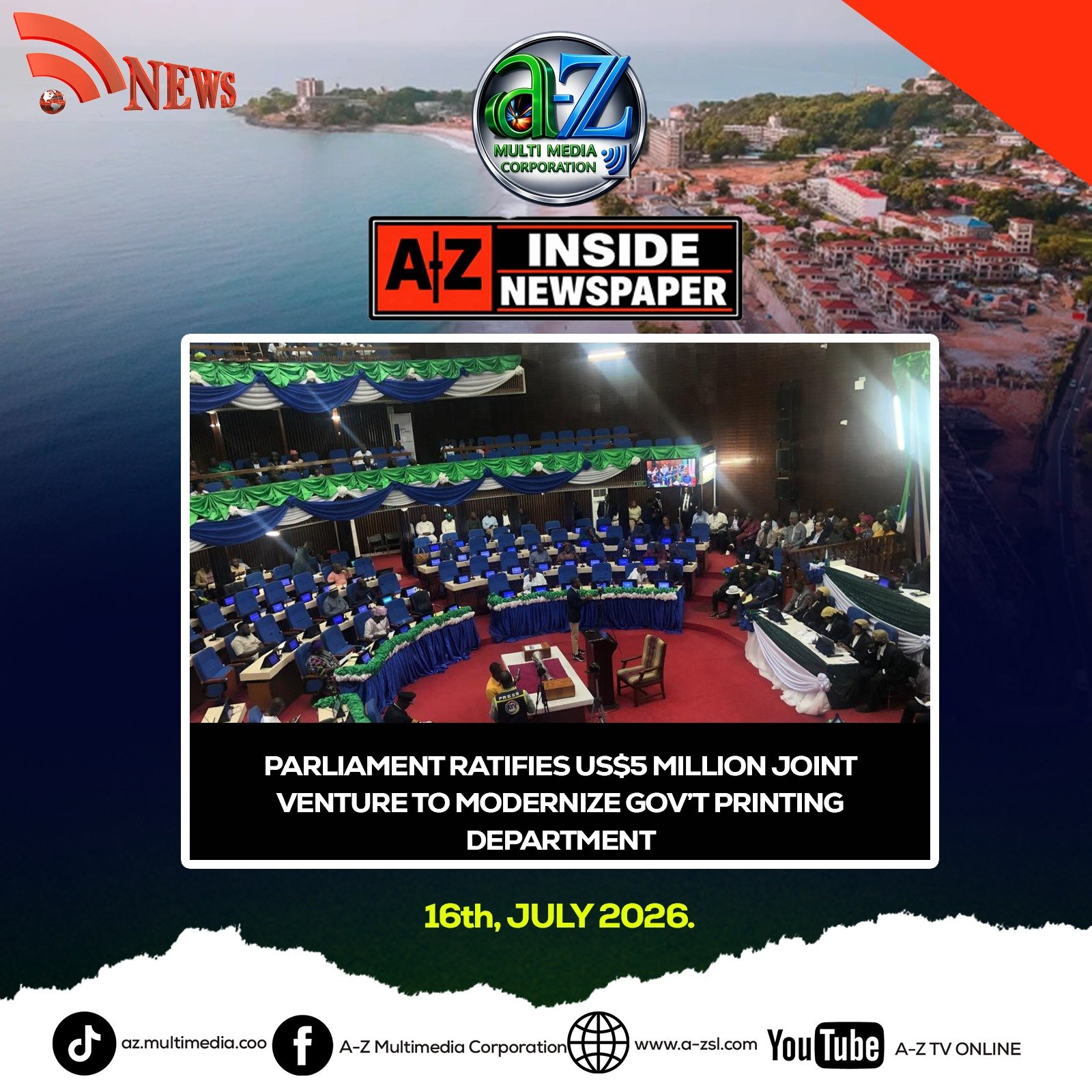
Parliament has ratified a Joint Venture Agreement between the Ministry of Information and Civic Education and Jimmy Nimu Printing Group, paving the way for a US$5 million investment to modernize Sierra Leone’s Government Printing Department after years of operational decline.
Presenting the agreement before Parliament on Tuesday, the Minister of Information and Civic Education, Chernoh Bah, said the investment will finance the rehabilitation of the Government Printing Department, the installation of modern digital and offset printing equipment, technology transfer, and the training of local personnel.
Minister Bah emphasized that the Government will not make any direct financial contribution to the project. Instead, it will provide its existing assets, including land, buildings, and technical expertise, as its equity contribution.
He informed Members of Parliament that the Government had successfully negotiated its equity stake from an initial proposal of 15 percent to 30 percent, leaving the investor with a 70 percent share in the joint venture. He stressed that the arrangement is not a privatization but a partnership, assuring lawmakers that ownership of all Government assets will remain with the State throughout the agreement.
According to the Minister, the agreement provides that, upon the expiration of the 10-year partnership, all facilities, equipment, and associated assets will revert fully to the Government of Sierra Leone.
Minister Bah also assured Parliament that the printing of sensitive Government documents would remain under strict Government control through the department’s existing security protocols. He added that the upgraded facility would generate revenue by providing both Government and commercial printing services, thereby reducing dependence on foreign printing companies.
Supporting the agreement, the Chairperson of the Parliamentary Committee on Information and Civic Education, Hon. Rosay Kanu, described the Government Printing Department as one of Sierra Leone’s oldest public institutions, noting that the project would transform it into a modern production centre capable of printing newspapers, books, educational materials, brochures, flyers, security documents, and other commercial publications.
She said the investment would significantly reduce Government expenditure on outsourced printing services, create employment opportunities, and strengthen local technical capacity through continuous training of Sierra Leonean staff alongside experienced Chinese technicians.
Hon. Kanu also encouraged Members of Parliament to visit the facility, describing it as one of the most advanced government-owned printing centres in the sub-region.
Despite supporting the initiative, several opposition Members of Parliament raised concerns over certain provisions of the agreement.
Deputy Opposition Leader II, Hon. Aaron Aruna Koroma, questioned the absence of a clearly defined commencement date for the project and sought clarification on how the 70–30 ownership structure was determined. He also asked whether an independent valuation of Government assets had been conducted before the equity distribution was agreed upon.
Additionally, Hon. Koroma expressed concern that the tax incentives granted to the investor could place existing private printing businesses at a competitive disadvantage.
Opposition Leader Hon. Abdul Kargbo welcomed the investment but emphasized the importance of ensuring that the promised technology transfer leads to meaningful skills development for Sierra Leoneans. He urged the Government to ensure that local professionals acquire sufficient expertise to independently manage the facility in the future.
He also called on Parliament’s Labour Committee to closely monitor the implementation of the agreement to ensure that commitments relating to skills transfer, employment creation, and capacity building are fully honoured.
Following extensive debate, Parliament unanimously ratified the Joint Venture Agreement, clearing the way for the implementation of the US$5 million project, which is expected to transform the Government Printing Department into a modern, efficient, and revenue-generating national institution while strengthening Sierra Leone’s printing industry.