

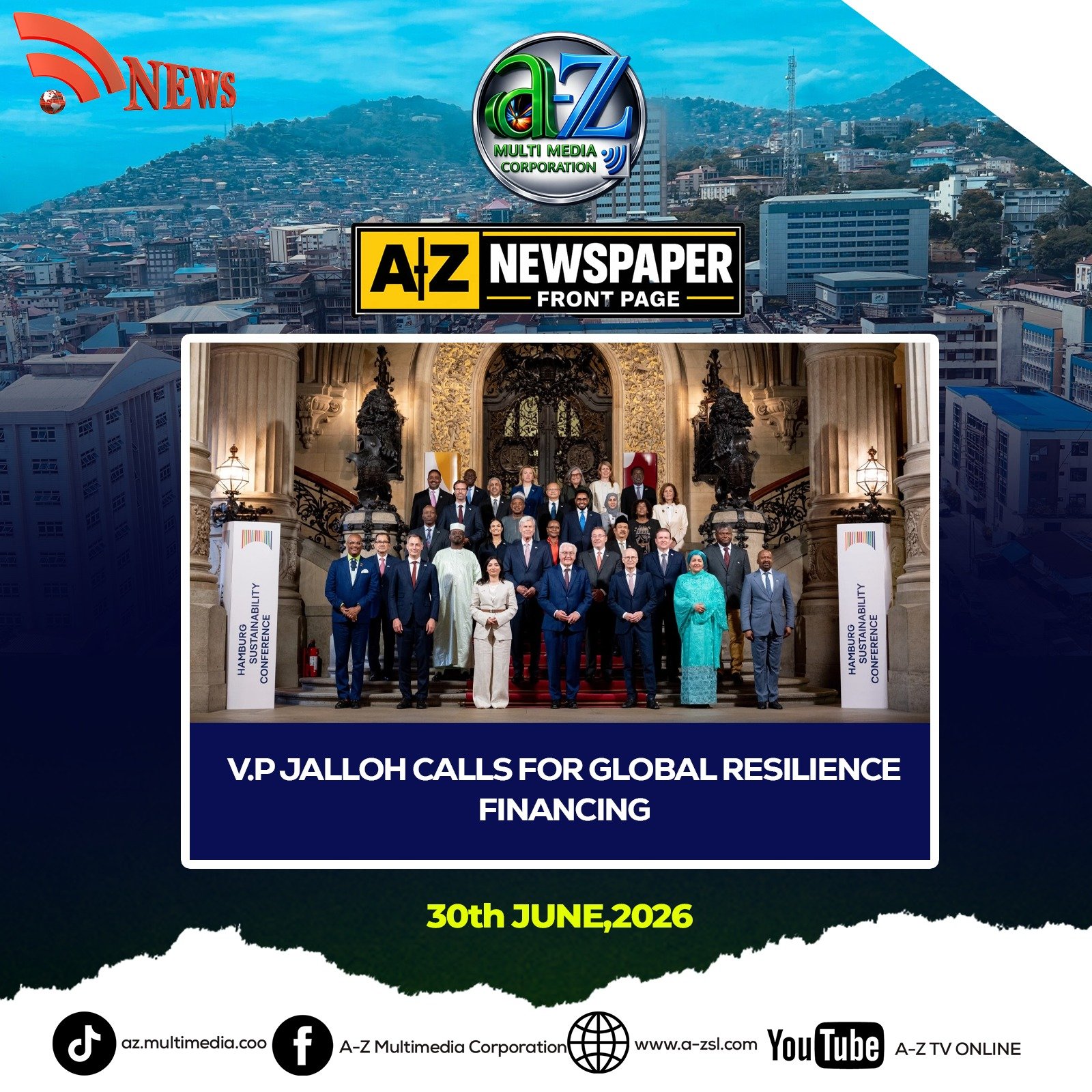
Vice President, Dr. Mohamed Juldeh Jalloh, joined world leaders, senior government officials, and heads of international financial institutions at the Hamburg Sustainability Conference (HSC) 2026, where he participated in a high-level panel discussion titled, “Navigating the Hormuz Crisis: Forging a Collective Response” in Hamburg, Germany on 29 June 2026.
The session followed a keynote address by United Nations Deputy Secretary-General Amina J. Mohammed and featured Germany’s Federal Minister for Economic Cooperation and Development, Reem Alabali-Radovan; United Nations Development Programme (UNDP) Administrator Alexander De Croo; the United Kingdom’s Minister of State for International Development and Africa, Baroness Jennifer Chapman; and the President of the African Development Bank Group, Dr. Sidi Ould Tah.
The conference also brought together prominent global leaders, including German President Frank-Walter Steinmeier, World Trade Organization Director-General Dr. Ngozi Okonjo-Iweala, Asian Development Bank President Masato Kanda, and representatives from governments, multilateral institutions, and the private sector to discuss solutions to today’s most pressing global challenges.
During the panel discussion, Vice President Juldeh Jalloh highlighted the disproportionate impact of geopolitical tensions on developing economies, stating:
“For the Global South, an oil shock is never just an oil shock. It becomes a food shock, a fiscal shock, and ultimately a human development shock.”
Drawing on Sierra Leone’s experience as a small, import-dependent economy, the Vice President explained that disruptions to strategic shipping routes, such as the Strait of Hormuz, quickly lead to rising costs of fuel, food, fertilizer, electricity, and transportation, placing additional pressure on already constrained national budgets.
Reflecting on his previous service with the United Nations as a governance and security expert for West Africa and the Sahel, Vice President Juldeh Jalloh urged the international community to recognize food and energy security as fundamental pillars of global resilience. He called on multilateral development banks, including the African Development Bank and the World Bank, to establish a Global South Shock Absorption Facility that would provide rapid and flexible financing to countries affected by geopolitical and supply chain disruptions.
Drawing on his experience leading Sierra Leone’s socio-economic and growth initiatives, the Vice President emphasized that vulnerable economies need financing mechanisms capable of responding to crises before they escalate. He argued that the international community should “shift from financing recovery after crises to financing resilience before they occur.”
His intervention reinforced growing calls for stronger international cooperation and more responsive development financing to help protect low-income countries from external shocks beyond their control.