

By: Madina Kula Sheriff
The first time 25-year-old Thaimu Brima began coughing persistently, he thought it was exhaustion.
A student and footballer in Bo District, Southern Region, he was accustomed to long hours of running and other physical execises. So when persistent coughing, night sweats started in early 2024, he assumed it was something ordinary.
“I thought it was just a cold,” he recalled. “My parents also believed it was a cold, because I liked drinking cold beverages and bathing with cold water.”
For weeks, he relied on medicines purchased from a pharmacy without undergoing any medical tests. Like many Sierra Leoneans, he made the pharmacy his first visiting point, because for him it was cheaper, quicker, and easier to access than a hospital.
But instead of improving, his condition worsened.
Thaimu said eventually, his family took him to the Bo Government Hospital. He noted that after a series of tests, doctors confirmed that what had seemed like a stubborn cold was tuberculosis (TB).
“I was shocked”, he said quietly. “I never thought it could be TB.”
Thaimu’s experience reflects a broader public health challenge unfolding in Sierra Leone, which is delayed health seeking behaviour which health workers say contribute to complicate the efforts in the fight against tuberculosis.
25-year-old Thaimu Brima at Bo District, Southern Region
Sierra Leone is among the 30 countries with the highest number of tuberculosis cases in the world. According to the country’s 2024- 2030 Medium Term National Development Plan, an estimated 24,000 TB cases are reported annually, while the disease remains the sixth leading cause of premature death among top ten causes of mortality in the country.
The Director of Disease Prevention and Control at the Ministry of Health, Dr. Sulaiman Lakkoh, said Sierra Leone currently has an estimated TB burden of 372 cases per 100,000 people, compared with the World Health Organization’s estimate of 289 per 100,000 people in 2021.
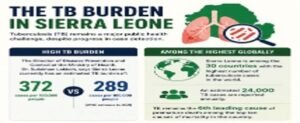
Infographics credit: Benjamin Tenkorang
For Ya-Marie Kamara, an elderly woman living in Makeni, Northern Region of Sierra Leone, the journey to diagnosis followed a very different path. Her symptoms started in 2023.
“I started coughing continuously and losing weight. At night, I was sweating a lot, I thought it was because of the work I do and the weather,” she said.
As her condition worsened and the weight loss became more noticeable, she said neighbours began making assumptions about her illness and calling her names.
“Some people said I was a witch because of how I looked”, she stated almost in tears. “That really stayed in my mind, and I isolated myself from everyone.”
Rather than seeking medical care immediately at the hospital, Ya Marie initially relied on local herbal remedies at home, hoping the illness would pass.
But it did not. “I can still remember the day the coughing became too much and I started coughing out blood. I called my children and they immediately took me to Mabenteh hospital where I was diagnosed with tuberculosis” she said.
For Ya-Marie diagnosis brought another form of suffering, which is stigma.
“People stopped eating the food I shared. They said they did not want ‘dry cough’,” she explained, using a local stigmatized term often associated TB.
She said that really shocked her, because she has never disclosed her diagnosis publicly.
“I think some people might have seen me going to the treatment centre,” she added.
Ya-Marie Kamara, at Makeni, Northern Region
What causes the delay?
Although TB case detection has improved over the years, challenges remain. According to the
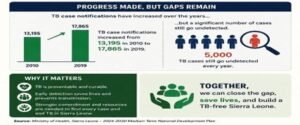
Sierra Leone’s 2024-2030 Medium Term National Development Plan, TB case notifications increased from 13,195 in 2010 to 17,865 in 2019, but the plan noted that 5,000 TB cases still go undetected each year.
Infographics credit: Benjamin Tenkorang
Health workers say delayed diagnosis remains a major factor.
Elizabeth Ngevao, a Nurse at Bo government Hospital who oversees TB patients on medications, said misunderstanding of symptoms and self-medication are often the first barriers to timely diagnosis.
“Before they know what it is, many go to pharmacies for malaria or typhoid drugs, avoiding the hospital to do proper checkups” Ngevao said.
She added that misconception about TB also influences where people people seek care.
“In villages, many people think TB is witchcraft. In Mende (a local dialect spoken in Sierra Leone), they call it ‘bio-lo-eh’,” she said, adding that this causes some to first seek treatment from herbalists, while others combine hospital prescribed medication with herbal concoctions.
“Out of every ten patients that come for treatment to the hospital, three have first pursued traditional treatment before coming to the hospital,” Ngevao said.
Such delays, she noted, can worsen patients’ conditions and increase risk of complication.
Research conducted across West Africa suggests that cultural beliefs can influence where people first seek care, particularly when symptoms are misunderstood. Studies published through the U.S National Institute of Health and PubMed Central, also suggest that delayed diagnosis is often linked to a combination of social, cultural and health-system barriers.
However, health officials insist that the problem is not simply a lack of services.
Dr. Sulaiman Lakkoh, the Director of Disease Prevention and Control at the Ministry of Health, said Sierra Leone has expanded access to TB detection through mobile screening and community-based services.
He attributes social and other barriers as the key factors contributing to delayed diagnosis.
“Some people assume they will have to pay at hospital for tests, which is not the case. Others seek care from pharmacies, dispensaries, or unqualified providers, or even health workers who prioritise money and receive injections or tablets without proper diagnosis” he explained.
He also cited social barriers including the need for spousal or parental consent, as well as persistent stigma surrounding the disease often discourage many people from seeking, testing or learning their TB status.
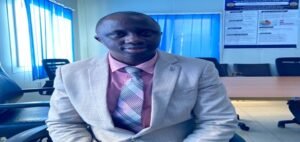
Dr. Sulaiman Lakkoh, the Director of Disease Prevention and Control at the Ministry of Health
Civil society activists argue that access to health centres also remains uneven.
During a radio engagement, the Program Manager of the Civil Society Management Against Tuberculosis, Mohamed Samura, noted that currently only 239 out of Sierra Leone’s 1,633 healthcare facilities currently provide for TB testing and treatment.
He said limited access to TB services remains a challenge, particularly for people living far from treatment centres.
A 2023 Report by STOP TB Partnership points to similar service gaps. The report notes that out of the 1500 health facilities and 1284 PHU in Sierra Leone, there are only 186 Directly Observed Treatement Short-course centres, 1 National Reference Laboratory and 3 Multi-drug-resistant TB treatment facilities.
For Thaimu in Bo, delayed diagnosis came at a high cost beyond his own illness.
He disclosed that a few weeks after he started his treatment, his younger sister began coughing and fell seriously ill.
“She got the illness because of me,” Thaimu said, his voice breaking. “I can still remember how sad I felt when I was told she had gotten the infection from me.”
Fortunately, his sister recovered after early diagnosis and consistent medication. Thaimu’s own condition, however, became more severe. He later developed multidrug-resistant tuberculosis (MDR-TB).
He said health workers informed him that the delayed diagnosis and inconsistency in taking his medication contributed to the development of multidrug-resistant tuberculosis.
Studies from the National Library of Medicines suggest that delayed diagnosis can worsen the disease outcome, increase transmission rates, and contribute to MDR-TB.
For months, Thaimu was admitted to the MDR treatment centre at Lakka Hospital on the outskirts of Freetown, capital of Sierra Leone. But this came with a cost. He lost his business partnership and stopped playing football.
“When they told me I had to leave Bo where my family and I stay, that was the hardest part. I cried a lot,” he said.
The Emotional Burden of Tuberculosis
For many survivors TB is not only a physical illness, but also emotional, and social burden.
Yatta Brima, Thaimu’s sister, sought treatment as soon as she noticed symptoms because of what had happened to her brother.
believe they took me to the hospital quickly because of my brother. They did not want to delay like before,” Yatta said.
Yet treatment was not easy.
“Every morning when I woke up, so many things went through my mind, and I doubted whether I could recover,” she said.
she recalled being mocked because of her illness. “My half-sister called me demeaning names, and even sang songs about TB to mock my condition,” Yatta added
Ngevao, the nurse at Bo Government Hospital, said stigma remains one of the most significant but least visible barriers affecting the emotional well-being and treatment of TB patients.
“We have seen family members abandon their relatives after learning they tested positive” she said, adding that even healthcare workers are not exempted. “Sometimes when we go to other departments, some nurses would say the TB Nurses are here, please give them way”.
Yatta Brima at Bo District, Southern Region
As Sierra Leone reviews its 2026-2030 National Tuberculosis Strategic Plan, health officials say that community-based detection and early diagnosis remain central priorities.
Dr. Lakkoh said that the Ministry’s goal is not only to detect more cases but to ensure patients complete treatment and recover fully.
But survivors believe tackling tuberculosis will require more than treatment available.
For Thaimu, awareness remains critical.
“I think the government needs to engage more communities and educate people about the disease. People need to know about the symptoms and why they should go to the hospital early,” he said.
Today he is slowly rebuilding his life. His passion for football remains at a pause, but he hopes to return to the field.
Thaimu wants people living with TB to believe that having the disease is not the end of life.
“Do not be afraid, Tuberculosis can be cured. You just need to know your condition early and start treatment,” he said.
Note: Thaimu Brima, Ya-Marie Kamara, and Yatta Brima names were changed because of the sensitivity of the story and they asked for anonymity.
This content received support from the Thomson Reuters Foundation as part of its global programme aiming to strengthen free, fair and informed societies. Any financial assistance or support provided to the journalist has no editorial influence. The content of this article belongs solely to the author and is not endorsed by or associated with the Thomson Reuters Foundation, Thomson Reuters, Reuters, nor any other affiliates.