

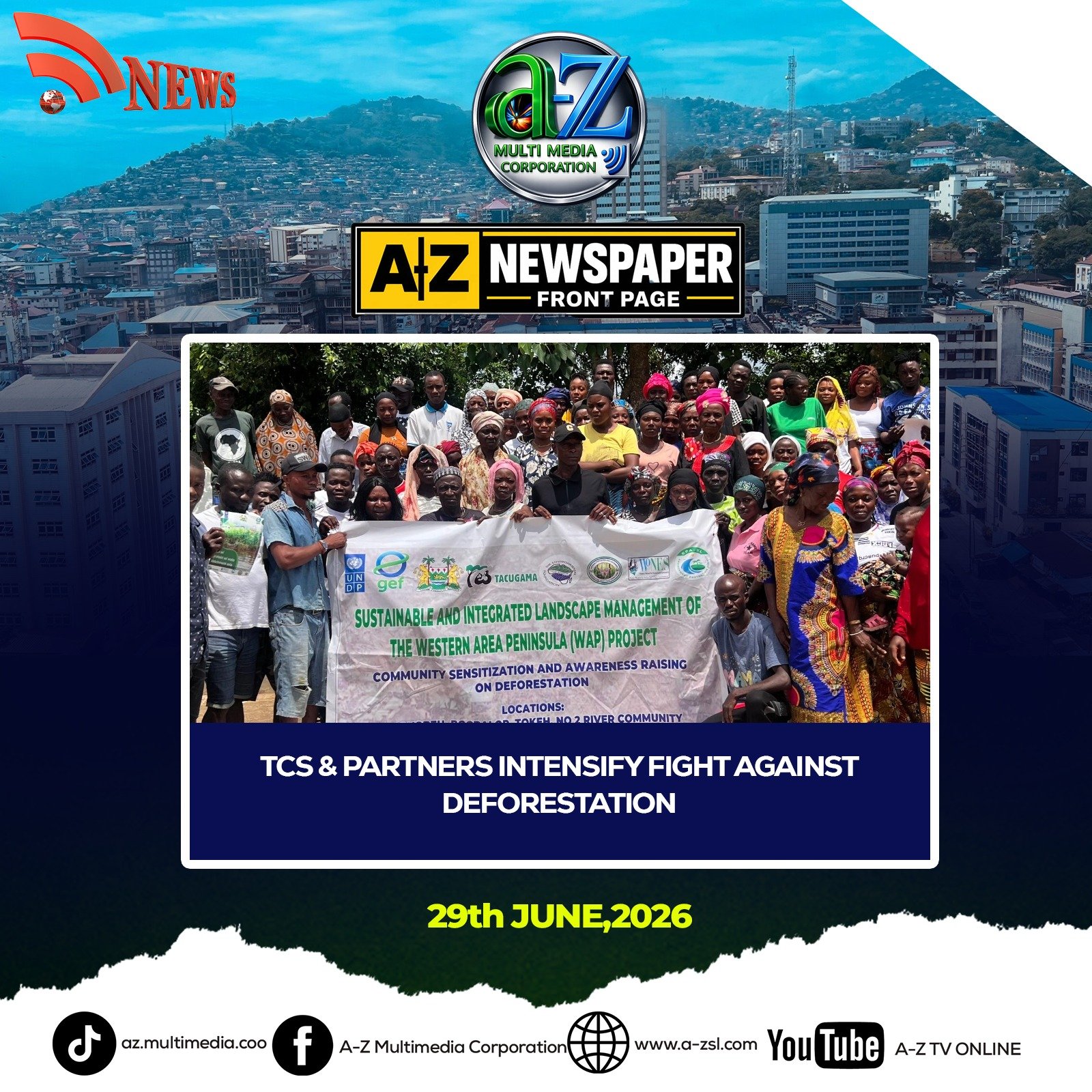
Tacugama Chimpanzee Sanctuary (TCS), with support from the Government of Sierra Leone, the United Nations Development Programme (UNDP), and the Global Environment Facility (GEF), on Saturday, 27 June 2026, concluded a four-day community sensitization and awareness campaign across eight communities within the Western Area Peninsula National Park.
The campaign forms part of the Sustainable and Integrated Landscape Management of the Western Area Peninsula (WAP) Project, which seeks to address the growing threat of deforestation and promote sustainable environmental management through active community participation.
Deforestation remains one of the most critical environmental challenges affecting the Western Area Peninsula National Park and its surrounding communities, many of whose livelihoods depend on forest resources. The park has experienced significant forest loss due to agricultural expansion, illegal logging, infrastructure development, stone mining, and charcoal production.
These activities have resulted in severe environmental consequences, including biodiversity loss, accelerated climate change, soil degradation, disruption of water cycles, and increasing threats to the livelihoods of indigenous and forest-dependent communities.
Eight communities namely; Markobeh, Robgelor, Tokeh, River Number Two, Sussex, Last Banking (Aberdeen), Bathurst, and Charlotte were selected for the awareness campaign because they have experienced significant deforestation in recent years.
Despite ongoing interventions by government institutions and environmental organizations, there remains a considerable gap in public awareness and community participation in forest conservation efforts. The four-day campaign therefore aimed to educate residents on the causes and impacts of deforestation while encouraging sustainable environmental practices through community-led initiatives.
The primary objective of the campaign was to increase awareness and strengthen community engagement on the causes, consequences, and mitigation strategies of deforestation. Specifically, the campaign sought to educate community members on the environmental, social, and economic impacts of forest loss; encourage the establishment of local environmental protection groups; and strengthen collaboration among community members, local authorities, and environmental stakeholders in promoting sustainable forest management.
The sensitization exercise adopted a participatory and inclusive approach. Organizers worked closely with local leaders and community stakeholders to mobilize participants and conducted interactive workshops in each of the eight communities. The sessions were delivered in local languages and supported with culturally appropriate educational materials, including posters and storytelling, to ensure effective communication and greater community participation.
Key discussion topics included the causes and effects of deforestation, climate change, biodiversity conservation, and sustainable alternatives to activities that contribute to forest degradation.
The project expects to increase awareness of deforestation and its impact among at least 80 percent of residents in the target communities. It also aims to reduce activities that contribute to forest destruction through positive behavioural change and strengthen collaboration between community stakeholders and environmental agencies.
Speaking on the significance of the initiative, project partners emphasized that protecting the Western Area Peninsula National Park requires the active participation of communities living around the forest. They noted that sustainable conservation can only be achieved when local people understand the value of preserving the environment and are empowered to become custodians of their natural resources.
Ultimately, the awareness campaign seeks to create a lasting culture of environmental responsibility at the grassroots level. By empowering vulnerable communities surrounding the Western Area Peninsula National Park, the initiative aims not only to mitigate deforestation but also to lay a strong foundation for sustainable environmental stewardship that will benefit both present and future generations.