

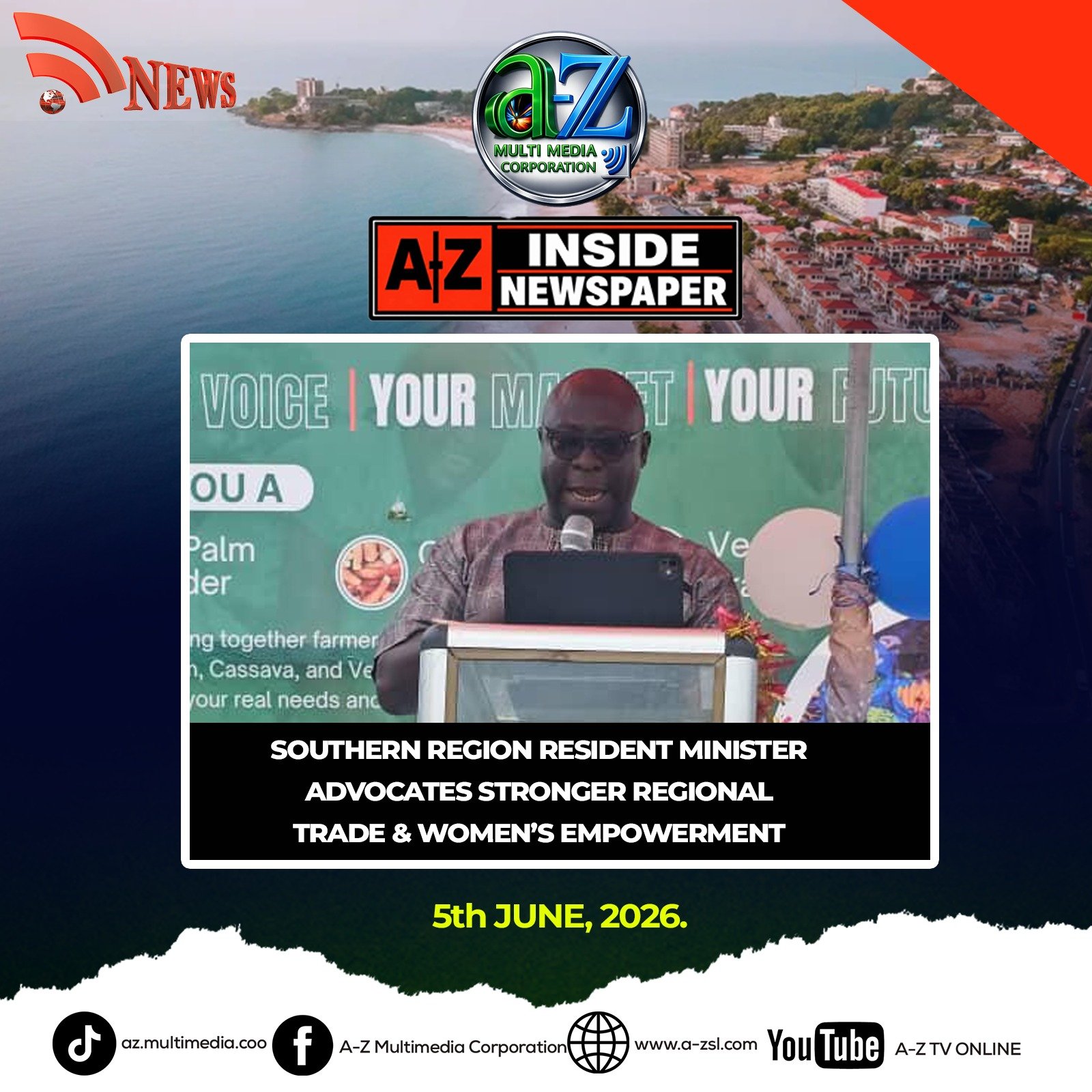
By: Fatmata Grace Okekearu, Bo City
The Resident Minister for the Southern Region, Chief John Abu, has called for stronger regional integration, women’s economic empowerment, and social inclusion through cross-border trade during the official opening of the Regional Cross-Border Trade Fair involving women traders from Bo Waterside in Liberia and Jendema in Sierra Leone.
Speaking at the opening ceremony of the two-day event, held under the theme “Promoting Economic Empowerment, Social Inclusion, and Regional Integration through Cross-Border Trade,” Chief Abu described the fair as a significant milestone in the collective efforts of Sierra Leone and Liberia to deepen economic cooperation and strengthen people-to-people relations.
Addressing representatives of the Mano River Union (MRU), the African Development Bank (AfDB), government officials from Sierra Leone and Liberia, traditional leaders, development partners, women traders, youth representatives, and members of the media, the Resident Minister conveyed greetings from President Brig. (Rtd.) Dr. Julius Maada Bio and reaffirmed the Government of Sierra Leone’s commitment to regional economic transformation and integration.
Chief Abu emphasized that the trade fair represents far more than a gathering of traders. According to him, it symbolizes the enduring friendship, shared history, and common aspirations that bind Sierra Leone and Liberia together.
He commended the Mano River Union for spearheading the initiative through the Building Inclusive Business Ecosystems for Stabilization and Transformation (BI-BEST) Project and expressed appreciation to the African Development Bank for its financial support toward the programme.
According to the Minister, the BI-BEST Project is both timely and strategic, as it directly targets women and youth involved in the cassava, palm oil, and vegetable value chains in border communities such as Jendema, Bo Waterside, Koindu, and Foya.
Chief Abu noted that women have long played a pivotal role in cross-border commerce across the sub-region, contributing significantly to household incomes, food security, and local economic development. Despite their contributions, however, many women traders continue to face challenges, including limited access to markets, inadequate business networks, insufficient financing, and barriers associated with cross-border trade.
He stressed that the trade fair provides a valuable platform to address these challenges by enabling women entrepreneurs to showcase their products, build strategic partnerships, exchange experiences, and gain access to broader regional markets.
“The impact of this initiative on the livelihoods of women and young people cannot be overstated,” he said, noting that increased market opportunities would boost incomes, improve productivity, create employment opportunities, and strengthen family welfare.
He further observed that stronger businesses contribute to improved educational opportunities for children, better living standards, and greater economic security for families and communities.
Highlighting the broader significance of cross-border trade, Chief Abu described such initiatives as powerful tools for economic growth and regional development. He stated that trade fairs stimulate local production, encourage entrepreneurship, facilitate the movement of goods and services, and strengthen commercial relationships between neighbouring countries.
“When traders from different countries come together, they create markets that transcend national borders and contribute to sustainable economic growth across the region,” he said.
Beyond its economic benefits, the Resident Minister emphasized that cross-border trade also serves as an important mechanism for peacebuilding, social cohesion, and regional stability.
“Trade creates interdependence among communities and fosters mutual trust, understanding, and cooperation. Shared prosperity across borders becomes a powerful incentive for peace and stability,” he noted.
Reflecting on the history of regional commerce, Chief Abu recalled the once-thriving Koindu Trade Fair in Kailahun District. Before the civil conflicts in Sierra Leone and Liberia, the fair was one of the largest commercial events in the Mano River region, attracting traders from Sierra Leone, Liberia, Guinea, and other neighbouring countries.
He described the Koindu Trade Fair as more than just a marketplace, noting that it served as a symbol of regional integration, cultural exchange, peaceful coexistence, and economic opportunity.
According to him, although years of conflict disrupted this important tradition, initiatives such as the current Regional Cross-Border Trade Fair are helping to revive the spirit of commerce, solidarity, and cooperation that once united communities across national borders.
“We are rebuilding the bridges of commerce, friendship, and partnership that once made our region a vibrant hub of economic activity,” he emphasized.
Chief Abu encouraged participants to maximize the opportunities presented by the two-day event through networking, knowledge-sharing, partnership-building, and the exploration of new business opportunities capable of promoting sustainable development.
He concluded by expressing profound appreciation to the African Development Bank and the Mano River Union for their continued commitment to empowering women, supporting youth development, and advancing regional integration.
“Their investment in our people is an investment in the future peace, stability, and prosperity of the Mano River region,” he remarked.
The Regional Cross-Border Trade Fair is expected to expand economic opportunities for women traders, strengthen cross-border relationships, and contribute significantly to inclusive growth, regional cooperation, and sustainable development between Sierra Leone and Liberia.