

By: Audrey Raymonda John
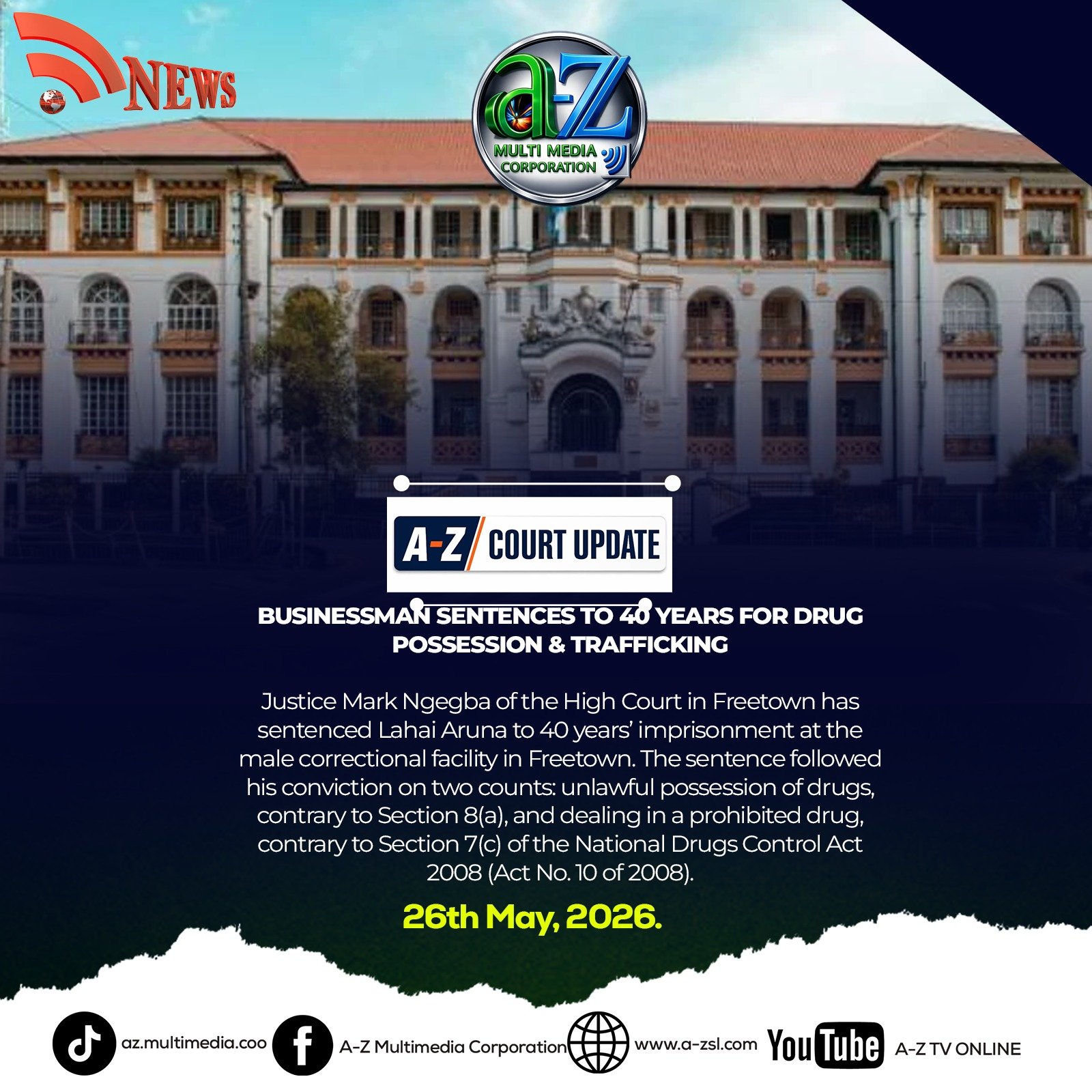
Justice Mark Ngegba of the High Court in Freetown has sentenced Lahai Aruna to 40 years’ imprisonment at the male correctional facility in Freetown. The sentence followed his conviction on two counts: unlawful possession of drugs, contrary to Section 8(a), and dealing in a prohibited drug, contrary to Section 7(c) of the National Drugs Control Act 2008 (Act No. 10 of 2008).
According to the particulars of the offence, on 1 November 2025, in the Western Area of Sierra Leone, the convict was found in possession of four polythene bags containing cannabis sativa, weighing approximately 1.2 kilograms. He was also found to be dealing in the prohibited substance without lawful authority.
The accused was arraigned on 21 January 2026, where he pleaded not guilty to all charges.
During the trial, the prosecution called three witnesses to prove its case beyond reasonable doubt, as required by law.
The first prosecution witness (PW1), Assistant Superintendent of Police Joseph Stevens, a forensic analyst attached to the Transnational Organized Crime Unit (TOCU), testified that he received a laboratory request on 10 December 2025 to analyze dried leaves suspected to be cannabis sativa. The substances were contained in four black polythene bags.
He stated that he conducted both presumptive and laboratory analyses, including chemical and microscopic examination. The results confirmed the presence of tetrahydrocannabinol (THC), a substance found in cannabis. He tendered the laboratory request as Exhibit A and the laboratory report as Exhibits B1-2.
The second prosecution witness (PW2), Detective Police Sergeant 9589 Prince Joe Kpandewa Jabati, also attached to TOCU, testified that he received the case file and other related documents on 2 January 2026 for further investigation. He tendered several exhibits, including the defendant’s photograph, voluntary caution statement dated 1 November 2025, arresting officer’s statement, and charge sheet.
The third prosecution witness (PW3), Detective Police Constable 13682 John Umaru, attached to the Crime Writers Office at TOCU, testified that he received and registered the exhibits, including the four black polythene bags containing the suspected cannabis, in the court exhibit register under serial number 230/2025. He confirmed that samples were taken for forensic analysis and tendered the exhibits in court.
At the close of the prosecution’s case, the defendant chose to rely on his statement to the police. In his statement, he admitted that the substance was found in his possession during a search of his room.
In his judgment, Justice Ngegba emphasized the principle of proof beyond reasonable doubt, noting that the prosecution bears the burden of proving each element of the offence.
The court held that possession may be actual or constructive, meaning that a person can be deemed possession of a prohibited substance if it is found under their control or within their immediate vicinity.
The judge further noted that under Section 57 of the National Drugs Control Act 2008, once a sample is proven to contain a controlled substance, it is presumed to have the same properties unless proven otherwise.
The forensic evidence presented by PW1, along with the laboratory report, confirmed that the substance was cannabis sativa. The court found no evidence from the defence to rebut this finding or to show lawful possession.
Justice Ngegba concluded that the prosecution had successfully proven both charges beyond reasonable doubt. The court therefore convicted the defendant.
He sentenced Lahai Aruna to 10 years’ imprisonment on the first count and 30 years’ imprisonment on the second count, making a total of 40 years’ imprisonment.