

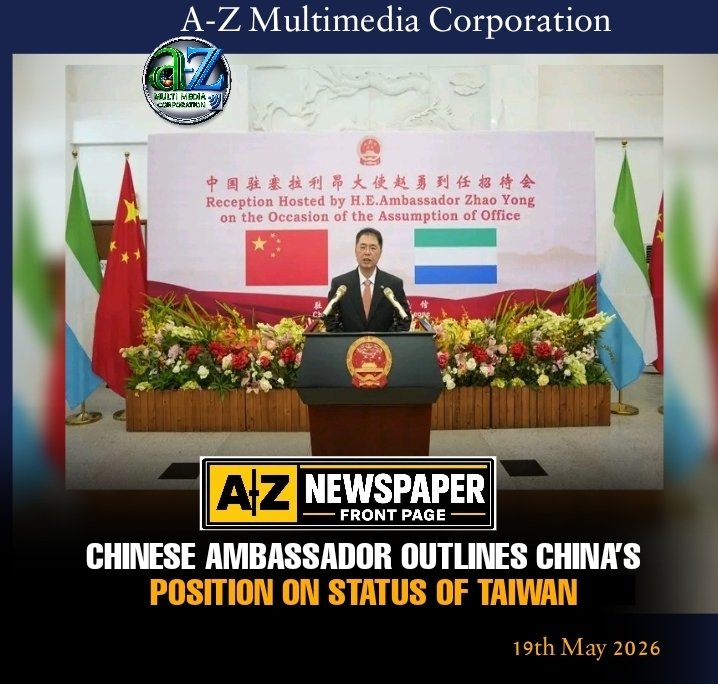
Ambassador Zhao Yong recently granted a written interview to Sierra Leonean media on the Taiwan question. In the interview, he outlined China’s position on the historical status of Taiwan, reaffirmed the One-China Principle, and criticized “Taiwan independence” separatist activities as well as what he described as external attempts to “use Taiwan to contain China.”
Ambassador Zhao stated that Taiwan has belonged to China since ancient times, emphasizing that its historical and legal status is clear and indisputable.
He noted that in 230 AD, during the Three Kingdoms period, the Kingdom of Wu reportedly sent officials and troops to Taiwan. He further stated that successive Chinese dynasties, including the Song and Yuan periods, exercised administrative authority over the island.
He added that in 1895, the Qing Dynasty was forced to cede Taiwan to Japan following its defeat in war. However, he described Japan’s colonial rule over Taiwan as illegitimate, stating that the Taiwanese people continued to resist Japanese occupation.
He further stated that after China’s victory in the War of Resistance Against Japanese Aggression, Taiwan was returned to China in 1945. He argued that this restoration formed part of the post-Second World War international order, referencing documents such as the Cairo Declaration, the Potsdam Proclamation, and the Japanese Instrument of Surrender, which he said affirmed China’s sovereignty over Taiwan.
According to him, the status of Taiwan was effectively settled following Japan’s defeat in 1945.
Ambassador Zhao explained that the One-China Principle consists of three core elements: there is only one China in the world. Taiwan is an inalienable part of China’s territory. The Government of the People’s Republic of China is the sole legal government representing all of China.
He stated that United Nations General Assembly Resolution 2758 reflects and affirms the One-China Principle, recognizing the People’s Republic of China as the only legitimate representative of China at the United Nations.
He further noted that Sierra Leone was among the co-sponsors of the resolution and expressed appreciation for its position.
According to him, 183 countries have established diplomatic relations with China based on the One-China Principle.
He also referenced UN documentation and interpretations within the UN system that describe Taiwan as “Taiwan, Province of China,” and noted that international organizations such as the World Trade Organization (WTO), the Asia-Pacific Economic Cooperation (APEC), and the Asian Development Bank (ADB) allow Taiwan to participate under the name “Chinese Taipei.”
Ambassador Zhao criticized recent international activities involving Taiwan’s leadership, specifically referencing a visit by Lai Ching-te to Eswatini.
He stated that China does not recognize any so-called “President of the Republic of China” and described such claims as inconsistent with historical and international consensus.
He further alleged that attempts by Taiwan’s leadership to conduct international visits reflect separatist intentions and violate the One-China Principle.
Ambassador Zhao highlighted the longstanding friendship between China and Sierra Leone, stating that both countries consistently support each other on issues of core national interest.
He noted that Sierra Leone has repeatedly reaffirmed its adherence to the One-China Principle. He also referenced the 2024 China–Sierra Leone joint statement, which reiterated Sierra Leone’s recognition of the People’s Republic of China as the sole legal government of China and its position that Taiwan is an inalienable part of China.
He stated that Sierra Leone opposes “Taiwan independence” and does not maintain official relations with Taiwan.
Ambassador Zhao concluded that China appreciates Sierra Leone’s stance and expressed China’s willingness to continue strengthening cooperation, mutual support, and coordination in international affairs, with the aim of promoting peace, stability, and shared development.