

By: Saidu Jalloh
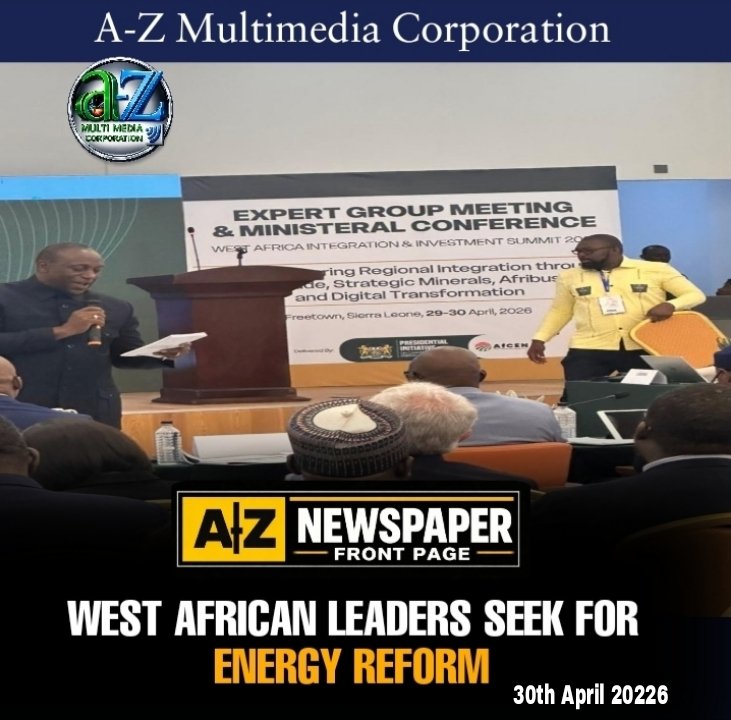
Leaders, policymakers, and development partners from across West Africa have gathered in Freetown for the 2026 Economic Integration and Investment Summit, focusing on urgent reforms in energy, digital transformation, and regional trade to unlock the subregion’s economic potential.
The summit, held at the Bintumani Conference Centre, has brought together representatives from across the Economic Community of West African States (ECOWAS) to chart a more coordinated path toward growth and cooperation.
Held under the theme “Powering Regional Integration through Energy Trade, Strategic Minerals, Agribusiness, and Digital Transformation,” the gathering places strong emphasis on practical solutions to long-standing economic challenges.
Welcoming delegates, Kandeh Yumkella, Chairman of the Presidential Initiative on Climate Change, Renewable Energy and Food Security, described the summit as a critical step in aligning political leadership with technical expertise.
Yumkella noted that countries such as Sierra Leone, Liberia, and Guinea are rich in natural resources, including iron ore, bauxite, and gold. However, he stressed that the region has yet to translate this wealth into broad-based prosperity.
“The challenge is not just about resources,” he explained. “Exporting raw materials without local processing limits economic gains, while weak energy systems, poor regional coordination, and inefficiencies in revenue management continue to hold us back.”
He emphasized that reliable energy is the foundation for development. Without consistent electricity, industrialization cannot progress, digital systems struggle to function, and investors are less likely to commit to the region. Strengthening power supply, he said, must be treated as an urgent priority.
Yumkella also called for deeper regional collaboration, noting that frameworks like the West African Power Pool already exist but require stronger political will and faster implementation.
Also speaking at the summit, Henry Musa Kpaka, Minister of Agriculture and Food Security, stressed the importance of turning large-scale development plans into real results. He noted that while institutions such as the African Development Bank and the World Bank continue to fund major initiatives, success ultimately depends on effective execution at the national level.
Representing the AfDB President, Vice President Abdul Kamara outlined a ten-year strategy focused on building expertise and ensuring sustainability across key sectors in Africa.
Meanwhile, Salima Monorma Bah, Minister of Communication, Technology and Innovation, said Africa stands at a defining moment where the digital economy can drive growth and job creation. She pointed out that although the continent is rich in ideas especially among young people many innovations fail to scale due to weak infrastructure and limited policy support.
She emphasized that digital investment must go beyond technology to include building a supportive ecosystem for innovation, entrepreneurship, and cross-border trade. A unified digital market in West Africa, she said, would help businesses expand, improve efficiency, and attract investment.
Experts at the summit noted that the global digital economy is now valued at around $16 trillion, accounting for roughly 15 percent of global output. Africa’s share, estimated at $3.5 trillion, remains relatively small but is growing rapidly.
Participants also warned that Africa’s expanding youth population will only become an economic advantage if matched with deliberate investments in digital skills and infrastructure. Without such efforts, the region risks missing out on key opportunities in the global digital economy.
Overall, there was broad agreement on priority areas, including expanding energy access, promoting local processing of minerals, strengthening regional cooperation, and improving governance systems.
The summit continues with expert sessions and ministerial discussions expected to produce practical, actionable strategies for transforming West Africa’s economic future.