

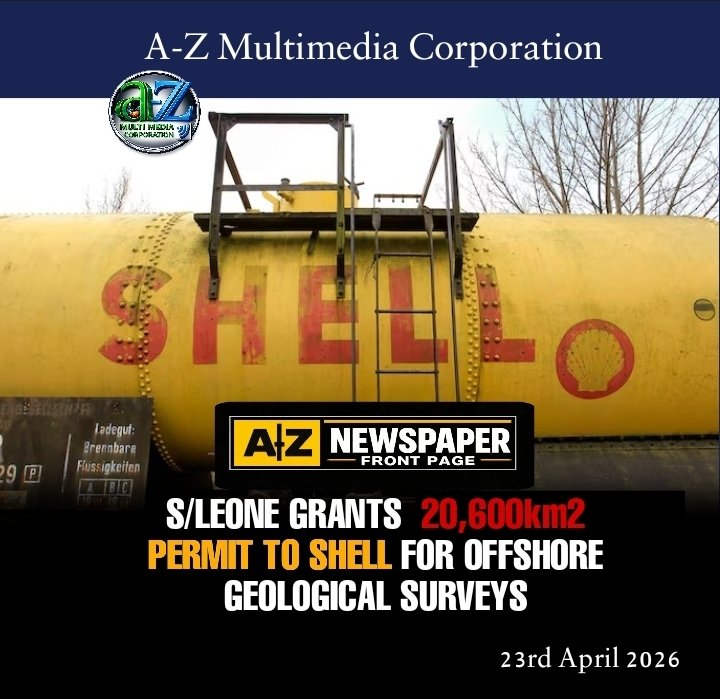
Sierra Leone has signed an agreement with Shell plc allowing the energy major to conduct advanced geological and geophysical surveys across several offshore blocks, the country’s Petroleum Directorate announced on Wednesday 22nd April 2026.
The reconnaissance permit covers an area of approximately 20,600 square kilometres and includes basin modelling and petroleum systems analysis, according to an official statement.
This initiative follows a similar agreement signed with Eni in October last year. Both programmes are expected to improve understanding of Sierra Leone’s deepwater hydrocarbon potential.
The Petroleum Directorate of Sierra Leone (PDSL) said the permit will provide a data-driven framework for technical evaluation and could support future participation in licensing opportunities.
“Our strategy is deliberately focused on de-risking the basin through high-quality data, attracting credible global players, and accelerating the pathway toward exploration drilling,” said Foday Mansaray, Director General of PDSL.
Shell noted that it routinely enters into non-binding agreements with governments to access data and assess potential opportunities. The company emphasized that the agreement does not represent a commitment to proceed with further activities. Any next steps will depend on regulatory approvals, due diligence, and other considerations.
Shell PLC is one of the world’s largest integrated energy companies, with roots dating to the 1907 merger of Royal Dutch Petroleum and the UK’s Shell Transport and Trading Company. Headquartered in London since 2022, the company operates across the full energy value chain from upstream oil and gas exploration and LNG to chemicals, trading, and growing renewables and EV charging portfolio.
The company maintains a presence in more than 70 countries, including key markets in North and South America, Europe, Asia, the Middle East, and Africa. In Africa, Shell has long-standing operations in Nigeria for natural gas and is expanding exploration in Angola and Namibia’s Orange Basin. Its global strategy is currently shifting toward lower-carbon energy, with investments in hydrogen, carbon capture, and electric vehicle infrastructure alongside its traditional LNG and deepwater projects.
SOURCE: Reuters