

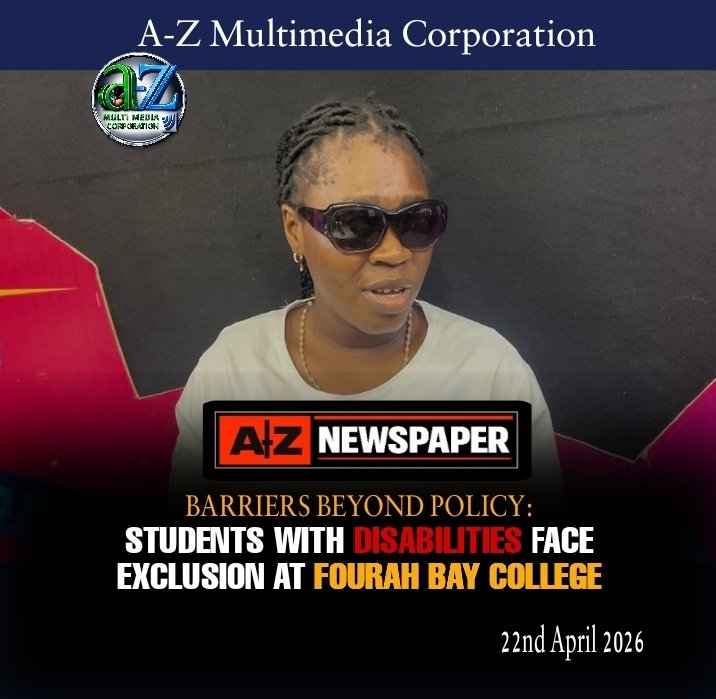
By: Esther Kadie Tarawally
Perched on Mount Aureole overlooking Freetown, Fourah Bay College is one of Sierra Leone’s most historic centres of higher learning. However, beyond its academic reputation, the campus terrain marked by steep slopes, long stairways, and widely scattered buildings poses daily challenges for students with disabilities moving between hostels, classrooms, and administrative offices.
Fifteen years after the enactment of the Persons with Disability Act 2011, which mandates accessibility and equal access to education, students say the reality on campus tells a very different story. Section 14(2) and (3) of the Act requires structural adaptation and the provision of learning devices in educational institutions to accommodate persons with disabilities.
This investigation finds that students with disabilities at Fourah Bay College continue to face significant infrastructural and academic barriers from inaccessible buildings and limited mobility support the absence of inclusive learning materials raising concerns about compliance, accountability, and the slow pace of implementation of the law.
For many students, accessing education is a daily struggle shaped by unsafe infrastructure, limited learning support, and social barriers.
Mariama Sallay Kamason, a student at the Institute of Gender Research and Documentation studying Gender and Development Studies, says the reality became clear on her first day on campus. She recalls arriving two years ago and immediately wondering whether she could cope—not only with her studies but also with navigating a campus dominated by steep stairs and inaccessible structures as a visually impaired student.
“On my first day, I stood at the campus bus park, popularly called ‘airport’ by students, for about 10 minutes, hoping someone would assist me,” she explains. “When no one came, I decided to walk on my own, even though it was risky.”
Mobility remains one of the biggest challenges. Abu Kamara, a Legal Studies student who uses crutches, describes campus life as extremely difficult, especially in the hostels.
He says many buildings, including hostels, are inaccessible due to poor design and the absence of proper ramps, forcing him to miss classes when he cannot find assistance.
“Sometimes, I have to ask classmates to carry me on their backs, and that strips me of my dignity,” Kamara says. “Some days, when I think about all the obstacles, I just stay in my room and do not go out at all.”
Even basic facilities such as bathrooms are not disability-friendly. Kamara adds that the few available ramps are poorly constructed and unsafe. He is calling on the university to engage experts in future construction to ensure proper accessibility features, including standard ramps and guardrails.
Beyond physical access, students say the learning environment itself is unequal.
Brima Jalloh, a visually impaired student, notes that most academic materials are not accessible. Library resources are not available in braille or audio formats, while handouts are distributed only in print.
This, he says, limits their ability to participate equally in class. “Sometimes even colleagues who assist us are overwhelmed and unable to help,” he explains.
He also recounted missing classes for three weeks after being hit by a taxi on his way to campus, highlighting the additional risks students face.
Similarly, Alhaji Lolleh says his challenges begin before he even reaches campus. Living off campus, he relies on others to help him board public transport.
“There was a day no one was around to help,” he recalls. “I fell into a hole and almost broke my leg.”
On campus, locating lecture halls especially when venues change without notice is another major difficulty. He also points to social isolation, noting that some students avoid him due to misconceptions about disability.
“It is painful,” Lolleh says.
For Mariama, the risks extend beyond infrastructure and academics.
She recounts a disturbing incident in which a man she asked for assistance allegedly threatened her safety.
“He told me that even if he raped me, nothing would happen because I could not see him,” she says.
Her experience underscores the heightened vulnerability faced by women with disabilities, particularly in environments where support systems are weak.
Students say these experiences reveal a clear gap between policy and practice.
While the Persons with Disability Act 2011 guarantees the right to education and accessibility, Lolleh notes that additional costs and barriers still limit access to essential academic services.
“If we are properly supported, we will not be a liability but contributors to national development,” he says.
Responding to these concerns, James Abraham George, Senior Administrative Assistant in charge of Special Needs, acknowledged that the institution is “far from where it needs to be.” He estimates that less than one percent of the college’s infrastructure is disability-friendly.
He says the administration is using what he describes as “human-face approaches,” such as relocating classes to more accessible buildings and working with alumni groups to support students.
According to him, the college currently has 26 students with special needs, including individuals with visual impairments, albinism, polio, amputations, and epilepsy.
At the national level, Brima Abdulai Sheriff, Chairman of the National Commission for Persons with Disability, says institutions must do more to ensure accessibility through structural adaptation.
He argues that claims of limited resources are not always justified, noting that institutions often mobilize funds for other priorities while neglecting accessibility.
Failure to comply with the law, he warns, denies students their fundamental right to education as guaranteed by the Constitution and the Disability Act. Although the law required public institutions to become accessible within five years of its enactment in 2011, progress has been slow.
The experiences of these students show that exclusion is not just a policy issue it is deeply personal. From inaccessible infrastructure and limited learning materials to safety risks and social stigma, students with disabilities at Fourah Bay College continue to face barriers that affect both their education and dignity.
Their stories highlight the urgent need for improved infrastructure, accessible learning resources, and stronger institutional commitment to inclusion. For Mariama and others like her, education is not just about learning it is about navigating a system that has yet to fully accommodate them.