

By: Aminata Sesay
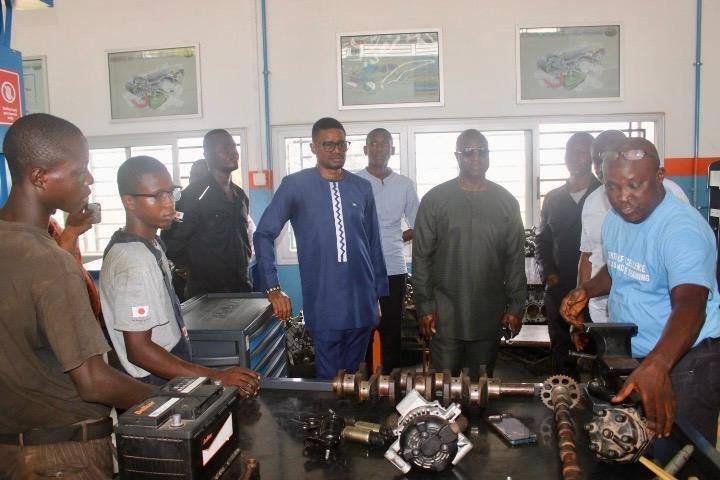
Efforts to strengthen Sierra Leone’s industrial and technical capacity have received a significant boost as the Ministry of Technical and Higher Education (MTHE) and the Ministry of Transport and Aviation (MoTA) focus on the Automotive Training Centre of Excellence at Freetown Polytechnic’s Kissy Campus as a potential driver of innovation, skills development, and service delivery.
The joint visit reflects growing government interest in transforming the facility from a training institution into a strategic hub capable of supporting public sector vehicle maintenance and contributing to national development goals.
The centre, established by the United Nations Industrial Development Organization with support from the Government of Japan, represents a key investment aligned with the vision of Julius Maada Bio to advance technical and vocational education in Sierra Leone.
Deputy Minister of Technical and Higher Education, Sarjoh Aziz-Kamara, highlighted the broader economic potential of the facility, noting that plans are underway to introduce commercial vehicle servicing for government fleets. He explained that this approach could reduce maintenance costs while generating sustainable revenue to support the centre’s operations.
Minister of Transport and Aviation, Alhaji Fanday Turay, emphasized the need to align technical training with real-world demands. He pointed to opportunities for collaboration in vehicle maintenance, road safety initiatives, and the long-term ambition of assembling vehicles locally. He also proposed the establishment of a joint technical team to formalize cooperation between the two ministries.
From the academic perspective, officials at Freetown Polytechnic underscored the centre’s growing role in developing a skilled workforce. Dean Prince Brainard encouraged students to specialize and innovate, while Engineering Dean Musa Bah highlighted the institution’s competency-based training model, which equips learners with practical, job-ready skills and promotes entrepreneurship.
Inclusivity is also improving, with female participation in training programmes steadily increasing reflecting changing perceptions about careers in technical fields.
However, stakeholders acknowledged ongoing challenges. Limited access to modern diagnostic software and slow IT infrastructure continue to hinder advanced training, while basic issues such as inadequate water supply still affect workshop operations.
Despite these constraints, the centre continues to train dozens of students, reinforcing its potential as a cornerstone for technical excellence and industrial growth in Sierra Leone.