By: Saidu Jalloh
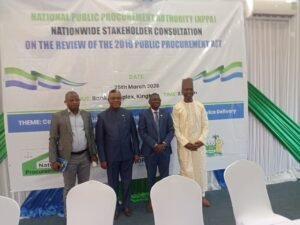
The Chief Executive Officer of the National Public Procurement Authority (NPPA) has called for strengthened procurement reforms during a nationwide consultation on the review of the Public Procurement Act.
Speaking at the consultation held at the Bank Complex, the NPPA CEO noted that the review comes at a critical moment in Sierra Leone’s reform agenda. He emphasized that public procurement is a vital government function that determines how public resources are translated into essential services such as roads, schools, hospitals, and energy.
He stressed that a transparent, efficient, and accountable procurement system is crucial for effective service delivery, warning that weaknesses in the system can lead to delays, inefficiencies, and the misuse of public funds.
The NPPA boss explained that the review process aims to gather input from a broad range of stakeholders to strengthen the existing law and improve its implementation. He added that the consultation provides an opportunity to identify gaps and align the Act with current realities and international best practices.
He acknowledged that meaningful reform requires the active participation of all stakeholders, including government institutions, oversight bodies, the private sector, civil society organizations, and development partners.
Key priority areas identified include procurement planning, compliance, oversight, contract management, and capacity building. He emphasized that improvements in these areas will enhance efficiency, fairness, and value for money.
In a keynote address, Dr. Emmanuel Gaima stressed that Sierra Leone’s public procurement system must evolve to withstand modern pressures and meet citizens’ expectations. He underscored the need for reforms to be carried out in a structured and procedural manner.
Dr. Gaima noted that it is no longer sufficient to focus solely on compliance with forms and procedures. Instead, attention must be given to whether procurement systems deliver quality outcomes, protect public funds, promote fair competition, and reduce delays.
He argued that the ongoing review of the Public Procurement Act should be guided by both policy ambition and operational realism, cautioning against superficial amendments while also warning against frameworks that are impractical to implement.
He further stated that effective procurement laws must be clear, enforceable, and aligned with the broader public financial management system, supported by capable institutions and independent oversight bodies.
Highlighting additional priorities, Dr. Gaima underscored the need to strengthen procurement planning and market discipline, noting that many challenges stem from weak needs assessments, poor costing, and inadequate contract design.
He also emphasized that transparency must go beyond paperwork to real visibility, advocating for the increased adoption of digital procurement systems to enhance accountability and traceability.
Dr. Gaima stressed that professionalizing the procurement sector is essential, calling for competent and ethical practitioners committed to continuous capacity development and accountability. He added that procurement entities and committees must operate with integrity and in the public interest.
On integrity risks, he asserted that the legal framework must work in tandem with anti-corruption mechanisms, audit systems, and sanctions regimes to safeguard public confidence. He highlighted the importance of strong measures on conflict of interest, complaints handling, and records management.
He concluded that the procurement regime should support national development goals while ensuring fairness, competition, and the promotion of local content.