By: Precious Miracle Kargbo (Snr)
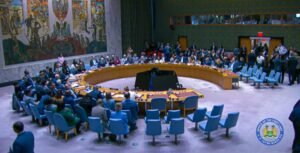
Sierra Leone’s First Lady, Fatima Bil, addressed the United Nations Security Council on 2 March 2026, highlighting urgent challenges facing children’s education in conflict zones and calling for immediate, coordinated action to protect and educate learners affected by war, instability, and climate shocks.
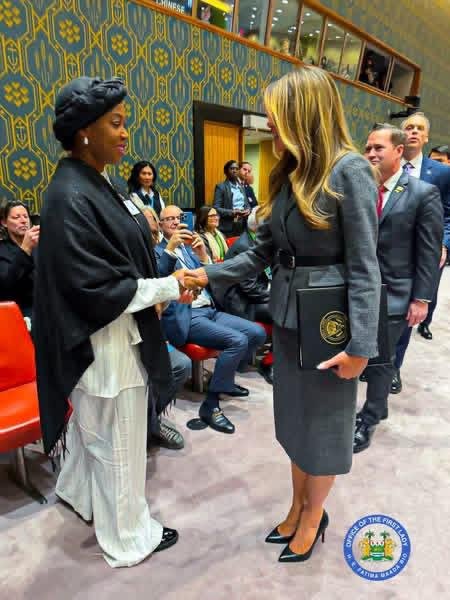
Mrs. Bil participated in the 10,113th Council meeting in her dual role as First Lady of Sierra Leone and President of the Organisation of African First Ladies for Development (OAFLAD). She was invited by the U.S. First Lady, who presided over the Council as the United States assumed its one-month presidency. During the session, she emphasized that the plight of millions of disrupted learners is a matter of international peace and security.
Drawing on OAFLAD’s flagship programme, Building Resilience for Women and Children in the Face of War and Climate Change, Mrs. Bil urged member states, UN agencies, and donors to implement targeted interventions to keep children
particularly girls in safe, inclusive, and quality learning environments. “Children in conflict zones face unimaginable barriers to learning, safety, and opportunity,” she stated.
A major focus of her remarks was the dual role of technology in conflict-affected education. While digital platforms can provide continuity for displaced or remote learners and offer psychosocial support, she warned of significant online risks, including exploitation, trafficking, and exposure to harmful content. Mrs. Bil called for child-cantered digital literacy, robust safeguards, and secure platforms designed with privacy and protection at their core, stressing: “Technology must empower and protect never endanger.”
The Council also discussed practical measures to translate commitments into results, including scaling safe remote learning, investing in teacher training for emergency contexts, protecting schooling spaces from attacks, and ensuring education financing is responsive to crises. Mrs. Bil emphasized integrating climate adaptation into education planning, noting that climate-induced displacement increasingly compounds the disruption of schooling in parts of Africa.
Civil society representatives and child protection experts echoed her call for inclusive approaches that prioritize girls and marginalized groups, strengthen community engagement, and expand psychosocial support for traumatized learners. Delegations highlighted the need for better coordination between ministries of education, protection actors, and technology partners to deliver context-sensitive solutions.
As OAFLAD president, Mrs. Bil pledged to intensify regional efforts to build resilience for women and children, advocating partnerships that combine emergency response with long-term investments in safe schools and secure digital learning pathways. The session underscored a growing global consensus: protecting children’s right to education in conflict zones is a security imperative that requires coordinated political will, funding, and technical safeguards to ensure technology serves as a lifeline, not a risk, for the world’s most vulnerable learners.