By: Mohamed Sahr
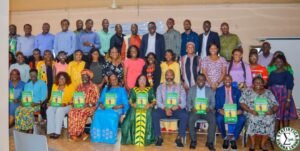
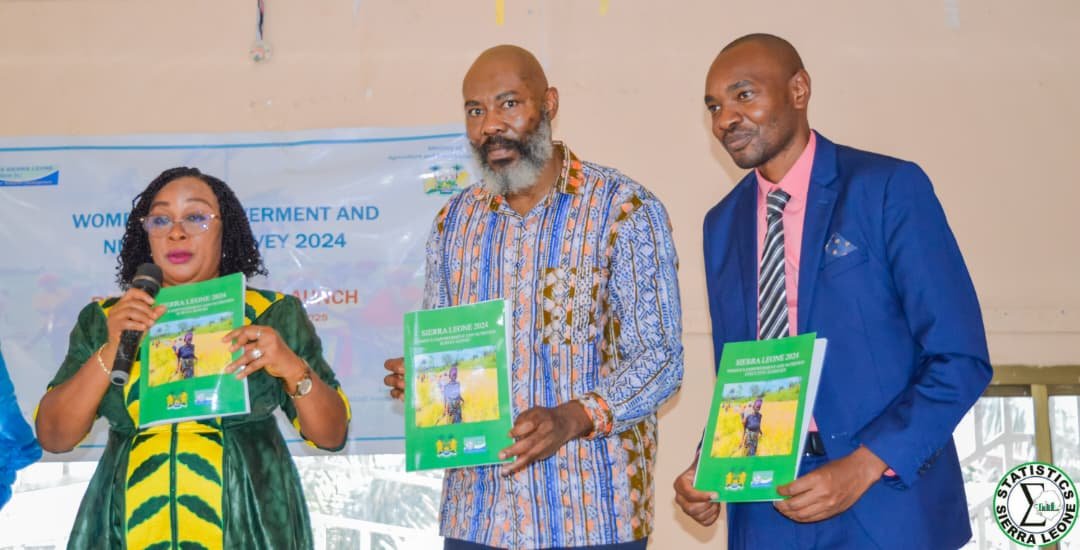
In a bid to enhance women’s empowerment and dietary diversity in the agricultural sector, Statistics Sierra Leone (Stats SL), in partnership with the Ministry of Agriculture and Food Security, officially launched the Women’s Empowerment and Nutrition (WEN) Survey and Data Report 2024. The launch, supported by the Food and Agriculture Organization (FAO), took place at Sella Spot on Tuesday, 26th August 2025.
The survey seeks to monitor annual progress in the agricultural sector, aligning with the National Development Plan, Comprehensive Africa Agriculture Development Programme (CAADP), and the Sustainable Development Goals (SDGs) under the 50×2030 Initiative, which aims to close the agricultural data gap.
Making the keynote address, Dr. Tenema Theresa Dick, Deputy Minister of Agriculture and Food Security, emphasized the vital role women play in agriculture and local economic development. She pointed out that, despite their immense contributions, women still face limited access to essential resources and decision-making opportunities within the sector.
“Women continue to experience restricted rights to land use, limited financial inclusion, and poor access to credit facilities,” Dr. Dick stated. She added that these challenges negatively impact national productivity, food security, and poverty reduction efforts.
Dr. Dick called for consistent empowerment of women to strengthen food systems and close existing data gaps. She expressed gratitude to FAO and the Bill & Melinda Gates Foundation for their support through the 50×2030 Initiative, which enabled the integration of live questionnaires into the project.
Mr. Lansana Kpelewo Kanneh, Deputy Statistician General, highlighted Sierra Leone’s commitment to achieving the Medium-Term National Development Plan (MTNDP 2024–2030). He stressed the significance of the WEN report as a critical tool for evidence-based policymaking and program implementation.
“Agriculture remains the backbone of our economy and the foundation of our Feed Salone initiative,” he said. “This report shows clearly that we cannot achieve true agricultural transformation without addressing the systemic barriers hindering women’s full participation and empowerment.”
Kanneh acknowledged the complexity and resource intensity of conducting a national survey of this scale. However, he praised the collaborative approach taken by Stats SL, the Ministry of Agriculture and Food Security (MAFS), and the FAO, which allowed for efficient use of resources and stronger technical execution.
Kanneh noted that the WEN survey offers a comprehensive understanding of the links between agriculture, nutrition, empowerment, and development. He emphasized the importance of fostering partnerships among stakeholders in agriculture, gender, health, and nutrition sectors.
He also explained that the WEN survey was integrated into the broader National Agricultural Survey of 2024, with data collected from a sub-sample of agricultural households. This integration reduced costs while maintaining data quality.
Two empirically tested modules were used in the survey: the Minimum Dietary Diversity module, developed by FAO and used in international surveys such as the DHS and Gallup Polls; and the Women’s Empowerment Metric, designed by IFPRI and its partners, previously piloted in several countries.
Dr. Samwell Mwenda, Consultant for FAO and Statistics Sierra Leone, explained that the WEN project was conducted over 2023 and 2024. FAO provided technical support to both MAFS and Stats SL to improve women’s empowerment outcomes in agriculture.
Households were given rosters to complete the questionnaire, with eligible participants ranging from ages 18 to 64. The Computer-Assisted Personal Interviewing (CAPI) program automatically and randomly selected individuals to participate in the WEN module.
The launch event concluded with various presentations from key stakeholders, highlighting their contributions and collaboration in the successful implementation of the project.