

By: Thaimu Bai Sesay
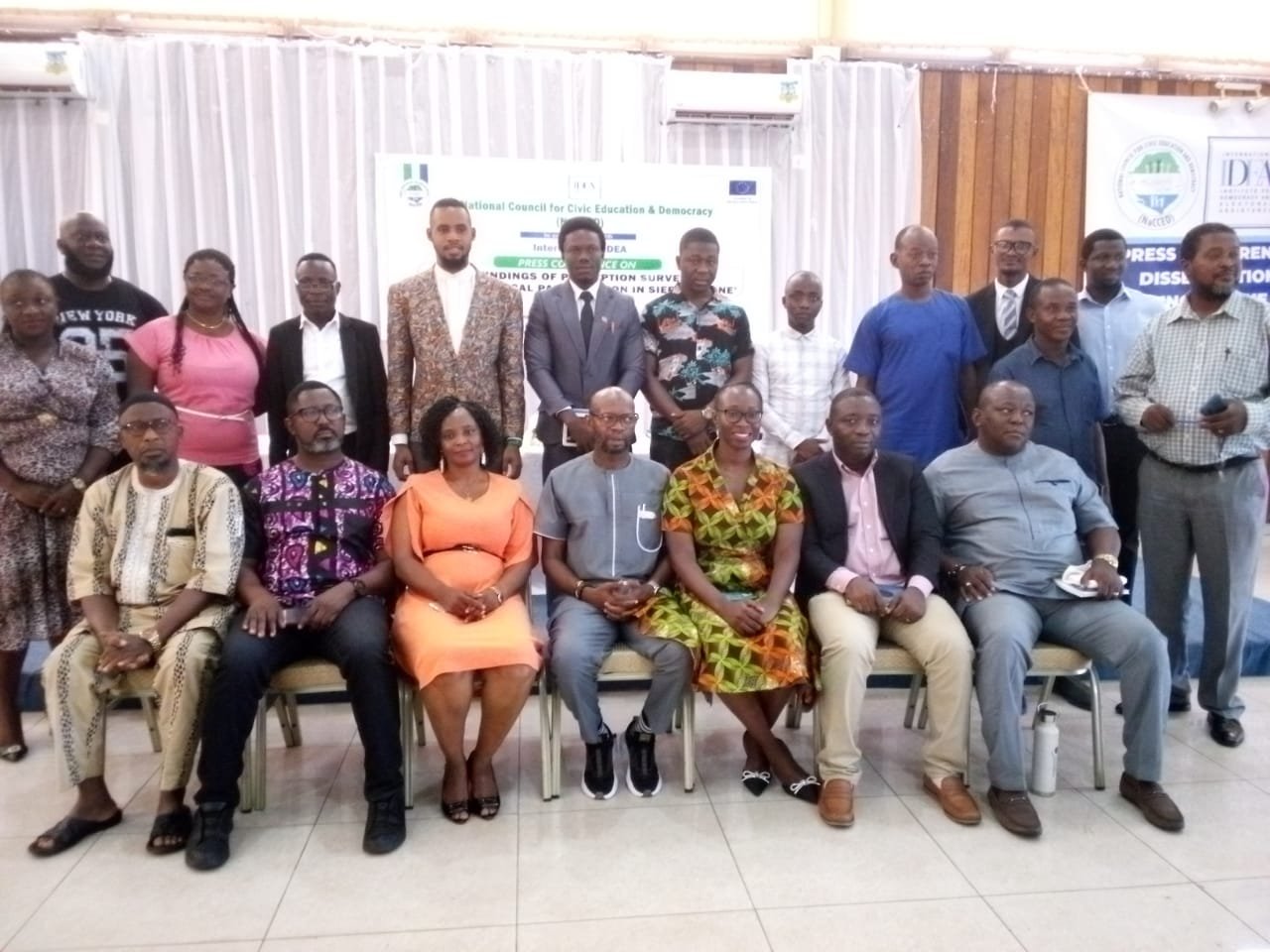
Ahead of the June 24, 2023 election, the National Council for Civic Education and Democracy (NaCCED) in collaboration with the Institute for Democracy and Electoral Assistance (International IDEA) has on Tuesday, May 16, 2023, launched the Findings of Perception Survey on ‘Youth Political Participation in Sierra Leone.
Funded by the European Union (EU), the launching of the initiative housed members of the press, representatives of ECSL, PPRC, Youth Commission, political parties, IGR and some other actors in a conference at the Bank of Sierra Leone Complex Kingtom, Freetown.
The Chairman of the National Council for Civic Education and Democracy (NaCCED), Kalilu Totaugi in a statement intimated that the perception survey was an initiative geared towards understanding not only young people’s perceptions of the electoral process and level of participation but also helping them to understand voting and issues of elections in Sierra Leone. In this year’s survey, Kalilu Totangi explained that a survey of 1,600 young people was conducted nationwide with several questions on the electoral process. “If the people lack awareness about certain things, it would be very easy for miscreants to come in and plan their misinformation and fake news in order to put the people asunder and we don’t want problem in this country,” He expressed.
NaCCED Chairman assured that the empirical data and information of the survey provided were based on fact and the data would be used to inform their actions. Kalilu Totangi said that according to their findings, 41 per cent of young people were uninformed of the Proportional Representation (PR) system and also said that during elections a lot of invalid votes were encountered due to low education and people who pretend to understand.
He assured me that they had packaged a whole lot of sensitization messages in different forms that would be sent to a variety of platforms for people to access within the remaining one-month period. “More importantly the survey is not only to know about it but we want to take action. The information contained therein is a call to action,” he reiterated
A representative of the European Union Enrico Sborgi commended NaCCED and the other actors who participated in the findings. He elucidated that political participation was one of the two pillars of representative democracy together with political pluralism. He went on to note that it was on those two dimensions political scientists assess how healthy and real was democracy in each country.
“Civic and voter education inform and stimulate political participation: the results of the survey which are disseminated today are therefore essential for the development of the voter education strategy and targeted content not only for NaCCED but for all actors involved in stimulating political participation in Sierra Leone,” Enrico expressed.
He added that it was their belief that the survey would contribute to enhancing the quality and effectiveness of voters’ education and participation as well as to building a harmonious society.
Analyzing the presentation of the findings, Andrew Lavali, CEO and Chairman of the Institute of Governance Reforms (IGR) explained the objectives, methodology and statistics of the people’s responses to the questions asked in the survey.
He said that the report of the findings showed that out of the 96.1 people that confirmed to have registered, 90 per cent of those registrants planned to vote in the June 24 election. From the responses in the report, Lavali also said that 71 per cent of the youth believed that their condition would change if the political party they support win the election.
IGR chairman analyzed that encapsulation of the findings in the report stated that the trust in the ECSL was high but youth participation was constrained by a low understanding of electoral processes and mechanisms.
He said that the report also projected that food, prices, education and jobs were the biggest policy priorities for young people in the 2023 election. The findings of the report ended with the hope that at least one-third of young people were willing to make innovative contributions to community peace and stability.
The Director of Electoral Education ECSL Momoh M. Kanneh, having watched the presentations of the findings and the sensitization animation messages, commended NaCCED.
He accepted the challenges projected in the report, especially on the 41 per cent of youth they said were not educated on the PR system of voting and assured of working on improving on that. “The message is very clear and the animation by NaCCED is very good and it would give ideal information to the public,” he added.
The Deputy Director of the Political Parties Registration Commission (PPRC) Josephine Panda commended NaCCED for the findings report and for inviting the PPRC Commission. He explained that politicians used the youths to cause mayhem and unstable situations.
She assured that PPRC was willing to work with NaCCED and other actors to ensure that youth are educated on electoral processes and prevented from causing violence.
