

By: Aminata Sesay
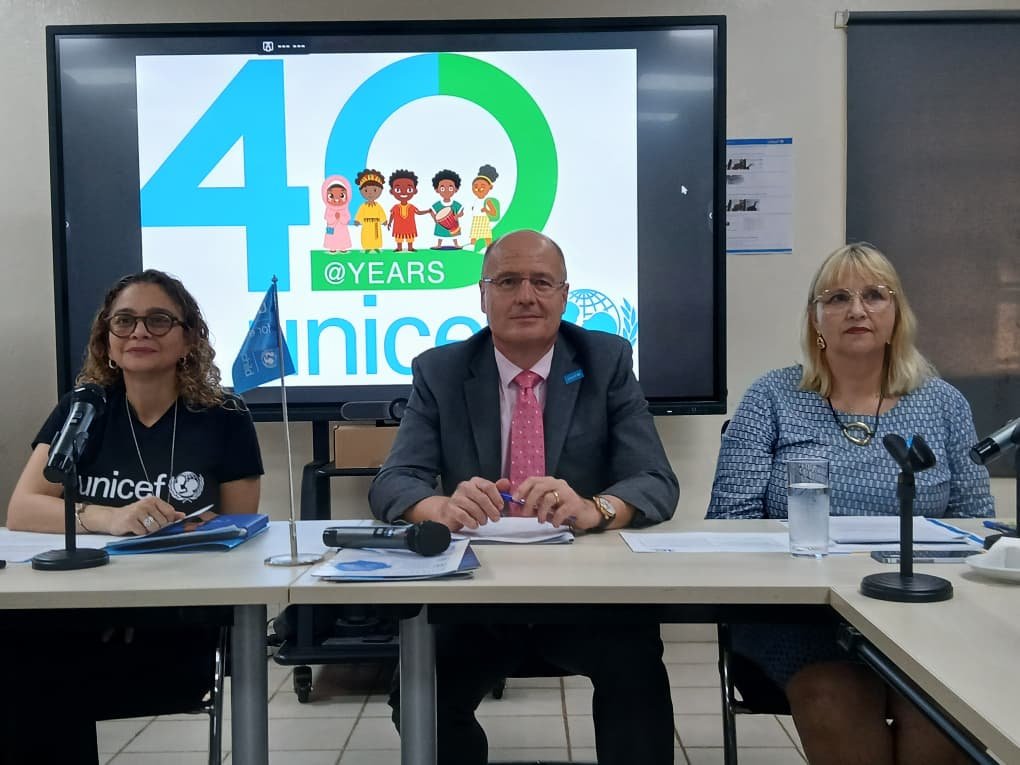
UNICEF has marked more than four decades of partnership with Sierra Leone, celebrating a journey defined by resilience, collaboration, and an unwavering commitment to the rights and well-being of children. Speaking during a media engagement in Freetown, UNICEF Representative Rudolph Schwenk described the milestone as “four decades of progress for children,” highlighting the organization’s long-term investment in national systems and communities.
From its early programmes in the 1980s supporting basic health, nutrition, and education UNICEF’s mission, Schwenk said, has remained consistent: ensuring that every child survives, learns, and thrives. During the civil war, UNICEF played a pivotal role in protecting children affected by violence, supporting the demobilization and reintegration of child soldiers, and ensuring essential services remained available. In the post-conflict years, UNICEF supported the rebuilding of schools and health facilities, strengthened child protection systems, and expanded access to safe water and sanitation across the country.
UNICEF’s support has also been crucial during major health emergencies, including the Ebola outbreak, COVID-19, and other public health crises. Through these interventions, the organization delivered life-saving services to children, families, and communities. These combined emergency and development efforts have produced notable results: under-five mortality has been more than halved, school enrolment has significantly increased, and access to clean water and basic social services has expanded. UNICEF also noted that Sierra Leone was recently ranked among the fastest-progressing countries toward achieving the Sustainable Development Goals.
UNICEF Deputy Representative Liv Elin Indreiten emphasized that the gains achieved over the past 40 years were the result of an integrated, system-strengthening approach implemented in partnership with government, civil society, communities, traditional and religious leaders, and children themselves. She highlighted progress in health, education, child protection, water and sanitation, and social protection, while stressing UNICEF’s focus on inclusive education for girls, children with disabilities, pregnant girls, and those living in remote communities.
UNICEF Education Specialist Jonathan Williams reflected on the organization’s unique role during the conflict, recalling how UNICEF worked across battle lines to ensure continued access to education, health services, and clean water. He noted that cooperation and partnership were essential to UNICEF’s ability to deliver services even during the most difficult periods a principle that continues to guide its work today.
Child Protection Expert David Lamin spoke about UNICEF’s role in the demobilization and reintegration of children associated with fighting forces. He noted that thousands of children received psychosocial support, education, and skills training that enabled them to rebuild their lives. Many of those children, he added, are now adults with families of their own a testament to the impact of treating children with dignity and care.
Looking to the future, UNICEF officials said the organization’s new country programme, running from 2025 to 2030, is fully aligned with Sierra Leone’s national development priorities and Africa-wide strategies for children. The programme prioritizes delivering results on a scale, using evidence and innovation, and strengthening national systems in an increasingly complex global environment.
Closing the event, UNICEF Communications Officer *Susan* (surname not provided) called on journalists to continue telling evidence-based stories that amplify children’s voices and influence policy and budget decisions.
“You hold the pen, the voice, and the camera lens,” she said, describing the media as essential partners in advancing child rights.
As UNICEF celebrates 40 years in Sierra Leone and approaches its global 80th anniversary, the organization reaffirmed its commitment to working with all partners to ensure that no child is left behind.