

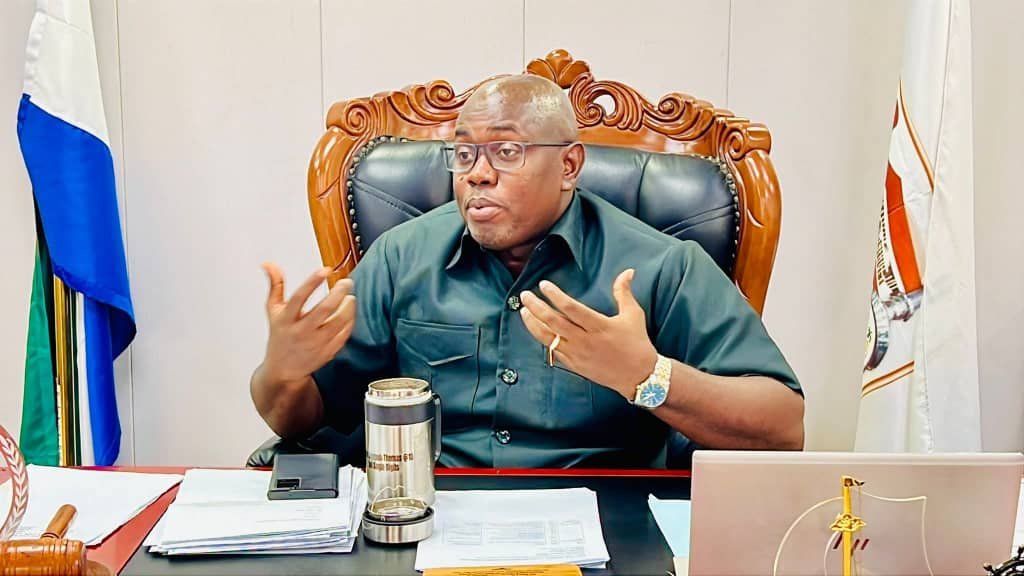
By: Aminata Sesay
In his recent address in the Well of Parliament, Rt. Hon. Segepoh Solomon Thomas, Speaker of the Parliament of the Republic of Sierra Leone has called on Sierra Leoneans to embrace constructive national dialogue regarding the country’s political system, while dispelling widespread misconceptions about the Proportional Representation (PR) system.
He firmly rejected the notion that introducing a Proportional Representation (PR) system at the executive level would lead to a one-party state, describing this perception as a dangerous misconception.
“I refuse to see the link between power-sharing and a one-party system,” he asserted.
The Speaker also challenged what he termed the dangerous and unfounded perception of a “ten-ten years” rotational basis for political power in Sierra Leone.
“Ten Ten Ten years where is it found?” he questioned rhetorically.
He criticized those who oppose PR for believing it is their “turn” to govern, stating that such notions are unconstitutional and divisive.
“There is no ‘turn’ for anybody. The popular candidate wins that is democracy,” he stated firmly.
He revealed that when asked if the PR system should be extended to the executive level, he suggested the need for a national conversation. Acknowledging that no political system is perfect, he said such a dialogue would help identify and address existing gaps.
Explaining the benefits of a PR system, Speaker Thomas emphasized that it ensures inclusivity and equal participation, allowing even small parties that secure a minimum vote percentage to gain representation.
He clarified how this could work in practice, stressing that the president must retain disciplinary authority.
“If the president has the power to hire and fire, even if a political party has 40% representation in the executive, any member who misbehaves can be dismissed, and the president can refer back to that political party for a replacement,” he explained.
The Speaker issued a strong warning against the negative branding of Sierra Leone, which he said threatens national unity. He cited a disturbing claim by a Member of Parliament that employment opportunities are determined by one’s surname and region.
“Such perceptions are harmful,” he cautioned.
He also mentioned that losing parties often discredit the government after elections, damaging the country’s international image. He expressed concern over senior citizens issuing threats on social media about what they would do when they take power.
“That is not healthy for our democracy,” he warned.
Reflecting on Sierra Leone’s civil war, Speaker Thomas urged politicians to learn from history and focus on building a stable future.
“How do you want to leave behind your children in a nation where their opportunities depend on which party is in power?” he asked. “We must do better for the next generation.”
He called on all political parties to convene a national conference to discuss reforming the political system to promote unity.
“We need a political system that leaves no one behind,” he urged.
He continued to firmly reject the claims linking the PR system to a one-party state, describing such assertions as “misleading and dangerous.”
“I refuse to see any link between the PR system and the one-party system,” he stated. “What I want to see as a nation is an open, inclusive dialogue one that examines the kind of political system we truly want for Sierra Leone.”
Rt. Hon. Thomas emphasized that the PR system, when properly applied, promotes political inclusion by ensuring that smaller parties also have a voice in governance. “If you are a small political party and you secure a certain percentage in elections, you should still have a seat at the table. That is how inclusivity works,” he explained.
He further warned against the spread of false information about the country’s electoral framework, referencing rumors that the PR system could extend government tenure to ten years. “It is very dangerous to share false information with the public,” the Speaker cautioned. “Such misinformation breeds mistrust and damages our democracy.”
Calling for a national conference to review the political structure, Rt. Hon. Thomas proposed that political parties, civil society organizations, and citizens come together to define a system that strengthens unity and accountability. “Every political system has its gaps,” he noted. “That is why we need a national conversation to identify these gaps and find lasting solutions.”
The Speaker also lamented the rise of divisive political behavior and regional bias, citing allegations of discrimination in job recruitment based on surnames or regional origin. “When people begin to feel disadvantaged because their political party is not in power, that trend becomes dangerous,” he said. “We are damaging the image of our country, even internationally, all in the name of politics.”
He urged all political actors to prioritize national development over partisan interests, suggesting that political manifestos should align with the country’s long-term development goals. “When one party comes to power, it should focus on executing the agreed national plan,” he emphasized.
Rt. Hon. Thomas concluded by stressing that Sierra Leone’s democracy must evolve through open dialogue and shared national values, rather than political propaganda. “The route we are taking as a nation is not good for all of us,” he warned. “We must come together and have honest conversations about the kind of political system that will unite and move this country forward.”
Concluding his remarks, Speaker Thomas stressed that Parliament must focus on legislating a national development agenda, and that political party manifestos should align with this goal.
“Every party manifesto should explain how it intends to implement the national development agenda. Once all development issues are aligned, Parliament will legislate them,” he concluded.