

By: Mohamed M. Sesay
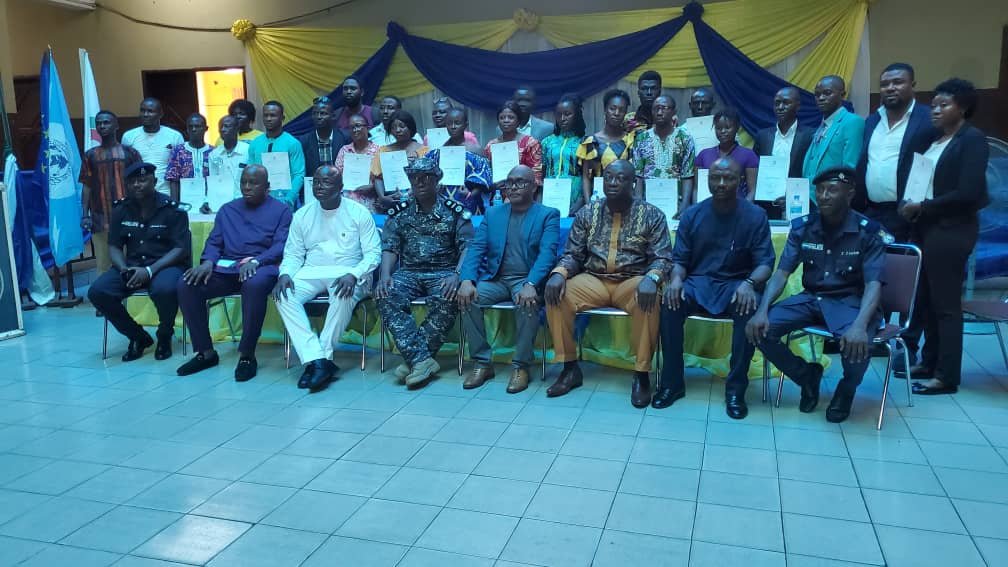
On Friday the 9th of December 2022 after five days intensive and comprehensive training, leadership of the Sierra Leone Police has conferred certificates to twenty-five (25) within the Sierra Leone Police, the Immigration Department and the Anti-Corruption Commission in a bid to fight transnational crimes under he West Africa Police Information sharing programme.
In his early statement during the commencement of the training, the Inspector General of the Sierra Leone Police (IGP), William Fayai Sellu, has stated that the West Africa Police Information System (WAPIS) is close to his heart and therefore, promised to give more budget support for the training of Crime Officers at the Criminal Investigation Department (CID) and encouraged officers at the CID to pay more attention on the WAPIS training.
The SLP Chief Executive Officer disclosed that the last time similar training was held, it was just about quality data but that today they were having another “Protection” being added to the 5 days training, commencing 5 12 2022.
He continued that they now need to work on how to protect the quality data collected because there are laws and those laws need to be customized to fit the Sierra Leone situation. “The quality of information we collect is important and how we protect it is equally important,” said IGP Sellu.
The Police Chief assured the European Union that the government is committed to ensuring WAPIS is sustainable but appealed for more work stations. He added that the country wants to remain integrated to the system as the training prepares officers to address transnational crimes.
IGP Sellu said the WAPIS programme is an extension of INTERPOL – a global information sharing platform, which was born out of the desire for Africa to entrench herself to things happening within her terrain.
The Deputy National Coordinator in the Office of National Security (ONS) Dr. Ahmed A Sannoh underscored the need for the training; noting, that the role of the SLP is to protect lives and properties, to ensure that criminals do not hunt people and put together necessary mechanisms to be able to counter terrorism.
In her statement, the Team Lead Governance, European Delegation (EU) to Sierra Leone, Serena Bertaina, said the event was another step towards the implementation of an integrated WAPIS, which is set to strengthen the security architecture of Sierra Leone and the whole sub-region. She continued that the WAPIS program strives to enhance the capacity of West Africa law enforcement authorities to combat transnational crime and terrorism.
Serena Bertaina pointed out that by supporting the establishment of Crime Management Systems at National level, coupled with building the capacity of the security apparatus to collect, store and share criminal data, WAPIS system is expected to facilitate information sharing amongst ECOWAS member states via INTERPOL secure communication system.
She added that the program aims at supporting the investigation of major international crimes and the front line officers in dealing with the movement of persons and goods at the border points. She stated that the in essence, WAPIS aims at being catalyst for security integration and interagency collaboration and its young embryo recalls the early days of a similar structure of the UE called INTERPOL, established in 1998 to fight against transnational threats such as terrorism, illicit drugs, trafficking in human beings and cybercrimes.
She revealed that data from the African Union shows that porous borders, uncoordinated state security agencies, weak legal regulatory frameworks are the specific challenges that stop ECOWAS member states from clamping down on organized crime.
Given a brief background of WAPIS, the WAPIS Coordinator, Dr. Mohamed Yanseneh, stated that they have come a long way in the implementation of the WAPIS program in the West.
He disclosed that it all started in September 2012 during the WAPCCO General Assembly meeting held in Abidjan, where the program was launched, beginning with four pilot countries in West Africa including Sierra Leone.
The WAPIS Coordinator further explained that since then, the Sierra Leone authorities have worked so hard within the framework of WAPIS implementation in the country and have met all the requirements necessary for the continuity of implementation of the program starting with the signing of the MOU by the Minister of Internal with INTERPOL on the implementation of the WAPIS program in Sierra Leone.
In order to reciprocate of Sierra Leone, he said INTERPOL has deployed 40 workstations in Sierra Leone, especially within the Immigration Department, the Anti-Corruption Commission and the Sierra Leone Police.
He stated that they have conducted three training sessions for 51 Law Enforcement personnel on the use of the system and trained the trainers and that they have also set up the Data Collection and Registration Center at the CID Headquarters in Freetown.