By: Marian Magdalene Bangura
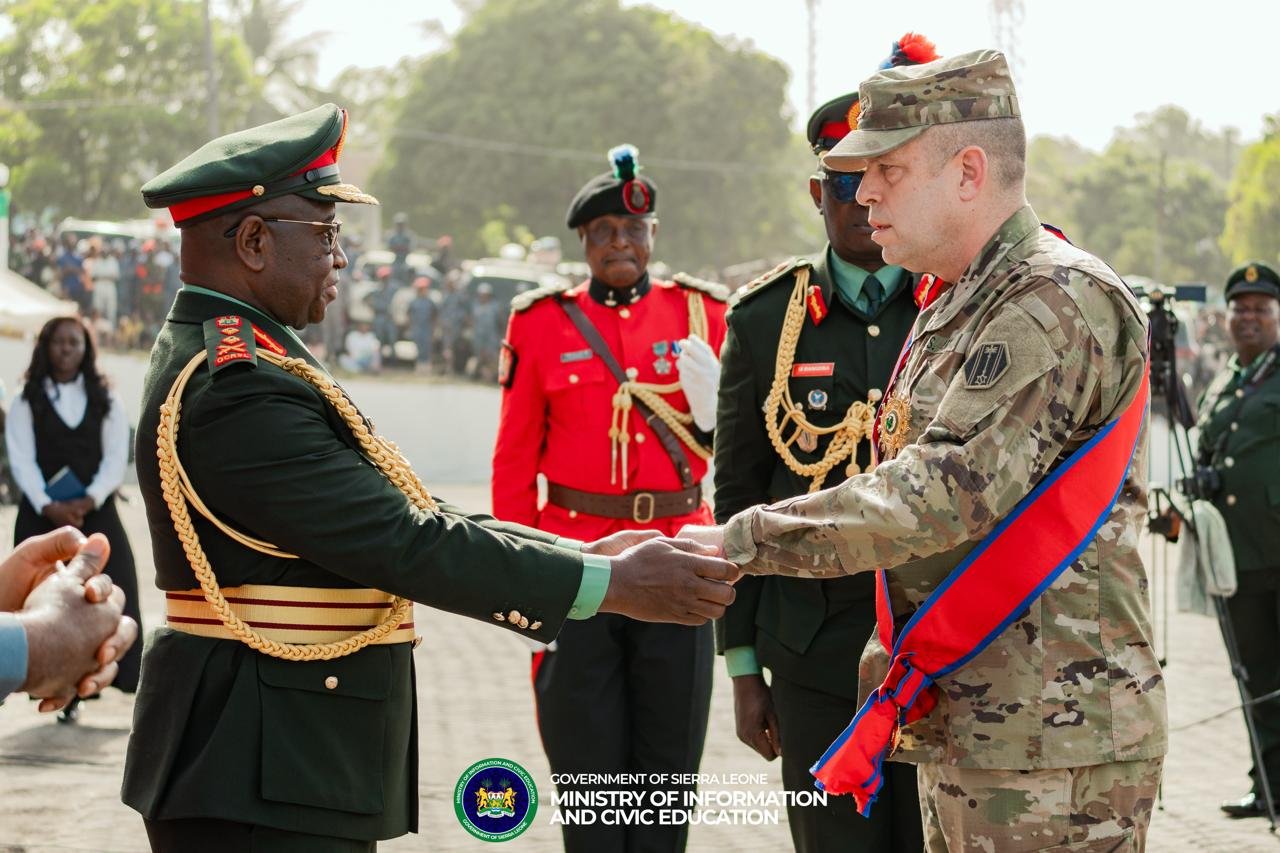
In a historic and moving gesture of national gratitude, His Excellency President Julius Maada Bio has conferred Sierra Leone’s prestigious national honour, the Grand Commander of the Order of the Rokel, on distinguished international military officers who played pivotal roles in helping the country achieve and sustain peace during and after its brutal civil war.
The awards were presented during a grand Armed Forces Day ceremony at the Julius Maada Bio Parade Ground in Wilberforce. The President honoured generals and commanders from Kenya, Nigeria, Ghana, Guinea, the United States, and the United Kingdom nations that stood firmly with Sierra Leone in its most difficult moments more than two decades ago.
President Bio described the conferment as a “correction of history” and an overdue acknowledgment of those who sacrificed for Sierra Leone’s freedom and stability.
“For years, we celebrated our peace but forgot to formally thank those who helped us achieve it,” the President said. “Today, Sierra Leone expresses its gratitude to the brave men and women from across Africa and the world who stood with us when we needed them most.”
The honours also recognized the Republic of Sierra Leone Armed Forces (RSLAF), whose officers and soldiers fought valiantly during the civil war. As a former soldier and peace negotiator, President Bio emphasized that the moment also symbolizes remembrance for Sierra Leoneans who fought, died, and worked tirelessly for peace.
Lieutenant General Daniel Opande served as Force Commander of the United Nations Mission in Sierra Leone (UNAMSIL) from 2000 to 2003. Under his leadership, UNAMSIL became the largest peacekeeping mission in the world at the time, helping to secure disarmament and national stabilization after years of conflict. His steady command restored confidence among both warring factions and civilians.
General Martin Luther Agwai, one of Africa’s most experienced peacekeepers, served in Sierra Leone under the United Nations and later led peacekeeping missions across the continent. His strategic leadership, diplomacy, and professionalism were instrumental in coordinating multinational forces and guiding Sierra Leone toward a peaceful transition.
Major General Oluyede commanded Nigerian contingents under the Economic Community of West African States Monitoring Group (ECOMOG), which spearheaded early military interventions before UNAMSIL’s full deployment. His troops were among the first to secure Freetown and defend civilians during rebel offensives in the late 1990s. Nigeria’s leadership through ECOMOG laid the foundation for lasting peace.
General Bangoura represented Guinea’s critical contribution to Sierra Leone’s stability. Guinean forces protected the northern and eastern borders, thwarting rebel incursions and safeguarding thousands of refugees. Their presence helped prevent cross-border destabilization and reinforced regional solidarity.
Major General Paul Rogers, Adjutant General of the Michigan National Guard, has strengthened bilateral defence cooperation between Sierra Leone and the United States. In 2024, he spearheaded the State Partnership Program (SPP) between Michigan and Sierra Leone, enhancing logistics, military training, and security collaboration. His recognition highlights the enduring partnership between the two nations.
Representing the United Kingdom’s pivotal role during and after the civil war, Major General Edward Butler’s recognition reflects Britain’s steadfast support throughout the conflict and in rebuilding the RSLAF. British military training missions and advisory support were instrumental in professionalizing Sierra Leone’s armed forces and consolidating democratic peace.
The ceremony was more than a symbolic gesture. It served as a powerful reminder that Sierra Leone’s peace was achieved through both national resilience and international solidarity.
The honoured officers represent a generation of cooperation, courage, and shared sacrifice. By recognizing them and their respective nations, President Bio reaffirmed Sierra Leone’s enduring commitment to peace, regional partnership, and global collaboration.
“This is about remembering remembering those who fought for us, stood with us, and believed in Sierra Leone,” the President stated. “Today, we honour them. And in honouring them, we honour ourselves.”