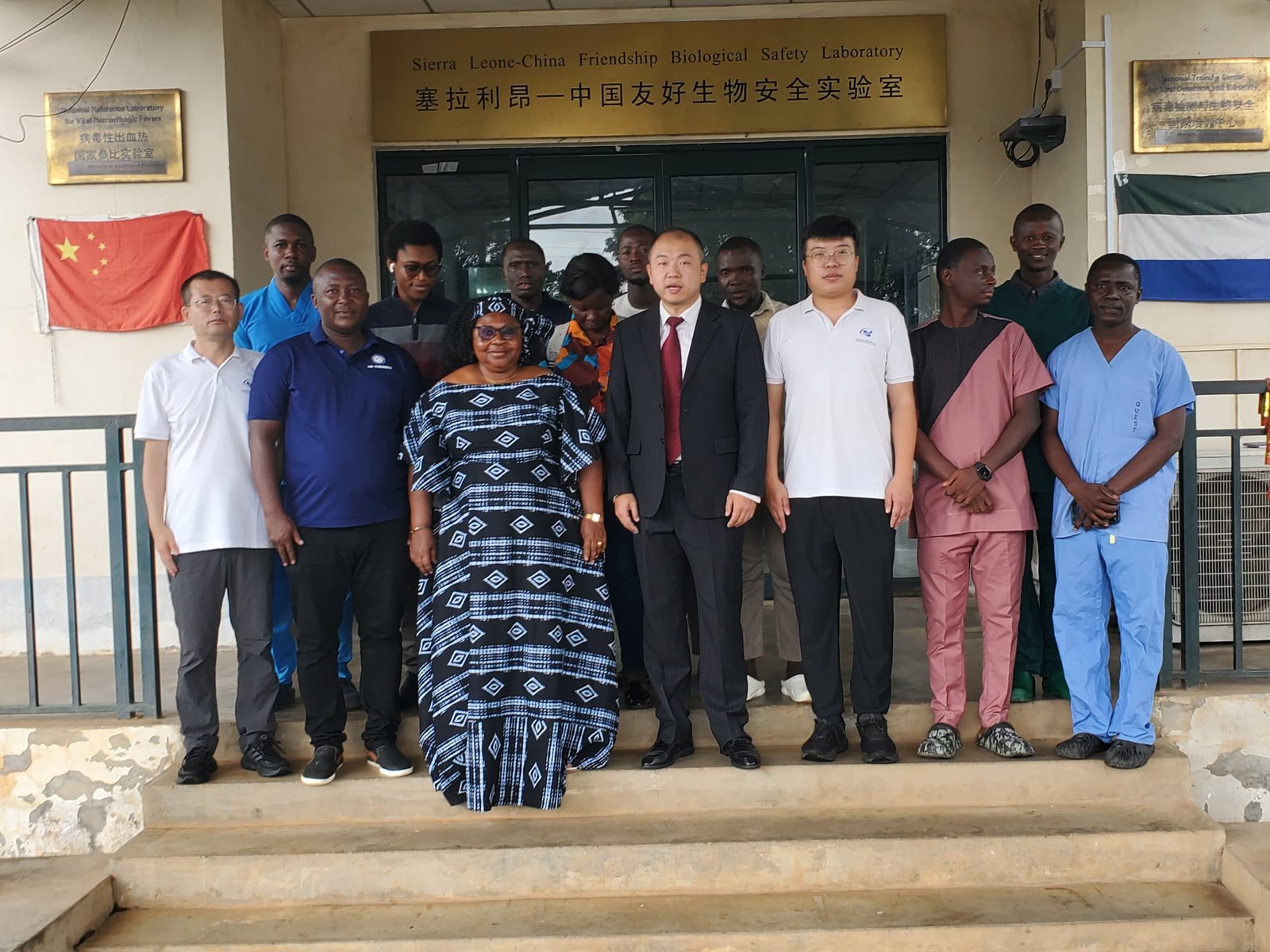
On October 3, 2025, the Sierra Leone-China Friendship Biological Safety Laboratory (SLCFBS Lab), welcomed Doris, Head of the Laboratory Management Division at the National Public Health Agency (NPHA), for an official inspection following the completion of repairs to its Biosafety Level 3 (BSL-3) facility. As Sierra Leone’s only P3 laboratory, its restoration is critical to national health security. Without a functional high-containment facility, the country would be unable to detect and respond to deadly pathogens such as Ebola, Marburg, and Lassa fever, posing a severe public health threat.
During the visit, a comprehensive simulation exercise was organized to evaluate the lab’s operational readiness. The drill simulated the detection of high-pathogenicity pathogens, such as Ebola, using mpox samples to mimic real-world scenarios. All aspects of the laboratory workflow were tested from sample reception and nucleic acid extraction to full diagnostic procedures under strict biosafety protocols. All systems operated seamlessly, confirming the successful repair and readiness for operational use. This practical demonstration reinforced the laboratory’s essential role in Sierra Leone’s public health emergency response.
The SLCFBS Lab’s contributions have been remarkable. Out of NPHA’s 11 affiliated laboratories nationwide, SLCFBS Lab processed 3,198 suspected Mpox samples as of September 27, 2025, confirming 2,702 positive cases accounting for over half of the country’s total 5,342 cases reported by the same date. The lab’s swift and accurate diagnostics provided crucial scientific support for epidemic containment and informed national response strategies, cementing its status as a cornerstone of Sierra Leone’s health security.
This laboratory was established with support from the Chinese government in 2014, during the devastating West Africa Ebola epidemic the largest in history, with over 28,600 cases and 11,300 deaths across Guinea, Liberia, and Sierra Leone. In Sierra Leone alone, nearly 4,000 lives were lost, overwhelming an already fragile health system. The SLCFBS Lab, located in Freetown, became the country’s first and only high-containment laboratory, providing essential testing, technical expertise, and capacity-building that helped contain the outbreak and save countless lives.
Over the past decade, with sustained support from China CDC, the laboratory has played a key role in Sierra Leone’s public health system. It successfully supported the COVID-19 response, Mpox response and continued to address endemic diseases like malaria. These joint efforts have focused on local capacity building, training hundreds of national professionals and enhancing self-reliance in public health management.
Following repairs completed on September 19, 2025, which addressed wear from intensive use, the SLCFBS Lab is again fully functional. This ensures Sierra Leone can safely manage high-risk pathogens and strengthens the surveillance capacity of the NPHA and the Ministry of Health and Sanitation (MoHS). Doris commended the collaboration, stating, “This restoration significantly boosts our outbreak preparedness.”
This achievement coincides with preparations to mark the 10th anniversary of Sierra Leone, with assistance from China, successfully defeating the Ebola outbreak. A series of commemorative events and an international public health academic exchange will be held in Freetown, organized in collaboration with Chinese partners. These activities will reflect on shared achievements, highlight the successes of the SLCFBS Lab, and explore new opportunities for collaboration in global health research and epidemic preparedness.
Looking ahead, Sierra Leone looks forward to continued partnership with China CDC to further strengthen national capabilities in infectious disease prevention and control. Together, both sides will keep enhancing Sierra Leone’s laboratory network and contributing to public health resilience at the national, regional, and global levels.