

By: Saidu Jalloh
Sierra Leone and Germany have renewed their development partnership with a strong focus on food security, education, and youth empowerment, following a high-level joint visit to Karene District that highlighted the impact of the Home-Grown School Feeding Programme.
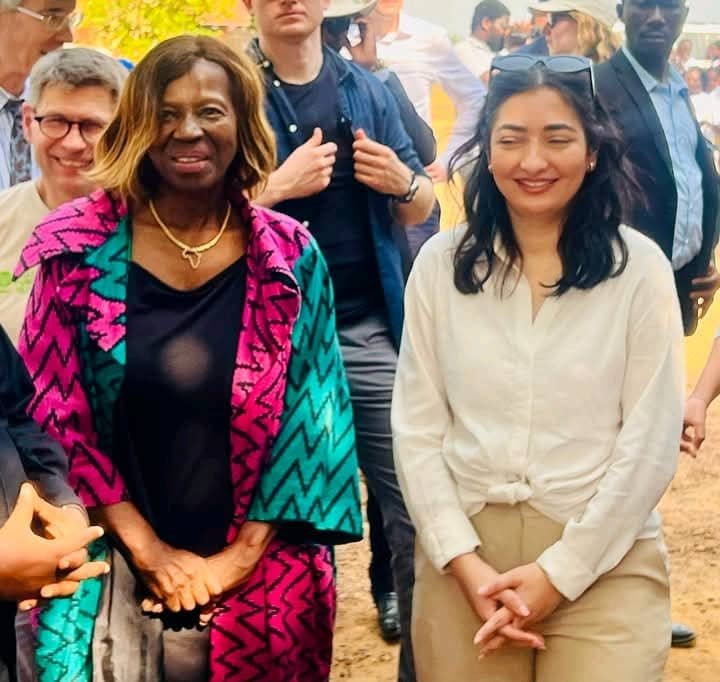
The Minister of Planning and Economic Development, Ms. Kenyeh Barlay, on Tuesday accompanied Germany’s Federal Minister for Economic Cooperation and Development (BMZ), Ms. Reem Alabali-Radovan, on a two-day official visit to Sierra Leone. As part of the visit, the delegation toured Roman Catholic (RC) Primary School in Gbinti, Dibia Chiefdom, where they observed the World Food Programme (WFP)-supported Home-Grown School Feeding Programme, funded by the Government of Germany.
The visit coincided with the launch of the School Meals Accelerator, a global initiative aimed at strengthening national school feeding systems and improving food security for children and young people. The initiative aligns with Sierra Leone’s Big Five Game Changers Agenda, particularly in the areas of human capital development and food security.
Speaking during the visit, the Head Teacher of RC Primary School, Mr. Kamara, commended the programme for its transformative impact on learning outcomes and school participation.
“The provision of school meals has made teaching and learning more effective, drastically reduced truancy, and increased school attendance,” he said, while applauding WFP, the German Government, and the Government of Sierra Leone for the intervention.
He also praised the accompanying infrastructure support. “We appreciate the construction of kitchens, stores, and improved teaching facilities, which have significantly enhanced our capacity to serve pupils. This is a permanent investment in our future leaders.”
The Paramount Chief of Dibia Chiefdom, PC Bai Sheka Bundu, welcomed the delegation and described the programme as critical to improving children’s nutrition, increasing school attendance, and supporting community livelihoods.
Addressing stakeholders, the Minister of Basic and Senior Secondary Education, Hon. Conrad Sackey, emphasized the strong link between nutrition and learning.
“Education cannot succeed on an empty stomach,” he stressed. “School feeding is not an add-on to education; it is a prerequisite for learning. A well-fed child learns better, stays in school, and achieves better outcomes.”
The Resident Minister for the North-West Region, Ambassador Bon-Wurie, reflected on his personal connection to the school and the bilateral partnership.
“This visit is deeply meaningful to me, both as a former pupil of this school and as someone who previously served as Sierra Leone’s Ambassador to Germany and on the WFP Executive Board,” he said, noting that the partnership continues to transform communities across the region.
Germany’s Federal Minister for Economic Cooperation and Development, Ms. Reem Alabali-Radovan, described the visit as inspiring and reaffirmed Germany’s long-term commitment to food security and youth development.
“What we see here demonstrates the importance of investing in school meal programmes,” she said. “When children receive nutritious meals, they have the energy to attend school consistently and pursue their dreams whether as doctors, pilots, lawyers, or future leaders.”
She further revealed that Germany has launched a new development agenda prioritizing food security, children, and youth.
“Nearly all the food used here is locally sourced, making this programme both sustainable and impactful,” she noted, adding that the model is currently operational in more than 150 schools nationwide.
Welcoming the delegation, the WFP Country Director highlighted the strategic importance of the visit as WFP prepares its 2026–2030 Country Strategic Plan.
“We are transitioning from direct food delivery to strengthening national systems and local capacities,” he explained.
“Home-grown school feeding turns schools into reliable markets for local farmers while ensuring that children receive nutritious meals.”
He disclosed that WFP plans to scale up the programme to reach an additional 100,000 children over the next four years, while increasing local food sourcing to 75 percent of supported schools through digital payment systems that ensure timely payments to farmers.
The delegation later visited Newton Village, where Welthungerhilfe (WHH) showcased interventions supporting smallholder farmers, agribusiness development, renewable energy, land governance reforms, and youth skills training. WHH also highlighted its support for the implementation of the Customary Land Rights Act, which promotes equitable land access for women and young people.
Concluding the visit, Minister Kenyeh Barlay reaffirmed the Government of Sierra Leone’s commitment to partnerships that advance national development.
“A well-nourished child learns better and becomes a more productive citizen,” she said. “School feeding is central to our development agenda, and partnerships like this enable us to deliver lasting impact for our people.”
The visit ended with renewed commitments from Sierra Leone, Germany, and development partners to deepen cooperation in food security, education, agriculture, and youth empowerment reinforcing the shared belief that feeding children today secures the nation’s future tomorrow.