

By: Audrey Raymonda John
Growing concern is sweeping across Sierra Leone as hundreds possibly thousands of schoolgirls remain confined in Bondo society bushes under unregulated traditional practices, placing their education, health, and personal safety at serious risk.
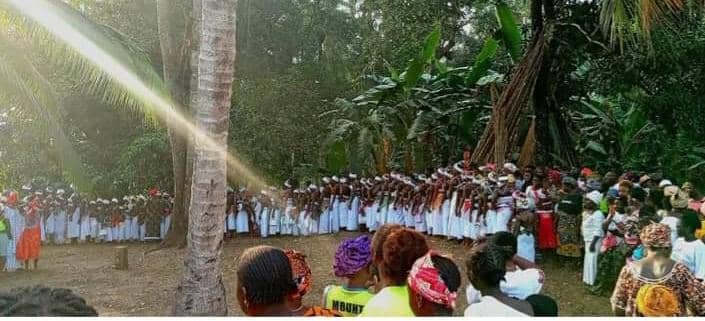
Reports from several districts indicate that girls are being kept in Bondo bushes for extended periods, causing them to miss weeks of schooling. In Gbonkolenken Chiefdom alone, eyewitness accounts suggest that more than 500 schoolgirls are currently confined in Bondo bushes, cut off entirely from formal education.
Parents have raised serious concerns over delays by soweis the traditional women who oversee Bondo initiations in releasing their daughters.
“Since my daughter, Alimatu Sankoh, was taken to the Bondo bush, I have spent millions of leones without even seeing her,” said Alimamy Sankoh of Mawaya Village. “I am deeply worried. The weather is cold, schools have reopened, and it has now been two weeks without her attending classes.”
He expressed regret over allowing his daughter to be initiated, noting that the decision has already disrupted her education.
Across many communities, the situation has become increasingly alarming. Girls are reportedly being held in Bondo bushes without clear oversight, regulation, or timely intervention by authorities, even as the academic term progresses.
The Principal of Mawaya Academy in Patifu Mawaya, Yele Chiefdom, Mr. Albert Joshua, expressed deep frustration over what he described as the continued disregard for girls’ education.
“In my school alone, more than 150 girls have been absent for the past two weeks,” he said. “This is heartbreaking and extremely frustrating.”
Mr. Joshua criticized traditional leaders for allowing girls to be kept in Bondo bushes during the school term, warning that the practice contributes significantly to poor academic performance among girls. He called on the government to urgently regulate women’s secret societies whose activities undermine education.
Similarly, Isata Turay from Mayorpoh Chiefdom in Tonkolili District described the prolonged confinement of schoolgirls in Bondo bushes as a violation of their fundamental rights. She also highlighted the financial burden initiation places on families already struggling to make ends meet.
These developments come amid a renewed surge in Female Genital Mutilation (FGM) across Sierra Leone. Since December, safeguarding organisations have documented widespread reports of girls being subjected to cutting in multiple districts, with indications that more mass initiations are planned in the coming weeks.
This escalation follows Parliament’s recent passage of legislation that failed to include an explicit ban on FGM a decision that has sparked deep concern among activists and child rights advocates.
Civil society figures, including Madam Rugiatu Neneh Turay, argue that without a clear legal prohibition, enforcement agencies lack the authority to intervene, allowing harmful practices to continue unchecked.
As a result, girls are not only subjected to cutting but are also kept out of school for prolonged periods under the guise of tradition.
Activist Turay described the situation as evidence that government commitments to Free Quality Education are not being fully upheld.
“Many girls have died, others are still trapped in bushes, and nothing is being done,” she said. “FGM has severe health consequences and continues to push girls backwards socially, educationally, and economically.”
Activist Alimatu Dimonekene, Founder of A Girl At A Time, warned that the absence of an explicit legal ban places girls in immediate danger.
“We are extremely concerned,” she said. “It appears the government is unable or unwilling to act. I currently have a live petition that has reached over 500,000 people worldwide, yet there has been no meaningful response.”
Across Sierra Leone, generations of women and girls have faced educational disadvantage due to unregulated secret societies and harmful traditional practices. The current wave of FGM, coupled with the absence of a clear legal ban, has intensified fears that hard-won progress on girls’ rights is being reversed.
Safeguarding advocates warn that unless the government takes urgent action to outlaw FGM and regulate traditional practices, thousands more girls remain at risk of abuse, lost education, and lifelong trauma.
For many families, the question is no longer whether change is needed, but how many girls must suffer before decisive action is taken.