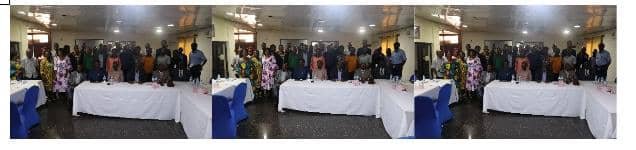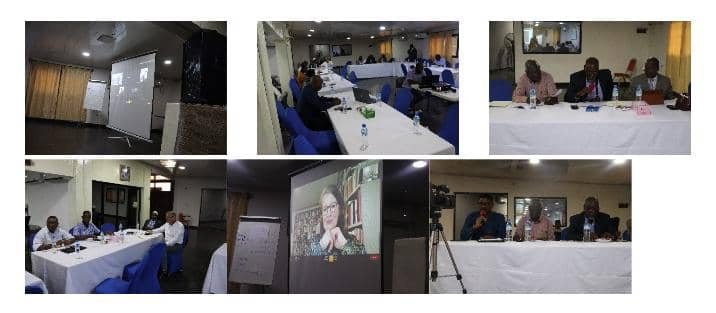
The National Council for Technical Vocational and Other Academic Awards (NCTVA) and the Ministry of Technical and Higher Education (MTHE) have held a workshop on the National Qualifications Framework (NQF) on Thursday, February 23rd, at the Family Kingdom Resort at Aberdeen in Freetown. The event attracted a host of stakeholders and international partners.
The opening session was chaired by Mr. Gilbert Cooper, Permanent Secretary at the Ministry of Technical and Higher Education. He observed that the framework is a very important one especially in the 21st century and called on all participants to make meaningful contributions during the deliberations.
Giving the welcome address, the Chairman of NCTVA, Prof. Abdul Babatunde Karim said that competence based education and training should now be a focus. He reiterated that for development to be achieved, TVET should be seen at the forefront and as a catalyst. He added that concerted efforts were therefore needed to ensure that the NQF is fully implemented and realized across all levels. He expressed gratitude to the World Bank and GIZ for supporting this venture
There was a statement from the Ag. Director of TVET at MTHE, Mr. Abdul A.B. Senesie who pointed out that for the NQF to be fully realized and implemented, the process has to be followed and that due diligence has to be carried out. Chairperson of Sierra Leone’s National Qualifications Framework Committee, Prof. Jonas Redwood-Sawyerr spoke about how the process has been very impactful and coordinated.
Making a statement on behalf of GIZ, Mr. Rudolf Shnieder said that the evaluation of the framework is very necessary in enhancing effectiveness and to equally harmonize things. He said that they were hopeful that the discussions and deliberations would be fruitful.
Giving the Keynote Address, the Deputy Minister of Technical and Higher Education, Mr. Sarjoh Aziz Kamara said that the framework seeks to aid in transforming education among other things. He noted that there have been broad based representations in the entire process and that same will ensure national and international progress. He recalled how there had been numerous forms of support for strategic partnerships and thanked the GIZ and the World Bank as key sponsors. Mr. Kamara added that a lot of reforms have taken place with the addition of new Technical universities and Government Technical Institutes in the educational system. Whilst making reference to how the private sector has also been very instrumental in all of this, he emphasized that they should also not be left out in the NQF. Such, he said, will aid in enhancing national development. He further called for effective and robust monitoring of the entire processes as to clearly realize the desired results and to finalize things on time.
Senior Human Capital Development Expert from the Qualifications Africa Team, Madam Eduarda Castel Branco of the European Training Foundation made an invaluable on line presentation during the technical session and touched on a wide range of topics that can enhance the work of the Technical Working Group. She advised the country to take advantage of Technical assistance and other support that will be available in the next cycle of the Africa Continental Qualifications Framworks project expected to start in April this year.
There were further discussions on the status of current work which was done by Ing. Alpha Badamasi Savage, ToR of the technical working group, NQF processes, table of contents and action points made by Lucas Dublemann, Morlai Mansaray and Abdul Rahman Sesay of NCTVA. Other participants included Mr, Samuel Weekes of the Spheire project, Prof Alieu Bah and Ing Alfred Abu of Njala University, Dr Sam Kargbo of UNIMAK, Eidleen Elba of Job Search, Dr. Mathew Gboku of SLARI and the GIZ team. The taking of a group photo climaxed the event.