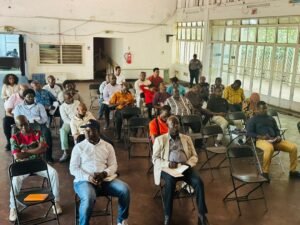
In a decisive effort to promote effective dialogue and enhance collaboration across the Downstream Petroleum Industry, the National Petroleum Regulatory Authority (NPRA) has engaged the Sierra Leone Petroleum Transportation Association and petroleum dealers at the Authority’s headquarters in Freetown. The meeting is part of NPRA’s strategic preparation for 2026, which is expected to be another year of major industry deliverables.
Chairing the meeting on behalf of the Director General, the Deputy Director General, Evangelist Alfred M. Kobba, stated that the engagement was long overdue. He explained that the Director General had intended to hold this meeting as far back as late October to identify potential irregularities and address them before the New Year. Such proactive engagement, he noted, would ensure collective progress and strengthen stability among all industry stakeholders.
The Deputy Director General further reaffirmed NPRA’s strong commitment and firm determination to enforce stringent regulations and standards aimed at preventing unforeseen challenges that could jeopardize the sector. He emphasized that discussions would focus primarily on two key agenda items: Licensing and Inspection, and Engineering and Quality Assurance.
Speaking during the engagement, the Director of Licensing and Inspection, Mr. Jayah K. Muana, commended petroleum dealers for their prompt attendance and applauded their ongoing cooperation with the Authority. He outlined the core mandates of the NPRA, which include overseeing, licensing, regulating, and monitoring all petroleum products nationwide—from importation and export to bunkering, distribution, transportation, and retailing. He added that the Authority executes these mandates in alignment with the revised pricing formula while regulating all activities within the Downstream Sector.
Mr. Jayah underscored that compliance remains central to growth in any regulatory environment. Compliance, he explained, means adhering to established policies for the benefit of regulators, Oil Marketing Companies, and petroleum dealers alike. He noted that the insistence on strict compliance and safety standards is driven by the nature of the petroleum sector hazardous, politically sensitive, unpredictable, and highly volatile. For these reasons, he said, the NPRA will not compromise on safety or compliance. He urged petroleum dealers to innovate and adopt modernized safety measures at all service and gas stations, stressing that the Authority will be vigilant and firm in the New Year.
The Deputy Director of Engineering and Quality Assurance, Ing. Alusine Barrie, provided clarification on the differences between Filling Stations and Service Stations. He explained that a Filling Station primarily stores petroleum products for public sale, while a Service Station offers additional facilities such as car washes, mini-marts, pharmacies, and restaurants. He added that a properly designed Filling Station with office space, storage facilities, canopy, and tank farm requires at least two plots of land, while a functional Service Station requires a minimum of three plots.
Addressing the meeting on behalf of petroleum dealers, the Secretary General of the Petroleum Union, Mr. Mohamed Sillah, appealed for consideration toward dealers who have frequently violated industry regulations. He asked the Authority to exercise calmness and understanding when enforcing strict compliance measures in the New Year. He further requested that NPRA share the names of potential defaulters so the union can engage them internally and work toward addressing the issues.