

By: Audrey Raymonda John
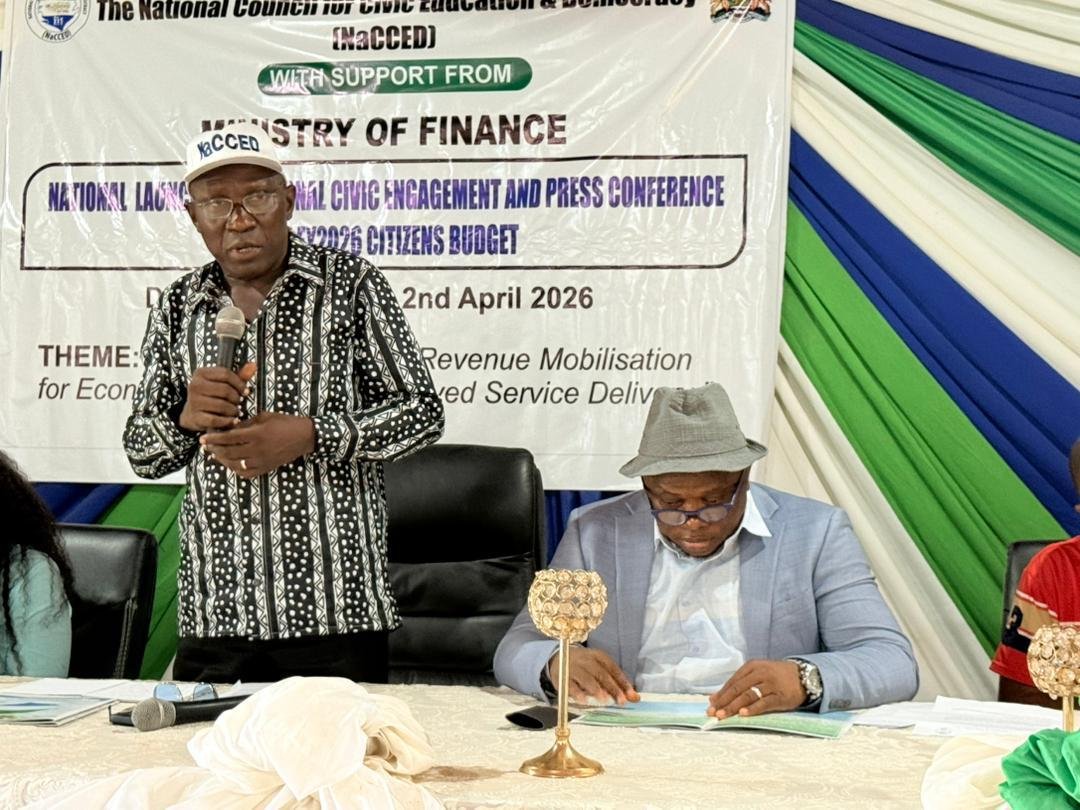
The National Council for Civic Education and Democracy (NaCCED) has conducted a Citizens’ Budget engagement in Kenema, aimed at promoting transparency and accountability in governance through public understanding of the 2026 National Budget.
The event, held on March 30, 2026, at the Kenema District Council Hall, brought together citizens, government officials, and civil society representatives to discuss key aspects of the national budget and encourage public participation in monitoring government spending.
Madam Adama C. Kallon, Chairperson of the District Budget Oversight Committee, explained that the Citizens’ Budget is a simplified version of the National Budget designed to make government financial information more accessible to the public.
“We are not here just to discuss and have lunch,” she said, urging participants to take the knowledge gained back to their communities and actively monitor the use of public resources.
NaCCED Chairman, Joseph Munda Bindi, highlighted the importance of citizen engagement in budget oversight, noting that such initiatives foster inclusivity, accountability, and transparency in governance.
He disclosed that NaCCED plans to conduct similar stakeholder engagements in all regional headquarters across the country. These sessions will involve a wide range of participants, including paramount chiefs, resident ministers, local council representatives, and civil society organizations.
The theme of the 2026 National Budget “Enhancing Domestic Revenue Mobilization for Sustainable Economic Stability and Improved Service Delivery” was central to discussions during the engagement.
Mr. Bindi emphasized that the Citizens’ Budget initiative promotes open dialogue between government and citizens, builds local capacity for budget oversight, and ensures that public feedback informs national priorities.
The engagement provided an interactive platform for participants to ask questions, seek clarification on budget allocations, and contribute ideas on improving service delivery. Citizens were encouraged to play an active role in holding public officials accountable.
Also speaking at the event, Deputy Minister of Information and Civic Education, Sheikh Aziz Bockarie Bawoh, commended the leadership of President Julius Maada Bio. He noted that the establishment of NaCCED reflects the government’s commitment to civic education and participatory governance.
He added that the government’s vision is to ensure citizens are well-informed and actively involved in decision-making processes.
NaCCED reaffirmed its commitment to expanding the initiative nationwide, with similar engagements planned in other regional headquarters to deepen public understanding of governance and budgeting processes.
The event featured a PowerPoint presentation followed by a question-and-answer session, allowing participants to engage directly with officials. Attendees praised the initiative, describing it as a significant step toward strengthening transparency, accountability, and good governance in Sierra Leone.