

By: Aminata Sesay
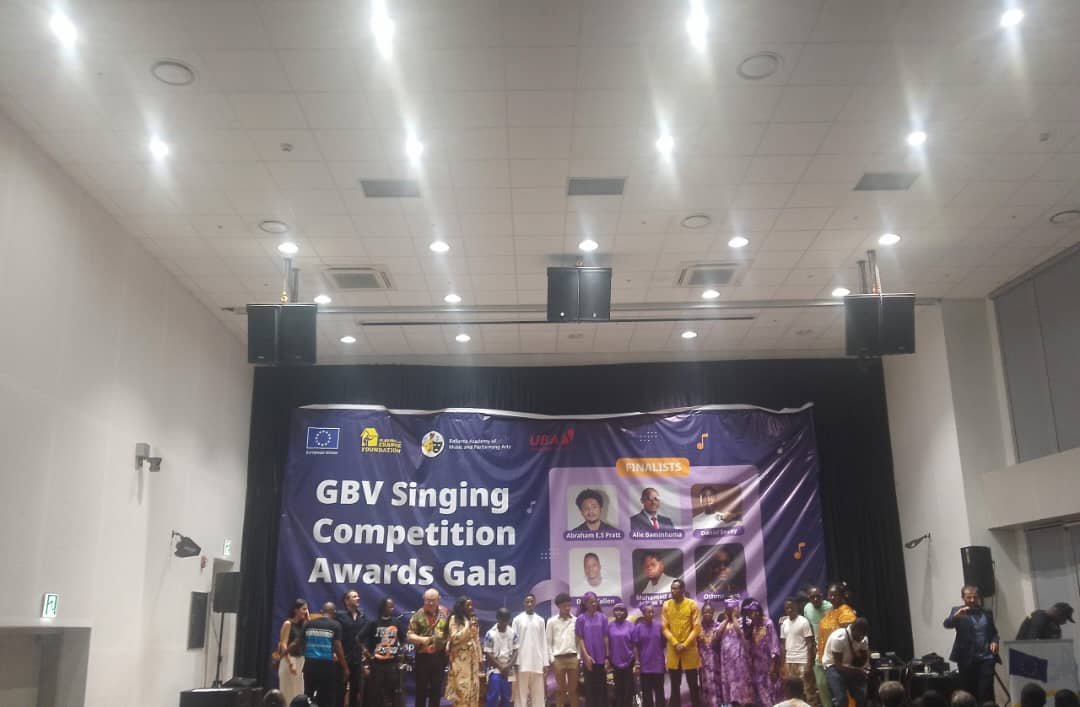
The grand finale of the Gender-Based Violence (GBV) Song Competition brought together government officials, diplomats, artists, young people and human rights advocates at Freetown City Hall, using the power of music to confront one of Sierra Leone’s most pressing human rights challenges.
The event was hosted by the Ballanta Academy of Music and Performing Arts, in partnership with the European Union (EU), Play for Change Foundation, and United Bank for Africa (UBA). It formed part of activities marking the final week of the global 16 Days of Activism Against Gender-Based Violence.
Opening the programme, the Principal of Ballanta Academy, Elvina M.J. Boston Kamara, described the competition as more than entertainment, but a platform to “lift voices, break silences and stand in solidarity with survivors of gender-based violence.” She highlighted Ballanta’s role since its establishment in 1995 as the country’s only institution of its kind, dedicated to nurturing musical talent while driving social change through the arts.
The EU Ambassador to Sierra Leone, Jacek Jackowski, said the competition aimed to become “the new soundtrack of change.” He noted that gender-based violence remains one of the most pervasive human rights violations globally and in Sierra Leone, often thriving in silence and shame. According to him, the overwhelming response 107 submissions from young people across the country demonstrated that Sierra Leone’s youth are ready to lead the fight against GBV.
“Music speaks where words fail,” the ambassador said, stressing that the competition was not a one-off initiative but part of the EU’s broader commitment to ensuring that women and girls live freely, safely and without fear.
Representing the Mayor of Freetown, Deputy Mayor Kweku Melvin Lisk Esq. said the event stood at the intersection of art and advocacy. He thanked the European Union and Ballanta Academy for using creativity as a tool for empowerment and urged society to translate the messages from the stage into collective action against violence, discrimination and inequality.
Delivering the keynote address, the Minister of Gender and Children’s Affairs, Isata Mahoi, described sexual and gender-based violence (SGBV) as a pervasive menace that weakens families and the fabric of society. She revealed that between 2023 and 2025, the national 116 hotline and One Stop Centres recorded approximately 183,000 cases of SGBV, underscoring the scale of the challenge.
The minister outlined key legal and policy reforms, including the amended Sexual Offences Act, the Gender Equality and Women’s Empowerment Act, and the Child Rights Act, while acknowledging existing gaps such as the limited number of safe homes for survivors. She called for stronger community engagement, sustained partnerships and greater investment in women’s economic empowerment as critical tools in preventing violence.
Speaking on behalf of the judging panel, Chief Judge Christopher James Lunde described the competition as a “call to action,” noting that the eight finalists selected from more than 100 contestants were not only musicians, but activists using art to demand safety, dignity and justice.
Throughout the evening, finalists performed original songs reflecting pain, resilience, hope and defiance, transforming lived experiences into powerful messages against gender-based violence. Organisers said the performances were designed to inspire empathy, spark dialogue and mobilise communities toward lasting change.
As the curtains closed, speakers and partners reaffirmed their commitment to sustaining the momentum beyond the 16 Days of Activism, united by a shared message echoed throughout the night: music can move hearts, challenge silence, and help build a society free from gender-based violence.