

By: Saidu Jalloh
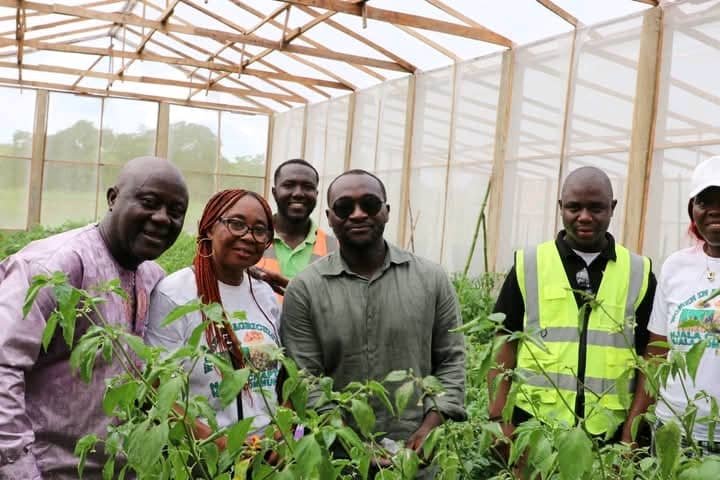
The Minister of Agriculture and Food Security, Dr. Henry Musa Kpaka, has officially launched the Ministry’s 2026 Service Delivery Agenda with a citizen engagement forum at Njala University, where he handed over four irrigated greenhouses and a Chinese 14th Phase Agricultural Technology Facility, and conducted a symbolic harvest of sweet peppers.
The facilities were provided under the World Bank-funded Food System Resilience Program (FSRP) as part of ongoing efforts to strengthen agricultural research, innovation, and climate-smart practices in support of the Government of Sierra Leone’s flagship Feed Salone initiative.
Handing over the facilities, Dr. Kpaka reaffirmed the Government’s commitment to linking research institutions with national food security priorities. He described Njala University as a strategic partner in Sierra Leone’s agricultural transformation, noting that the new infrastructure would enhance practical research, youth skills development, and year-round food production.
“Njala University remains a strategic partner in driving agricultural transformation. These facilities will strengthen practical research, youth skills development, and year-round production in support of Feed Salone,” Dr. Kpaka stated.
During the symbolic harvest of sweet peppers grown in the greenhouses, the Minister emphasized that Feed Salone goes beyond rice production. He explained that significant investments are also being made in vegetable production through FSRP funding, and urged women and young people to embrace vegetable farming as a short-cycle, labour-friendly venture capable of generating income and improving household nutrition.
The FSRP Project Manager, Dr. Kepifri Lakoh, noted that the intervention is deliberately targeted at women and students to promote inclusive economic growth and nutrition-sensitive education. He said the initiative aligns with FSRP’s objective of building resilient food systems nationwide.
“By investing in modern infrastructure at Njala University, we are supporting innovation, technology transfer, and evidence-based solutions that will benefit farmers across Sierra Leone,” Dr. Lakoh remarked.
Receiving the facilities, the Vice Chancellor of Njala University expressed appreciation to the Ministry of Agriculture and Food Security and its development partners. He said the greenhouses and technology facilities would significantly enhance the university’s teaching, research, and community outreach, while contributing to national agricultural development.
The initiative is supported by key partners including the World Bank, World Bank Africa, the World Food Programme (WFP), the International Fund for Agricultural Development (IFAD), and the International Institute of Tropical Agriculture (IITA), under a broader framework aimed at strengthening Sierra Leone’s food system resilience.