

By: Fatmata Grace Okekearu, Bo City
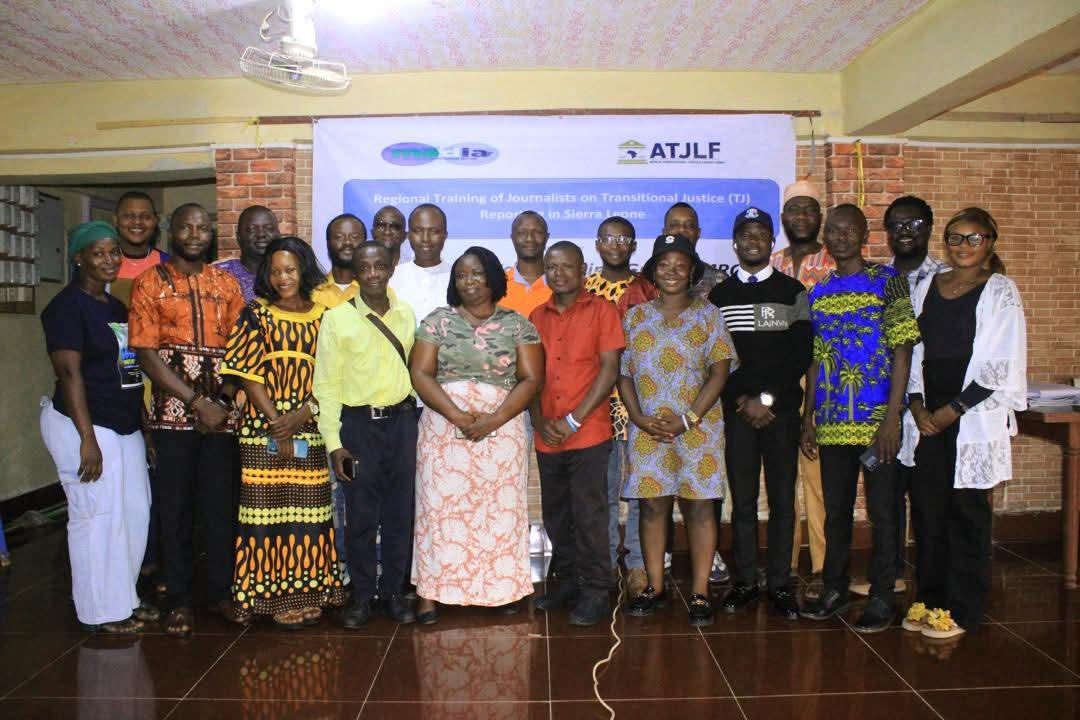
Enhancing journalists’ understanding on transitional justice issues, the Media Reform Coordinating Group Sierra Leone with funding and technical support from the Africa Transitional Justice Legacy Fund (ATJLF), has conducted a one-day capacity-building workshop for journalists from Sierra Leone’s Southeastern region. Held in Bo on Friday, September 19, 2025, the training focused on strengthening their ability to report accurately, sensitively, and effectively on issues of post-conflict accountability and peacebuilding.
The workshop covered several key thematic areas, including introduction to transitional justice, aims of the transitional Justice Process, media and transitional justice, transitional Justice Mechanisms and reporting on transitional Justice in West Africa.
Transitional Justice is a globally recognized framework that seeks to address gross human rights violations committed during periods of civil conflict, political repression, or systemic abuse. Its goal is to confront past atrocities, provide justice for victims, and establish the foundation for lasting peace.
Sierra Leone remains a significant case study in the implementation of transitional justice. Following its decade-long civil war, which ended in 2002, the country introduced mechanisms such as the Truth and Reconciliation Commission (TRC) and the Special Court for Sierra Leone (2001–2004), to promote justice, reconciliation, and national healing.
Dr. Francis Sowa, National Coordinator of MRCG, opened the session by emphasizing the continued relevance of transitional justice in Sierra Leone’s current socio-political landscape.
“Many of the factors that triggered the civil war are resurfacing in different forms,” Dr. Sowa warned. “We must engage in dialogue, reflect, and act to prevent a recurrence of conflict. Training journalists and holding community engagements are vital to reshaping narratives and preserving the hard-earned peace.”
He further stated that MRCG’s broader objective is to cultivate a network of informed journalists capable of translating complex transitional justice topics into compelling stories that foster public awareness and democratic accountability.
Participants hailed the training as both timely and empowering. Veronica Diana Fillie Blackie, Southern Regional Secretary-General-elect of the Sierra Leone Association of Journalists (SLAJ), and Sir Albert N. Kanu, Production Manager of Soa Community Radio in Kono, praised the initiative, calling it “a right step in the right direction.” They pledged to apply the knowledge gained to inform and educate citizens on justice, peace, and national development.
“This training has equipped us with tools to report more accurately and sensitively on issues of justice and reconciliation,” said Ms. Blackie. “Such reporting is critical to sustaining the peace Sierra Leone has enjoyed for over two decades.”
The Bo workshop forms part of a nationwide series of regional trainings aimed at increasing media engagement in peacebuilding and transitional justice reporting. Upon completion of these sessions, MRCG will launch a Transitional Justice Reporting Fellowship, which will provide selected journalists with six months of mentorship and support to produce in-depth stories on transitional justice themes.
Through this initiative, MRCG and ATJLF aim to ensure that the Sierra Leonean media continues to serve as a watchdog and public educator reinforcing democratic values and helping preserve the nation’s hard-won peace.