

By :Fatmata Grace Okekearu, Bo City
As part of ongoing efforts to promote people-centred land governance in Sierra Leone, Land for Life Sierra Leone has conducted a one-day District Cluster Training for members of the District Multi-Stakeholders Platforms (DMSPs) on key provisions of the country’s land laws and the use of the standardised Chiefdom Land Governance Pack.
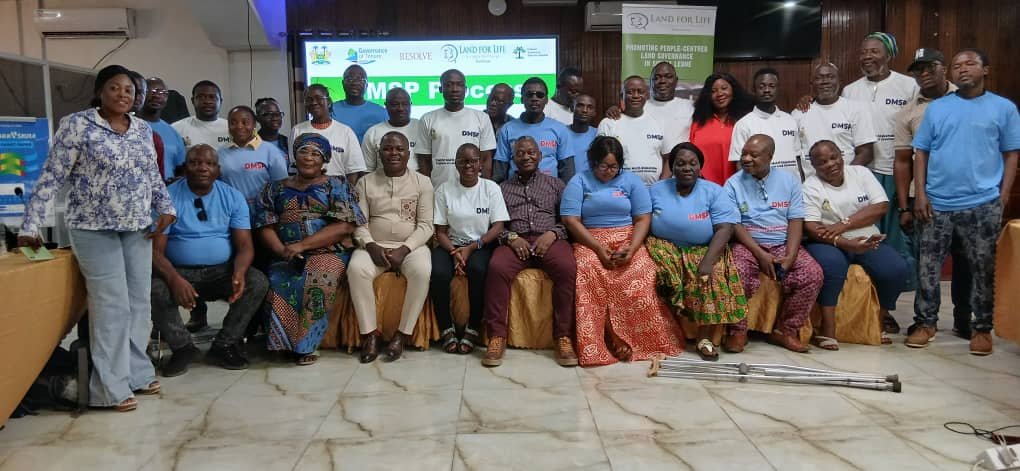
The training, held over the weekend at the Wizard Conference Hall along Dambala Road in Bo City, brought together DMSP practitioners from Bo, Kenema, and Pujehun districts. The objective was to strengthen stakeholders’ understanding of land governance frameworks and enhance collaboration at district and community levels.
Addressing participants, the National Coordinator of Land for Life Sierra Leone, Mr. Bangs Komba Lebbie, emphasized that the organization works closely with a range of institutions particularly the DMSPs to advance effective, inclusive, and accountable land governance across the country.
He explained that the engagement was designed to consolidate knowledge, deepen understanding, and strengthen collaboration among stakeholders to ensure the effective implementation of land governance reforms. According to Mr. Lebbie, Sierra Leone’s land sector has historically faced numerous challenges, including weak land administration systems, boundary disputes, multiple land sales, ownership conflicts, and the arbitrary conversion of land rights.
Mr. Lebbie noted that Land for Life Sierra Leone remains committed to addressing these challenges by working with partners to support the implementation of the 2022 Land Laws in selected pilot communities.
“As part of government-led reform mechanisms, Land for Life, in collaboration with its partners, is supporting the implementation of the 2022 Land Laws to formalize community-based land management systems, enhance transparency through standardized governance tools, and empower communities through the effective operationalization of the National Land Commission Act and the Customary Land Rights Act,” he stated.
He further explained that the DMSP framework is designed to promote inclusive decision-making processes in land governance, safeguard the rights of families and vulnerable groups, and provide equitable mechanisms for land access and dispute resolution.
Mr. Lebbie also highlighted that the establishment of the District Multi-Stakeholders Platforms was intended to create inclusive governance structures at the grassroots level, particularly through Town/Village Area Land Committees and Chiefdom Land Committees. These structures are responsible for formalising community land ownership by recording customary land rights and ensuring that such rights are legally documented and protected.
He stressed that for land governance reforms to succeed, the National Land Commission must work in close collaboration with DMSP structures to guarantee transparency, accountability, and sustainability in land administration nationwide.
In separate remarks, the Land Commissioners for Bo and Kenema districts reaffirmed their institutions’ commitment to working closely with the DMSPs. They described the platforms as a vital local-content approach for effectively rolling out and implementing the provisions of the twin 2022 land laws enacted by the Government.
The training marked another important step towards strengthening land governance systems and empowering communities to actively participate in the management, protection, and sustainable use of their land rights.