

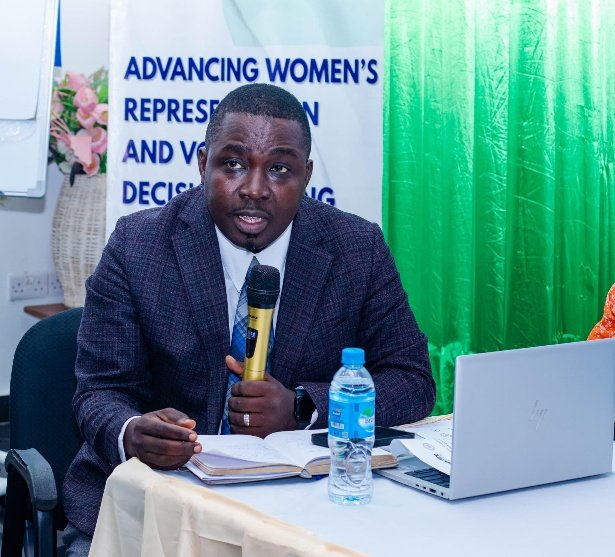
By: Aminata Sesay
Civil society advocate Sahr Kendema has warned that Sierra Leone’s ongoing constitutional review process risks once again marginalizing women’s political rights unless urgent steps are taken to entrench gender parity provisions before the proposed Constitutional Amendment Bill advances further in Parliament.
Speaking in an interview, Kendema recalled that the first draft of the Constitutional Review Committee (CRC) Report, released in February 2016, failed to include key gender equality measures, including guaranteed quotas for women in elective and appointive positions. He said the omissions sparked nationwide criticism, particularly from women’s organizations, who felt their long-standing demands were being ignored.
“The 2016 draft Constitution did not provide for absolute parity or even the minimum 30 percent representation for women that is already guaranteed in several African constitutions,” Kendema said.
He cited examples from Senegal, Angola, Zimbabwe, South Africa, and Uganda, where constitutional or legal frameworks explicitly protect women’s participation in governance.
According to Kendema, the draft also failed to reserve council seats for women at the local government level, omitted guarantees for gender balance in Parliament and judicial appointments, and retained discriminatory provisions such as Section 27 of the 1991 Constitution. These gaps, he noted, directly contradicted the recommendations of Sierra Leone’s Truth and Reconciliation Commission (TRC), which identified women’s empowerment as central to post-war recovery and democratic consolidation.
In response to public outcry at the time, women’s organizations regrouped with encouragement from the President, culminating in a National Women’s Conference held on 24 March 2016. The conference was coordinated by Kendema and organized by the Campaign for Good Governance, with support from Trócaire–Sierra Leone.
The conference produced the landmark 19-Point Women’s Empowerment Resolutions, titled “Many Messages, One Voice.” Central among the resolutions was the demand that no more than 50 percent of elective and appointive positions be occupied by one gender. The resolutions also called for mandatory gender balance in Parliament, the judiciary, and constitutional commissions.
Additionally, the resolutions urged political parties to field women candidates in at least 50 percent of constituencies and wards, with sanctions for non-compliance.
Nearly a decade later, Kendema warned that history could repeat itself if stakeholders fail to critically examine the current constitutional amendment process. He called on the Attorney General and Minister of Justice to immediately make public the full 2025 Constitutional Amendment Bill, which was laid in Parliament for first reading on 27 January 2026.
“With the second reading expected within weeks, this is a very narrow but decisive window,” he said. “If women’s priority issues are not firmly secured now, the opportunity for transformative constitutional reform may be lost for decades.”
Kendema urged civil society organizations, women’s groups, the media, donors, diplomats, and development partners to jointly review the 2016 Women’s Empowerment Resolutions and the 2024 Women’s Communiqué against the Government White Papers of 2017 and 2021.
He proposed that stakeholders urgently distil these documents into a single, one-page set of priority recommendations to influence the final text before any referendum is held.
Drawing parallels with the coordinated advocacy that led to the passage of the Gender Equality and Women’s Empowerment Act, 2022, Kendema stressed that unity remains the most effective strategy for reform.
“When women and their allies speak with one voice, change happens,” he said.
“The Constitution must reflect that same principle many messages, one voice if it is to truly represent the people of Sierra Leone.”