

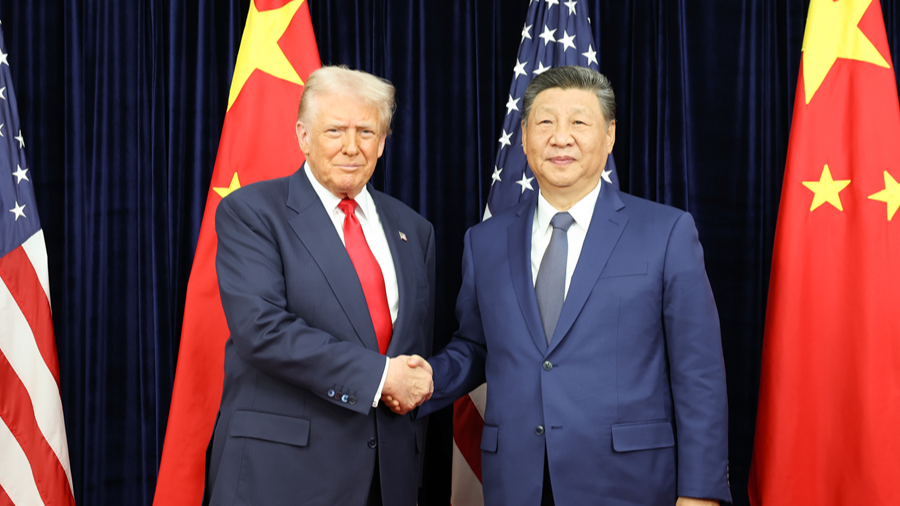
Following the previous five rounds of economic and trade talks held in Geneva, London, Stockholm, Madrid and Kuala Lumpur between May and late October 2025, China and the United States are set to hold a new round of talks, scheduled for March 14-17, in Paris, France, demonstrating that dialogue and cooperation remain the correct way forward for the two countries.
Head-of-state diplomacy plays an irreplaceable strategic role in steering China-US relations. Guided by the important consensus reached between Chinese President Xi Jinping and US President Donald Trump, the two countries’ economic and trade teams have achieved positive outcomes through multiple rounds of talks over the past year.
These agreements reflect the spirit of equality, respect, and mutual benefit and have helped steer China-US economic and trade relations toward sound, stable and sustainable development.
Steering China-US ties
In 2025, Chinese President Xi Jinping and US President Donald Trump maintained close communication through various means, such as telephone calls and a face-to-face meeting.
The phone calls between the two presidents served as important bridges for strategic communication. In a phone conversation last June after China-US economic and trade talks in Geneva, Switzerland, which set in motion a series of subsequent bilateral economic and trade talks, Xi stressed that it was “particularly important” for the two leaders to steer clear of various disturbances and disruptions.
Xi said the Geneva talks marked an important step toward resolving relevant issues through dialogue, calling on both sides to make good use of the economic and trade consultation mechanism already in place and seek win-win results in the spirit of equality and respect for each other’s concerns.
The Chinese always honor and deliver on their promises, Xi said, urging the two sides to make good on the agreement reached in Geneva.
In another phone conversation last September after the fourth round of economic and trade talks in Madrid, Spain, Xi hailed the dialogue process, adding that the two sides can continue to handle any outstanding issues in bilateral relations through appropriate channels and strive for win-win outcomes.
A key milestone in China-US ties came when the two heads of state met in the Republic of Korea’s port city of Busan, last October. Many global observers viewed this high-stakes meeting as a crucial opportunity to steady what many describe as the world’s most important bilateral relationship and reinvigorate confidence in the global economy.
During a roughly 100-minute meeting, Xi said the business relationship should continue to serve as the anchor and driving force for China-US relations, not a stumbling block or a point of friction, adding that the two sides should think big and recognize the long-term benefit of cooperation and must avoid falling into a vicious cycle of mutual retaliation.
Emphasizing that the US-China relationship is the most important bilateral relationship, Trump said the two countries working together can get many great things done for peace and stability in the world, and the US would like to have a long-term, big and great relationship with China.
In the run-up to the Busan meeting, the two countries’ economic and trade teams held a new round of talks in Kuala Lumpur, Malaysia, reaching a basic consensus on addressing respective major concerns, which provided the necessary conditions for the meeting.
What has been achieved so far demonstrates yet again that the description of China-US cooperation benefiting both sides and confrontation hurting both sides reflects a common sense that has been repeatedly proven by experience, and the vision of China and the United States helping each other succeed and prosper together is a tangible prospect within reach, Xi said during a phone call with Trump last November.
Guided by the head-of-state diplomacy, the last five rounds of China-US economic and trade talks have yielded tangible outcomes.
Key outcomes of these meetings include a one-year extension of the suspension of US 24% “reciprocal tariffs” on Chinese goods, the US cancellation of the 10% “fentanyl tariff,” the US suspension of the implementation of measures under its Section 301 investigation targeting China’s maritime, logistics and shipbuilding industries for one year, and China correspondingly suspending its countermeasures once the US suspension takes effect.
These achievements not only eased the pressure on enterprises of both countries but also stabilized market expectations, fully demonstrating the practical effect of head-of-state diplomacy in promoting practical cooperation.
In a most recent phone conversation with Trump on February 4 this year, Xi said that it is always right to do a good thing, however small, and always wrong to do a bad thing, however small, noting that the two sides should make progress step by step to build mutual trust, find the right way to get along, and make 2026 a year where the two major countries advance toward mutual respect, peaceful coexistence and win-win cooperation.
Describing 2026 as a “big year” for China-US relations, Chinese Foreign Minister Wang Yi said that when treating each other with sincerity and good faith, China and the US will be able to produce results that are satisfactory to both peoples and achieve a consensus that is welcomed by the whole world.
“The year 2026 can be a landmark year of sound, steady and sustainable development of China-US relations,” Wang said at a press conference on the sidelines of the just-concluded fourth session of the 14th National People’s Congress.
SOURCE: CGTN News